
If you run a restaurant or cloud kitchen in Chennai and sell through Swiggy or Zomato, your GST filing works differently from a normal restaurant’s — and most people get it wrong in exactly the same way. Since January 2022, the law requires Swiggy and Zomato themselves to collect and pay GST directly to the government on the food delivery orders they handle for you. Your restaurant doesn’t charge GST on those particular orders — but you still have to mention them correctly in your own filing, and that’s exactly where most mistakes happen. GST return filing starts at ₹5,990 + GST per year for up to 30 bills a month. Prefer to talk it through? Call or WhatsApp 70 9232 9232.
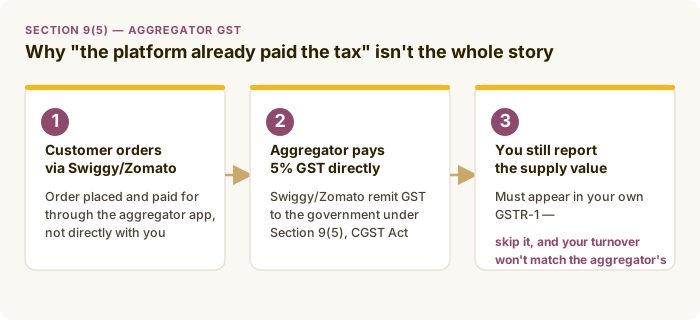
Table of Contents
- Why restaurant GST filing gets more complicated once Swiggy or Zomato is involved
- You still have to mention these orders in your own filing — even though you don’t collect the tax
- Two kinds of sales, two different rules
- Cloud kitchens follow the same rules — having no dine-in area doesn’t change anything
- What we actually do for restaurants and cloud kitchens
- Yes, composition-scheme restaurants can sell on Swiggy and Zomato
- Where 9(5) supplies actually go in your GSTR-1
- Catering and event orders don’t follow your standard restaurant rate
- Pricing — fixed, no hidden charges
- 3 mistakes we see restaurants and cloud kitchens make
- 1. Not reporting Swiggy/Zomato sales because “the tax is already paid”
- 2. Mixing direct sales and aggregator sales into one number
- 3. Charging the wrong GST rate on direct sales
- Frequently asked questions
- Do I need to report Swiggy or Zomato orders in my GST filing if they already paid the tax?
- What GST rate applies to my direct dine-in and takeaway sales?
- Does a cloud kitchen with no dine-in space follow different GST rules?
- What does GST return filing cost for a restaurant or cloud kitchen?
- Can I sell on Swiggy/Zomato if I’m on the GST composition scheme?
- Does alcohol served in my restaurant show up in my GST filing at all?
- Should I switch from 5% to 18%-with-ITC for a major kitchen renovation?
- If Swiggy already pays GST on an order, why does it still show in my GSTR-1?
- Related guides
- Talk to a consultant who understands Swiggy/Zomato GST, not a call centre
- Locality-specific guides for restaurants and cloud kitchens
- Serving Alcohol? That Portion Runs on a Different Tax Entirely
- Worked Example: A Restaurant Splitting Dine-In, Delivery, and Swiggy Orders
- ITC on Kitchen Equipment and Renovation
- GSTR-9 for Restaurants Crossing ₹2 Crore
- Packaging Costs and GST
- Catering for Corporate Events — A Recurring Point of Confusion
- What a Notice Actually Looks Like for a Restaurant, and Why
- What We Check Every Month, Before Filing
- Seasonal Volume Swings and What They Mean for Filing
Why restaurant GST filing gets more complicated once Swiggy or Zomato is involved
By law, Swiggy and Zomato are the ones responsible for paying GST on the food delivery orders they facilitate — not your restaurant. They collect 5% GST from the customer, pay it directly to the government, and issue the bill for that order. Your restaurant never charges GST on these specific orders and doesn’t pay tax on them either. That part is simple. What trips people up is what comes next.
You still have to mention these orders in your own filing — even though you don’t collect the tax
Because Swiggy and Zomato are the ones paying the tax, a lot of restaurant owners assume there’s nothing left for them to do — that these orders don’t need to appear anywhere in their own GST filing. That’s not correct. The value of these orders still needs to be reported in your monthly sales report, in the right place, separately from your own direct sales. Skip this, and the total sales your filing shows won’t match what Swiggy or Zomato reported against your GST number — which is one of the most common reasons restaurants on these platforms get a notice from the tax department.
Two kinds of sales, two different rules
Dine-in, takeaway, and orders through your own phone number or website are still your own responsibility — you charge and pay GST on these yourself, usually at 5% (with no credit for tax you’ve paid on your own purchases, for most standalone restaurants). Orders through Swiggy or Zomato work the way described above. Running both kinds of sales without a clean way of separating them in your books is the single biggest source of confusion we see.
Cloud kitchens follow the same rules — having no dine-in area doesn’t change anything
Cloud kitchens that only deliver, with no seating area at all, are still treated exactly like restaurants under GST law. If you sell only through Swiggy or Zomato, nearly all of your income falls under the rule described above — which makes it even more important to report it correctly, since it’s effectively your entire business.
What we actually do for restaurants and cloud kitchens
- Checking against Swiggy/Zomato records — every month, we match what Swiggy and Zomato reported against your own filing, so nothing goes unreported.
- Separating your two kinds of sales — clean tracking of dine-in/takeaway/own-website orders against Swiggy/Zomato orders.
- Filing your monthly returns — done correctly with your aggregator sales in the right place, not lumped in or left out.
- Checking your rate is correct — confirming the right GST treatment for your direct sales based on your restaurant’s category.
- Direct access to your consultant — no call centre, no automated menus, the same person every month.
Yes, composition-scheme restaurants can sell on Swiggy and Zomato
This is a genuinely common point of confusion, and the answer is more specific than a flat yes or no. Goods sellers on Amazon or Flipkart are barred from the composition scheme because those marketplaces deduct TCS under Section 52 — and composition dealers can’t be subject to TCS. Restaurant services through Swiggy or Zomato work differently: those platforms don’t deduct TCS on restaurant orders at all, because liability for the tax shifts to them entirely under Section 9(5) instead. Since there’s no TCS involved, a composition-scheme restaurant can list on Swiggy or Zomato without losing eligibility — as long as your only e-commerce activity is restaurant service under Section 9(5). Adding a genuinely separate supply that does require TCS (a retail goods arm through the same or a different platform, for instance) would change that picture, which is why we check your specific setup rather than giving a blanket answer.
Where 9(5) supplies actually go in your GSTR-1
Beyond just remembering to report Swiggy/Zomato sales, they need to land in the correct table of your GSTR-1 — reported separately from your own direct taxable supplies, since you’re not the person liable to pay tax on them even though you’re the actual supplier of the service. Filing software and manual filers alike sometimes lump these into the same line as direct sales because the distinction feels academic (both are still “your” sales, after all) — but the tax department’s reconciliation checks specifically look for this separation, and getting it wrong is a common trigger for a clarification request even when your total sales figure is otherwise correct.
Catering and event orders don’t follow your standard restaurant rate
If your kitchen takes on catering work alongside regular dine-in or delivery, that side of the business can be taxed differently — outdoor catering generally attracts 18% with full input tax credit, a different structure from the standard 5%-without-ITC rate most restaurant service runs on. Filing every invoice under your default restaurant rate without checking whether a specific order counts as catering is an easy, avoidable misclassification that shows up as a rate mismatch during reconciliation.
Pricing — fixed, no hidden charges
GST return filing starts at ₹5,990 + GST per year for up to 30 bills a month. If you’re running high order volume across Swiggy, Zomato, and direct sales combined, call 70 9232 9232 and our sales team will work out a fair price with you directly, based on your real order volume — fixed pricing, no hidden charges either way.
3 mistakes we see restaurants and cloud kitchens make
1. Not reporting Swiggy/Zomato sales because “the tax is already paid”
This is the single most common mistake, and it’s the one that actually causes notices. Swiggy or Zomato paying the tax doesn’t remove your own responsibility to report those sales in your filing.
2. Mixing direct sales and aggregator sales into one number
Without a clean split between what you sold directly and what came through Swiggy/Zomato, it’s nearly impossible to file correctly — you end up either double-reporting, under-reporting, or applying the wrong rule to the wrong sales.
3. Charging the wrong GST rate on direct sales
Your dine-in and takeaway sales follow their own rate rules, completely separate from how Swiggy/Zomato orders are handled. Getting this wrong on your own bills is a separate issue from anything Swiggy or Zomato takes care of.
Curious what a missed deadline would actually cost? Check our GST Late Fee Calculator.
Frequently asked questions
Do I need to report Swiggy or Zomato orders in my GST filing if they already paid the tax?
Yes. Swiggy and Zomato pay the GST on these orders, but the value of those orders still needs to be reported in your own monthly filing, in the right place. Not reporting it creates a mismatch between your filing and what the platform reported against your GST number — a common reason for a notice.
What GST rate applies to my direct dine-in and takeaway sales?
Most standalone restaurants charge 5% GST on direct sales, without claiming credit for tax paid on their own purchases. This is completely separate from how Swiggy/Zomato orders are handled, and needs to be applied correctly on your own bills regardless of your aggregator sales.
Does a cloud kitchen with no dine-in space follow different GST rules?
No — cloud kitchens are treated exactly like restaurants under GST law, whether or not there’s a seating area. If you sell mainly or entirely through Swiggy or Zomato, most of your income falls under the platform-pays-the-tax rule, which makes reporting it correctly even more important.
What does GST return filing cost for a restaurant or cloud kitchen?
GST return filing starts at ₹5,990 + GST per year for up to 30 bills a month. Above that volume, call 70 9232 9232 and our sales team will give you a fair price based on your real order volume — fixed pricing either way.
Can I sell on Swiggy/Zomato if I’m on the GST composition scheme?
Yes, generally — restaurant orders through Swiggy or Zomato fall under Section 9(5), not the TCS rules that bar composition dealers from goods marketplaces like Amazon. As long as your e-commerce activity is limited to restaurant service, composition eligibility isn’t affected. We confirm this against your specific setup before you sign up with a platform.
Does alcohol served in my restaurant show up in my GST filing at all?
No — alcohol is outside GST and falls under state excise/VAT instead. Your GST filing should only reflect food and non-alcoholic beverage sales; alcohol runs through a completely separate compliance track.
Should I switch from 5% to 18%-with-ITC for a major kitchen renovation?
It depends on your ongoing margin structure, not just the one-time renovation cost, since switching applies the 18% rate to all future sales, not just retroactively to the equipment purchase. Worth modelling out with us before deciding rather than switching reactively around one big purchase.
If Swiggy already pays GST on an order, why does it still show in my GSTR-1?
Because you still made the sale — Section 9(5) shifts who deposits the tax to the platform, not whether the transaction gets reported. Your GSTR-1 needs to reflect it as a 9(5) supply specifically, distinct from your directly-taxed dine-in and delivery sales.
Related guides
GST filing looks different depending on your business — here’s how it works for other industries we cover:
- GST Return Filing for Amazon, Flipkart & Meesho Sellers
- GST Return Filing for Contractors
- GST Return Filing for Manufacturers & Exporters
- GST Return Filing for Architects, Interior Designers & Civil Engineers
Talk to a consultant who understands Swiggy/Zomato GST, not a call centre
If you run a restaurant or cloud kitchen in Chennai on Swiggy, Zomato, or direct sales and want your platform sales checked and reported correctly every month instead of assumed away, call or WhatsApp us at 70 9232 9232. We’re rated 5.0★ across 1,000+ Google reviews, serving Chennai and Tamil Nadu businesses since 2017 — you’ll speak directly to the consultant handling your filing, not a rotating support queue.
Wondering whether the composition scheme makes sense before you register? See our GST Composition Scheme guide — including why Swiggy and Zomato listings make you ineligible.
Setting up a new outlet or cloud kitchen entity? new GST Registration, from ₹1,500 + GST. Already registered and just need ongoing filing? See our full GST Return Filing service.
Locality-specific guides for restaurants and cloud kitchens
Based in a specific part of Chennai? These cover the same Section 9(5) reporting and rate rules with local detail added in: Teynampet, Alwarpet, Mylapore, Nandanam, R.A. Puram, and Saidapet, T Nagar, Parrys Corner, Mannadi, Ritchie Street, Chromepet, Tambaram.
Serving Alcohol? That Portion Runs on a Different Tax Entirely
If your restaurant serves alcohol alongside food, the alcohol sales are outside GST entirely — they fall under state excise/VAT, a separate tax regime with its own licensing and filing obligations through the Tamil Nadu excise department, not the GST portal. This means a restaurant with a liquor licence effectively runs two parallel compliance tracks: GST on food and non-alcoholic beverages, VAT on alcohol, and the two should never be combined on the same invoice line or reported together in either filing. Mixing them is one of the more consequential mistakes we see, since it can create errors in both filings simultaneously rather than just one.
Worked Example: A Restaurant Splitting Dine-In, Delivery, and Swiggy Orders
Say a Chennai restaurant does ₹6,00,000 a month across three channels: ₹2,50,000 direct dine-in (5% GST, no ITC, restaurant charges and collects this), ₹1,50,000 own-delivery orders taken by phone (also 5% GST, same treatment as dine-in since it’s not through an aggregator), and ₹2,00,000 through Swiggy (Section 9(5) — Swiggy itself pays the GST on these orders, not the restaurant). The restaurant’s GSTR-3B needs to report the full ₹6,00,000 in outward supplies, but the tax treatment splits: 5% GST self-paid on the ₹4,00,000 in direct sales, and the ₹2,00,000 in Swiggy sales reported as Section 9(5) supplies where the platform, not the restaurant, deposits the tax. Getting this split wrong — either self-paying tax on the Swiggy portion that Swiggy already covers, or failing to report the Swiggy portion at all — are both real mistakes we catch during monthly reconciliation.
ITC on Kitchen Equipment and Renovation
Standalone restaurants on the 5% rate cannot claim ITC on any purchases, including capital equipment like kitchen appliances, refrigeration, or renovation work — this is the core trade-off of the 5% rate versus the 18% rate with ITC available for restaurants that opt for it (a choice made once at registration and generally not switched frequently). Cloud kitchens and restaurants considering a major equipment purchase or renovation sometimes ask whether switching to the 18%-with-ITC rate makes sense purely to recover tax on a big one-time purchase — the answer depends on your ongoing margin structure, not just the one-time equipment cost, since the 18% rate applies to all your ongoing sales going forward, not just retroactively to the equipment.
GSTR-9 for Restaurants Crossing ₹2 Crore
Once your combined turnover across dine-in, delivery, and aggregator channels crosses ₹2 crore annually, GSTR-9 becomes mandatory. For a restaurant running multiple channels with different tax treatments (self-paid 5%/18% vs. Section 9(5) aggregator-paid), the annual reconciliation needs to correctly separate these two categories across the full year — a mismatch between what you reported as your own liability versus what the aggregator reported as theirs is exactly the kind of thing that surfaces at annual-return stage if it wasn’t caught monthly.
Packaging Costs and GST
Cloud kitchens and delivery-heavy restaurants spend meaningfully on packaging — containers, bags, sealing materials — and the GST treatment of these purchases follows the same rule as any other input: if you’re on the 18%-with-ITC rate, the GST paid on packaging is claimable; if you’re on the 5% no-ITC rate, it isn’t, same as any other input cost. For high-volume delivery businesses where packaging is a genuinely significant cost line, this is one more factor worth including honestly in the rate-choice decision rather than treating it as a rounding error.
Catering for Corporate Events — A Recurring Point of Confusion
If your restaurant occasionally caters for corporate events or large private functions, this is generally treated as “outdoor catering” for GST purposes, which can carry a different rate structure from your standard dine-in/delivery rate — typically 18% with ITC available, regardless of what rate applies to your regular restaurant operations. Businesses that do both regular dine-in service and occasional catering need to correctly apply two different rates depending on the nature of each specific order, not default to whichever rate is easier to remember.
What a Notice Actually Looks Like for a Restaurant, and Why
The most common notice trigger we see for restaurants isn’t a dramatic compliance failure — it’s a mismatch between what Swiggy/Zomato reported as Section 9(5) supplies and what the restaurant separately reported as its own direct sales, where the two figures together don’t add up to what the restaurant’s actual total revenue looks like on paper (from POS records, bank deposits, or other indicators the department can cross-check). This is exactly why monthly reconciliation across every channel — not just filing each channel’s numbers separately without checking they add up to a coherent whole — is the single most protective habit a multi-channel restaurant can maintain.
What We Check Every Month, Before Filing
For every restaurant and cloud kitchen client, our monthly process covers: reconciling direct dine-in/delivery sales against POS or order-taking records, confirming Section 9(5) figures from Swiggy/Zomato match what those platforms actually reported that period, correctly separating any catering or event orders that carry a different rate, and flagging any alcohol-related revenue to make sure it never gets mixed into the GST-reportable food figures. This four-point check is what catches the kind of quiet mismatch that would otherwise only surface months later as a notice.
Running a single dine-in counter, a delivery-only cloud kitchen, or a business that mixes all of the above — call 70 9232 9232 and we will tell you plainly what your specific mix of channels means for your monthly filing.
Fixed, transparent pricing, and a consultant who actually understands the Section 9(5) mechanics that most generic filing services get wrong for restaurants — not a one-size-fits-all template applied to a business type that genuinely needs specific handling.
Seasonal Volume Swings and What They Mean for Filing
Restaurants near festival, wedding, or exam-season demand spikes often see monthly volume vary significantly — a quiet month followed by a much busier one. This doesn’t change your filing frequency or mechanics, but it does mean the absolute numbers you’re reconciling each month vary a lot, which makes catching a genuine error harder if you’re only glancing at whether “this month looks roughly normal” rather than actually reconciling the specific figures against source records every time, busy or quiet.
We are four floors above Teynampet Metro, and every restaurant client gets the same consultant month after month, not a rotating call queue.
Rated 5.0 stars across 1,000+ Google reviews, serving Chennai restaurants and cloud kitchens since 2017 with straight answers, not vague reassurances.
We tell you what is possible, not what you want to hear, on deadlines, penalties, and what GST actually requires from your specific restaurant setup.