
If you’re an architect, interior designer, or civil engineer in Chennai, most of your GST mistakes won’t come from missing a deadline — they’ll come from two specific things: charging the wrong type of tax based on where your client’s office is instead of where the actual project site is, and forgetting that tax is due the moment you receive an advance payment, not just when you raise your final bill. This page explains both in plain terms, and what it costs to have your filing handled properly — starting at ₹5,990 + GST per year for up to 30 bills a month. Prefer to just call? Reach us on 70 9232 9232.
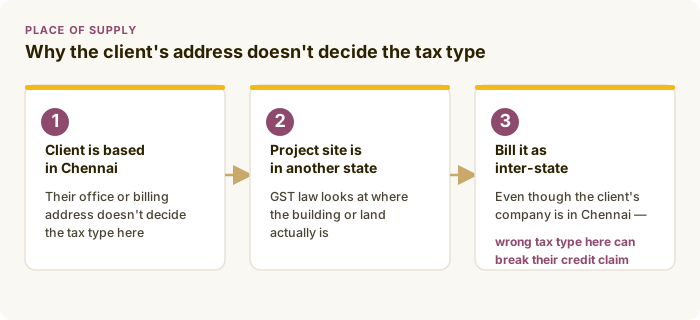
Table of Contents
- Why GST for design and engineering services is easy to get wrong
- You owe tax on an advance the day you receive it — not when you raise the final bill
- Interior designers who also supply furniture or materials need to bill it correctly
- What we actually do for architects, interior designers and civil engineers
- On the composition scheme? Your filing rhythm changes completely
- TDS from government and institutional clients needs monthly reconciliation
- SAC codes matter for your filing, not just your registration
- Large practices: e-invoicing crosses over from optional to permanent
- Filing separately across states when your projects do
- Pricing — fixed, no hidden charges
- 3 mistakes we see architects, designers and engineers make
- 1. Billing based on the client’s address instead of the project site
- 2. Not accounting for tax on advance payments when received
- 3. Combining design fees and material costs into one unclear invoice line
- Frequently asked questions
- How do I know which type of GST to charge on a project outside Tamil Nadu?
- Do I need to pay GST on an advance payment before I’ve raised an invoice?
- Can I bill design fees and furniture supply as one combined amount?
- What does GST return filing cost for an architect, designer, or engineer?
- Do you only work with firms in Chennai, or across Tamil Nadu too?
- When exactly does GST become due on a project advance?
- Can I bill design fees and furniture supply on one combined invoice?
- Is GST on my AutoCAD or Revit subscription claimable as ITC?
- Related guides
- Talk to a consultant who understands project-based billing, not a call centre
- Worked Example: Advance Payment Tax Timing
- Design Fees and Physical Goods — Why Combining Them on One Invoice Is a Problem
- GSTR-9 for Design and Engineering Practices Crossing ₹2 Crore
- ITC on Software Licences and Professional Tools
- Reconciling a Multi-State Project Across Its Full Timeline
- What We Check Every Month, Before Filing
- Retainer Arrangements vs Project-Based Billing
- Site Visit Expenses and ITC
- Refunds and Cancelled Projects
- Subcontracting Specialist Work to Other Consultants
Why GST for design and engineering services is easy to get wrong
For most services, GST is charged based on where your client is registered. But for anything connected to a specific building or piece of land — architectural design, interior design, structural or civil engineering work — the rule is different: GST law looks at where the actual property is located, not where your client’s office or billing address is. If you’re a Chennai-based architect designing a house in Bangalore, that project should be billed as an inter-state supply, even though your client’s company might be headquartered right here in Chennai. Get this wrong, and your invoice doesn’t match what the rules require — which can cause your client’s own tax filing to run into a mismatch too, since they’re the ones claiming credit for the tax you charged.
You owe tax on an advance the day you receive it — not when you raise the final bill
Design and consultancy work is usually billed in stages — a booking amount upfront, a payment at the design stage, another at execution. Many professionals only think about GST when they raise a formal invoice, but the law requires you to account for tax the moment you receive payment, including advances and booking amounts, whichever comes first. Waiting until the final invoice to “sort out the tax” on an advance you received months earlier means you’ve already missed the deadline for that portion, even if the eventual total tax is correct.
Interior designers who also supply furniture or materials need to bill it correctly
If you charge a single combined fee for design work and the furniture or décor items you’re supplying, the tax department may not accept that as one simple service — design fees and physical goods can attract different GST rates, and lumping them into one invoice line without separating them clearly is a common source of confusion during a review.
What we actually do for architects, interior designers and civil engineers
- Project-site-based billing checks — we confirm the correct tax treatment based on where each project actually is, not just where your client’s office is.
- Advance payment tracking — tax accounted for the moment you receive a booking or milestone payment, not left until the final invoice.
- Service vs. goods separation — if you supply furniture or materials alongside design work, billed and reported correctly as separate items.
- GST return filing — filed correctly and on time, every month.
- Direct access to your consultant — no call centre, no automated menus, the same person every month.
On the composition scheme? Your filing rhythm changes completely
Smaller practices under ₹50 lakh turnover sometimes register under the composition scheme for services — a flat 6% rate with quarterly-only filing instead of monthly. If that’s your setup, two things change your filing entirely: you can’t claim any input tax credit, so there’s no ITC reconciliation to worry about, but you also can’t issue a standard tax invoice — every bill needs to be a bill of supply that doesn’t show GST separately. This trips up practices that switch composition status without updating their invoice templates, since the format itself needs to change, not just the tax calculation behind it.
TDS from government and institutional clients needs monthly reconciliation
Government departments, PSUs, and similar institutional clients deduct 2% GST TDS (1% CGST + 1% SGST, or 2% IGST) on fees above ₹2.5 lakh under Section 51, crediting it to your electronic cash ledger via their own GSTR-7 filing. This works the same way for professional fees as it does for contractor payments — it’s a credit against your liability, not a shortfall, but only if you actively check for it every month rather than assuming your invoice value and your bank credit should match exactly. Practices working regularly with institutional clients should treat this as a standing item in their monthly filing checklist, not a one-off thing to look up occasionally.
SAC codes matter for your filing, not just your registration
The Services Accounting Code you declared at registration should match what actually shows up on your GSTR-1 filings, invoice by invoice. A practice that’s expanded into a new service line — structural consulting added to an architecture practice, say — without updating how those invoices are coded can end up with a classification pattern in their filing history that doesn’t match their registration, which is exactly the kind of inconsistency that draws a closer look during any departmental review.
Large practices: e-invoicing crosses over from optional to permanent
If your practice’s turnover crosses ₹5 crore in any financial year, B2B e-invoicing becomes mandatory — and once that threshold is crossed even once, it stays mandatory going forward, even in a slower year that dips back below ₹5 crore. This is unlikely to affect a small design studio, but it’s a real consideration for larger multi-disciplinary firms or engineering consultancies with institutional client rosters. Invoices raised without proper e-invoicing, once your practice is covered by the mandate, aren’t valid for your client’s own input credit purposes — which makes this a client-relationship issue as much as a compliance one.
Filing separately across states when your projects do
Once a project outside your home state has triggered a GST registration there (per the place-of-supply rule covered above), that registration needs its own return filed against it — it doesn’t get folded into your main state’s filing. Practices taking on their first out-of-state project sometimes assume one consolidated filing covers everything, since it’s the same firm and the same PAN underneath, but GST treats each state registration as its own filing obligation with its own monthly or quarterly cycle. We track each registration’s filing calendar separately, specifically so a second-state project doesn’t quietly fall behind while your home-state filing stays current.
Pricing — fixed, no hidden charges
GST return filing starts at ₹5,990 + GST per year for up to 30 bills a month. If you run projects across multiple states or bill in complex stages, call 70 9232 9232 and our sales team will work out a fair price with you directly, based on your real volume. Fixed pricing, no hidden charges either way.
3 mistakes we see architects, designers and engineers make
1. Billing based on the client’s address instead of the project site
This is the single most common mistake, and it’s an easy one to make without realising — the correct rule is based on where the property is, not where the client’s office or billing address is.
2. Not accounting for tax on advance payments when received
Booking amounts and milestone advances create a tax obligation the day you receive them, not on the date of your final invoice. Treating the final bill as the only tax event means missing deadlines on money you received months earlier.
3. Combining design fees and material costs into one unclear invoice line
Design services and physical goods you supply can be taxed differently. Bundling them into one number without a clear split makes it harder to justify your filing if it’s ever reviewed.
Curious what a missed deadline would actually cost? Check our GST Late Fee Calculator.
Frequently asked questions
How do I know which type of GST to charge on a project outside Tamil Nadu?
For architectural, interior design, and civil engineering work, GST law looks at where the actual property is located, not where your client’s office or billing address is. A project site outside Tamil Nadu should be billed as an inter-state supply, regardless of where your client is headquartered.
Do I need to pay GST on an advance payment before I’ve raised an invoice?
Yes — for services, the tax obligation arises when you receive the payment, including booking amounts and milestone advances, not only when you raise a formal invoice. This is one of the most commonly missed points for project-based professionals.
Can I bill design fees and furniture supply as one combined amount?
It’s better not to. Design services and physical goods can be taxed at different rates, and a single unclear invoice line makes it harder to justify your filing if it’s ever reviewed. Keeping them separate on the invoice avoids this entirely.
What does GST return filing cost for an architect, designer, or engineer?
GST return filing starts at ₹5,990 + GST per year for up to 30 bills a month. Above that volume, call 70 9232 9232 and our sales team will give you a fair price based on your real transaction volume — fixed pricing either way.
Do you only work with firms in Chennai, or across Tamil Nadu too?
We’re based in Teynampet, Chennai, and work with architects, designers, and engineers across Tamil Nadu, including those running projects in other states. Everything is handled over phone and WhatsApp, so your location doesn’t affect how we work with you.
When exactly does GST become due on a project advance?
In the month the advance is received, not when the project concludes or the final invoice is raised. This needs to be reported in that period’s GSTR-3B, then adjusted as subsequent milestone invoices go out.
Can I bill design fees and furniture supply on one combined invoice?
It’s not advisable — design services and physical goods can carry different GST rates, and a blended invoice line makes the correct tax treatment much harder to defend if ever questioned. Separate invoicing, or at minimum clearly separated line items, is the safer approach.
Is GST on my AutoCAD or Revit subscription claimable as ITC?
Yes, generally, if you’re not on the composition scheme and the subscription is billed to your GST-registered business account rather than a personal card.
Related guides
GST filing looks different depending on your business — here’s how it works for other industries we cover:
- GST Return Filing for Amazon, Flipkart & Meesho Sellers
- GST Return Filing for Contractors
- GST Return Filing for Restaurants & Cloud Kitchens
- GST Return Filing for Manufacturers & Exporters
Talk to a consultant who understands project-based billing, not a call centre
If you’re an architect, interior designer, or civil engineer in Chennai and want your project billing and advance payments handled correctly every month instead of guessed at, call or WhatsApp us at 70 9232 9232. We’re rated 5.0★ across 1,000+ Google reviews, serving Chennai and Tamil Nadu businesses since 2017 — you’ll speak directly to the consultant handling your filing, not a rotating support queue.
Want to understand how ITC and reconciliation actually work before you file? See our GST Reconciliation guide.
Setting up a new firm or entity? GST Registration starts from ₹1,500 + GST. Already registered and just need ongoing filing? See our full GST Return Filing service.
Worked Example: Advance Payment Tax Timing
Say an interior design firm receives a ₹3,00,000 booking advance in March for a project that will run through August, with the full design fee totalling ₹12,00,000. GST liability on that ₹3,00,000 advance arises in March — the month it was received — not in August when the project concludes or when the final invoice is raised. The firm needs to report and pay GST on the advance in that period’s GSTR-3B, then correctly adjust as subsequent milestone invoices are raised through the project. Firms that only account for GST when raising a “real” invoice, treating advances as informal bookings outside the tax system until the project is billed, create a genuine timing gap between when tax was actually owed and when it was reported.
Design Fees and Physical Goods — Why Combining Them on One Invoice Is a Problem
An interior design practice that also supplies furniture, fixtures, or materials as part of a project needs to invoice the design service and the physical goods separately, or at minimum with clearly separated line items — design services and furniture supply can carry different GST rates, and a single blended invoice line makes it difficult to defend the correct tax treatment if either figure is ever questioned. This is one of the more common structural mistakes we see corrected during onboarding, not something firms usually realise is a problem until it’s pointed out.
GSTR-9 for Design and Engineering Practices Crossing ₹2 Crore
Once your annual turnover crosses ₹2 crore, GSTR-9 becomes mandatory. For a project-based practice, the annual reconciliation needs to correctly tie out advances received and adjusted across the year, any inter-state project billing under the correct place-of-supply rules, and any TDS credits from government or institutional clients — all threads that are far easier to reconcile monthly than reconstruct once a year from project files and bank statements.
ITC on Software Licences and Professional Tools
GST paid on design software subscriptions (AutoCAD, Revit, SketchUp and similar), professional liability insurance, and office equipment is generally claimable as input tax credit for firms not on the composition scheme — a real, ongoing credit that firms sometimes forget to track consistently across monthly software renewal cycles, especially when subscriptions are billed to a founder’s personal card rather than the business’s own GST-registered account.
Reconciling a Multi-State Project Across Its Full Timeline
An architecture or engineering firm running a single project outside Tamil Nadu needs to track that project’s place-of-supply consistently from initial site visit through final handover — the correct state for GST purposes is generally where the immovable property is located, not where the firm’s office or the client’s headquarters sits. A project that runs a year or more needs this treatment to stay consistent across every milestone invoice, not just the first one, since an inconsistency partway through a long project is exactly the kind of thing that surfaces at annual reconciliation.
What We Check Every Month, Before Filing
For every architecture, design, and engineering client, our monthly process checks: whether any advances received that period have been correctly reported as taxable, whether design-fee and material-supply invoices are cleanly separated where both apply, whether inter-state project billing uses the correct place-of-supply rules consistently, and whether TDS credits from any government or institutional client work are actively claimed. Missing any one of these consistently is a common, avoidable source of either overpaying or underpaying GST across a project’s lifetime.
Retainer Arrangements vs Project-Based Billing
Some practices work on ongoing monthly retainers rather than per-project milestone billing — a structure more common for interior design consultancies with recurring corporate clients. GST on a retainer is due each month as the retainer invoice is raised, following standard service-invoicing timing rather than the advance-payment timing that applies to project deposits. Firms running both retainer and project-based client relationships need to correctly apply the right timing rule to each, not default to one pattern across both.
Site Visit Expenses and ITC
Travel, accommodation, and site-visit expenses for out-of-town or inter-state projects carry their own GST treatment on the invoices raised by hotels, transport providers, and similar vendors — and whether you can claim ITC on these depends on whether the vendor issues a proper GST invoice with your firm’s GSTIN, not a generic retail bill. Practices that pay for site travel on personal cards and only reimburse informally often lose access to ITC that would have been available with a correctly-invoiced business expense.
Running project-based billing, retainer work, or a mix of both across Chennai and beyond — call 70 9232 9232 and we will tell you plainly what your specific billing structure means for monthly filing.
Refunds and Cancelled Projects
If a client cancels a project after an advance was paid and GST already reported on it, the refund of that advance requires a credit note against the original invoice, correctly reducing your reported liability for the period the credit note is issued in — not a retroactive correction to the original period. Practices sometimes get this backwards, trying to amend the original filing rather than issuing a proper credit note in the current period, which creates more reconciliation work than the straightforward correct approach.
Subcontracting Specialist Work to Other Consultants
A design practice that subcontracts specialist work — structural calculations to a separate engineering consultant, or MEP design to another firm — invoices the client for the combined project, while the subcontracted consultant invoices your practice separately for their portion. Your practice can generally claim ITC on the subcontractor’s GST-charged invoice, provided their GSTR-1 correctly reports it, following the same supplier-reliability principle that applies to any input credit chain. Practices running multiple subcontracted specialists on a single project should reconcile each subcontractor relationship separately, not treat the combined project cost as one undifferentiated expense line.
Fixed, transparent pricing, and a consultant who understands project-based, milestone, and retainer billing structures — not a generic filing template applied to a business type that genuinely bills differently from most others.
We are four floors above Teynampet Metro, rated 5.0 stars across 1,000+ Google reviews, serving Chennai design and engineering practices since 2017.
We tell you what is possible, not what you want to hear, on deadlines, penalties, and what GST actually requires from your specific practice.