
If a GST notice just landed in your portal or your inbox, take a breath first. Most GST notices are not a raid, a court case, or proof that you did something wrong on purpose. They’re almost always a computer-generated flag — a number in your GST returns didn’t match another number somewhere else. The system caught it, and now it wants an explanation.
The part that actually matters is which notice you got, and how many days you have left to reply. Reply correctly and on time, and most notices close with zero penalty. Miss the deadline, and a small paperwork issue can turn into a demand order, a blocked GST portal, or — in the worst cases — your registration being suspended. Call 70 9232 9232 and read the notice out to us; we’ll tell you in two minutes what you’re actually dealing with.
Table of Contents
- Step 1: Find your notice below
- Why did I get a GST notice in the first place?
- What happens if I just ignore it?
- A worked example: an ASMT-10 over a ₹40,000 mismatch
- How we handle your notice
- What does it actually cost to fix a GST notice?
- Documents you’ll typically need
- What a personal hearing actually involves
- A realistic timeline from notice to resolution
- Mistakes we see when business owners reply themselves
- Who we help
- Why a Chennai consultant for something this deadline-driven
- Common questions
- Is a GST notice a big deal?
- Can I reply to a GST notice myself?
- How fast do I need to act?
- What if I’ve already missed the deadline?
- Will replying to a notice affect my GST rating or future scrutiny?
- Run a specific trade in George Town?
- Related guides
- Which Notice Did You Get? Quick Reference
Step 1: Find your notice below
Every GST notice has a form number printed on it, usually near the top — something like “ASMT-10” or “DRC-01.” That code tells you exactly what stage you’re at and how urgent it is. Find it below and click through for a plain-English explanation of what it means and what to do next.
Why did I get a GST notice in the first place?
You almost never get picked at random. GST notices come from an automated matching system that compares four numbers every month: what you sold (GSTR-1), what you paid tax on (GSTR-3B), what your suppliers say they sold you (GSTR-2B), and what’s actually in your books. If any two of these don’t line up, a notice gets generated — automatically, without a human deciding to “target” you.
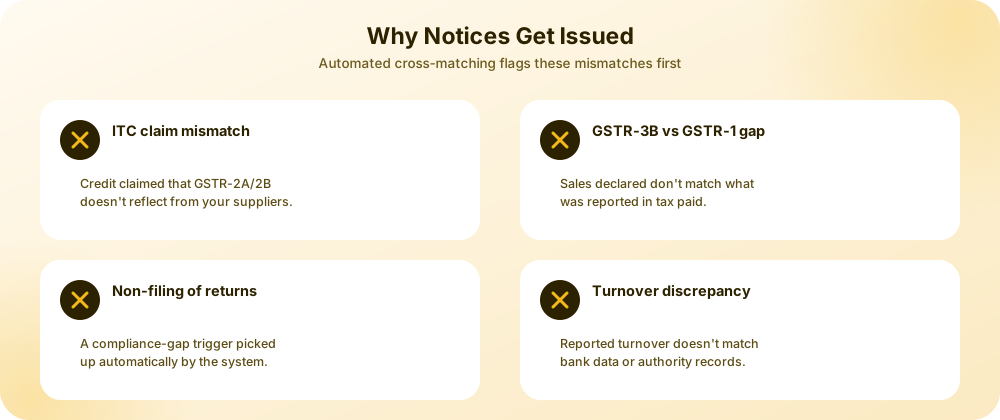
The most common real-world causes we see: a sale entered in GSTR-1 but the tax on it forgotten in GSTR-3B, an ITC claimed that your supplier hasn’t reported on their side yet, a round-number estimate filed instead of the exact figure “to fix later” (and then never fixed), or — for GST-suspended accounts — simply not filing for a few months in a row. None of these mean you did something illegal. They mean a number needs correcting, and someone needs to explain it to the department in the right form, in the right language.
What happens if I just ignore it?
This is the one thing you should never do. Every GST notice has a reply window — usually 7, 15, or 30 days depending on the type — and if that window closes with no reply, the system doesn’t wait patiently. It escalates automatically to the next, more serious stage.
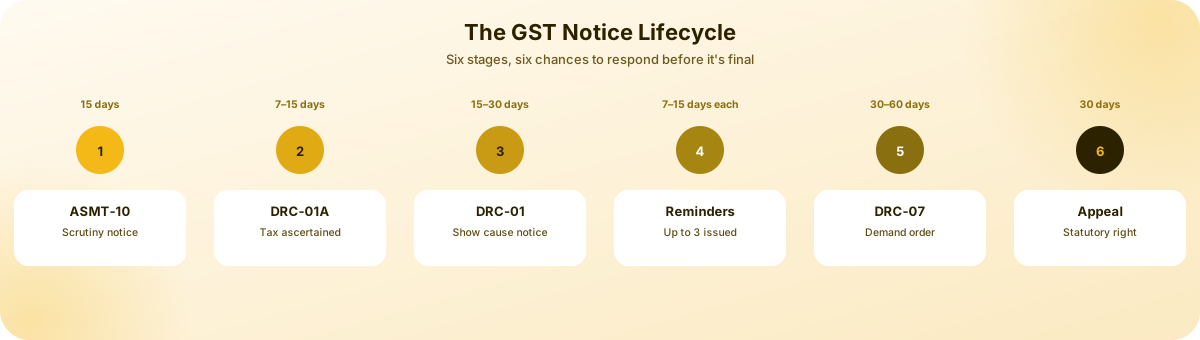
A scrutiny notice (ASMT-10) that’s ignored can turn into a formal Show Cause Notice (DRC-01). A Show Cause Notice that’s ignored turns into a Demand Order (DRC-07) — at that point, the tax, interest, and a penalty are all legally payable, and your only remaining option is a formal appeal with a upfront deposit. A registration-cancellation notice (REG-17) that’s ignored means your GST number gets cancelled — full stop, no reminder. Every one of these outcomes is avoidable with a reply filed on time. That’s the entire point of this page: don’t let a fixable notice become an unfixable bill.
A worked example: an ASMT-10 over a ₹40,000 mismatch
Take a business that gets an ASMT-10 flagging a ₹40,000 gap between GSTR-3B tax paid and what GSTR-2B shows as available credit for the quarter. On checking, it turns out ₹28,000 of that gap is a genuine timing issue — two suppliers filed their GSTR-1 three weeks late, so the credit shows up in GSTR-2B for the following period instead of the one being scrutinised, and simply needs a reply explaining the timing with the relevant invoice numbers. The remaining ₹12,000 is a real error — a purchase invoice entered twice in the books. The correct reply on Form ASMT-11 explains both: the ₹28,000 as a documented timing difference (no tax actually owed), and the ₹12,000 corrected voluntarily with the tax and applicable interest paid through DRC-03. Filed this way, the notice closes with Form ASMT-12 and no further liability beyond the ₹12,000 that was genuinely owed. Filed as a blanket “yes, ₹40,000 is correct, will pay” without checking — the mistake we see most often — the business would have paid over double what it actually owed.
How we handle your notice
Fixed, transparent pricing — call 70 9232 9232 and we’ll quote you based on which notice you’ve received and how many returns are involved. Fixed pricing, no surprise add-ons later. Our office is at 4th Floor, Fathima Akthar Court, 453 Anna Salai, Teynampet, Chennai — next to Teynampet Metro, B1 Exit — if you’d rather bring the notice in person.
What does it actually cost to fix a GST notice?
There are two separate costs here, and it’s worth understanding both before you panic about the number printed on the notice. The first is the tax itself — if the mismatch is a genuine error (say, a sale you forgot to include in a return), that amount was always owed; the notice just surfaced it. The second is the professional fee for handling the reply — this is what we quote you, and it’s fixed and transparent, based on which notice you’ve received and how many return periods are involved. We’ll never ask you to pay more once we’ve quoted. Call 70 9232 9232 and we’ll give you a real number after seeing your actual notice, not a guess.
What we won’t do is tell you to just pay the amount on the notice without checking it first. In a meaningful share of the ASMT-10 and DRC-01A cases we handle, the department’s figure turns out to be a data-matching timing issue — a supplier who filed their GSTR-1 late, for instance — not a real shortfall. Paying blind, just to make the notice go away, can mean paying tax you don’t actually owe.
Documents you’ll typically need
Having these ready before you call saves time, especially if your deadline is close:
- The notice itself (PDF from the GST portal, or a clear photo of the printed copy)
- Your GSTR-1 and GSTR-3B for the period(s) mentioned in the notice
- Purchase invoices or a purchase register, if the notice concerns ITC
- Sales invoices for the period, if the notice concerns turnover or outward supply
- Your GST login credentials, or access for us to file on your behalf via an authorized representative
- For a REG-17 (cancellation) notice specifically: proof your business is active — rent agreement, electricity bill, or recent photographs of your premises
Don’t have everything ready? Call us anyway — 70 9232 9232. We’ll tell you exactly what’s missing and how to get it quickly, rather than making you gather everything before we even look at your case.
What a personal hearing actually involves
For DRC-01 and REG-17 notices, you have the right to request a personal hearing before the officer decides — something most business owners don’t realise is available, since it isn’t offered automatically on every notice. A hearing is not a courtroom cross-examination; it’s usually a short, fairly informal meeting (in person or by video call, depending on the jurisdiction) where you or your representative explain the context behind the numbers — why a supplier’s late filing caused a temporary mismatch, why a particular transaction was structured the way it was, or why a technical reading of the notice doesn’t match the actual facts of your business. A written reply alone sometimes can’t convey this kind of context as effectively, particularly for anything involving a judgment call rather than a pure numbers error. We request a hearing on a client’s behalf whenever the case genuinely benefits from it — not as a default delay tactic, since an unnecessary hearing just adds time to a case that a strong written reply would have closed on its own.
A realistic timeline from notice to resolution
Once you send us the notice, checking your numbers against GSTR-1, GSTR-3B, GSTR-2B and your books typically takes 1-2 working days for a straightforward ASMT-10 or DRC-01A, longer if multiple periods or suppliers are involved. Drafting and filing the reply itself is usually same-day once the numbers are confirmed, well within whatever window remains on your notice. From there, the department’s own response time varies — a straightforward ASMT-10 reply often gets a drop order (ASMT-12) within a few weeks with no further contact; a DRC-01 show-cause, especially one where a hearing is requested, can take longer since it depends on the officer’s own schedule, not just your reply. The one variable entirely within your control is how quickly you send us the notice after receiving it — every day held onto before calling is a day taken directly out of your reply window, not added back later.
Mistakes we see when business owners reply themselves
The GST portal does let you file most notice replies yourself, and plenty of business owners try. Here’s where it usually goes wrong:
- Replying in the wrong form. Each notice has a specific reply form — ASMT-11 for an ASMT-10, DRC-06 for a DRC-01, REG-18 for a REG-17. A general written explanation uploaded as an attachment, without using the correct form, is often treated as inadequate.
- Answering vaguely. “We will check and correct” is not a reply an officer can act on. Every point raised in the notice needs a specific, numbers-backed answer.
- Missing the actual deadline. Some business owners count from the date they opened the notice, not the date it was issued — these can differ by several days, and that gap has cost people their reply window.
- Paying without checking. As covered above, paying the exact amount on the notice without verifying it against your own books can mean overpaying for an error that wasn’t actually yours.
- Not requesting a personal hearing when it would help. For DRC-01 and REG-17 notices especially, a hearing gives you a chance to explain context an officer can’t get from a written reply alone — and most business owners don’t know they can ask for one.
Who we help
Most of the notices we handle come from businesses in categories we already work with closely — Amazon, Flipkart and Meesho sellers dealing with TCS reconciliation mismatches, restaurants and cloud kitchens navigating Section 9(5) platform filings, contractors with RCM and works-contract notices, and manufacturers or exporters with LUT and refund-related scrutiny. If your business doesn’t fit neatly into one of these, that’s fine too — the notice-reply process itself is the same regardless of industry, and we handle all of it.
Why a Chennai consultant for something this deadline-driven
A GST notice reply is exactly the kind of task where a slow response costs real money — a REG-17 gives you only 7 working days, and every day spent figuring out who to call is a day gone from that window. We’re four floors above Teynampet Metro, and when a client WhatsApps us a notice, we read it and tell them what it actually means within minutes, not after a support ticket gets triaged by a national call centre. For business owners across Chennai — from Amazon sellers in Alwarpet to contractors working government tenders out of Ambattur — that same-day read is often the difference between a notice that closes quietly and one that escalates simply because nobody looked at it in time.
Common questions
Is a GST notice a big deal?
Usually no — most notices are automated mismatch flags, not accusations. It becomes a big deal only if it’s ignored past its deadline. Call 70 9232 9232 and we’ll tell you honestly how serious yours is.
Can I reply to a GST notice myself?
Technically yes — the GST portal lets any registered user file a reply. In practice, the reply has to be filed in the correct form, cite the correct section, and match your actual books, or it can be treated as inadequate and escalate anyway. Most business owners call us instead of risking a second, worse notice.
How fast do I need to act?
Depends on the notice — REG-17 (cancellation) gives you only 7 working days; most others give 15–30 days. Call 70 9232 9232 today and read us the date on the notice; we’ll tell you exactly how many days you have left.
What if I’ve already missed the deadline?
Call us anyway — 70 9232 9232. A missed deadline usually means the matter has escalated to the next stage, but there are still options at almost every stage except the very last one. The sooner you call after realizing you’ve missed it, the more options remain.
Will replying to a notice affect my GST rating or future scrutiny?
A properly filed, on-time reply that resolves the matter (ASMT-12, REG-20, or a dropped DRC-01) leaves no adverse mark. What does affect future scrutiny is a pattern of unresolved or ignored notices — which is exactly why replying correctly the first time matters.
Run a specific trade in George Town?
Iron & steel wholesaler on Sembudoss Street, optical/spectacle wholesaler on Broadway, or electronics wholesaler on Ritchie Street? These trades face genuinely different notice triggers from a typical retail business — see our trade-specific guides: Sembudoss Street (Iron & Steel), Broadway (Optical & Spectacle), or Ritchie Street (Electronics), Sowcarpet (Textile & Saree), or Evening Bazaar (Utensils).
Related guides
- GST Reconciliation — GSTR-1, GSTR-3B & GSTR-2B ITC Mismatch Explained — the exact mechanics behind most notices
- Activate Suspended GST Registration in Chennai — if a notice already led to a suspension
- GST Return Filing in Chennai — stop future notices before they start
- GST Registration in Chennai
Don’t wait until the deadline is close. Call 70 9232 9232 now, or WhatsApp us the notice — we’ll tell you exactly what it means and what to do next.
Which Notice Did You Get? Quick Reference
Not sure how urgent your notice actually is? Here is how the common ones compare, from least to most serious:
- ASMT-10 — a routine, often automated scrutiny notice flagging a mismatch. Reply deadline is usually 30 days. Not a bill, and not an audit — the cheapest, easiest stage to fix a genuine gap.
- DRC-01A — an intimation before a formal notice, giving you a chance to pay voluntarily (Form DRC-03) with reduced or no penalty before it escalates. Deadline is typically 15 days.
- DRC-01 (Show Cause Notice) — a formal notice under Section 73 (genuine error) or Section 74 (suspected fraud/suppression) — the section cited changes both the penalty exposure and how the reply should be framed. Deadline is usually 30 days.
- DRC-07 (Demand Order) — the officer’s final decision after a DRC-01 process. At this stage your options are to pay or appeal within 3 months — there is no further reply window.
- REG-17 (Cancellation Notice) — the most time-sensitive of all: only 7 working days to reply via Form REG-18, or the registration proceeds toward cancellation.
If you are not sure which one you have, call or WhatsApp 70 9232 9232 with a photo of the notice — we will tell you the same day.
Whichever notice you have, the underlying principle is the same: reply on time, back your reply with real numbers from your books, and treat the deadline printed on the notice as fixed, not flexible.