
If your business turnover exceeded ₹5 crore in a financial year, GSTR-9 alone isn’t enough — you also need to file GSTR-9C, a reconciliation statement that matches your GSTR-9 annual return figures against your audited financial statements. Since FY 2020-21 it’s self-certified, so you no longer need a Chartered Accountant or Cost Accountant to sign off on it — but that also means the responsibility for getting the reconciliation right, and defending it if it’s ever questioned, sits squarely with you and not with an auditor’s stamp. Call or WhatsApp us on 70 9232 9232.
Table of Contents
- Who actually needs to file GSTR-9C
- Self-certified doesn’t mean casual
- What GSTR-9C actually contains — Part A and Part B
- What the turnover reconciliation checks
- What the tax-paid and ITC reconciliation checks
- A worked example
- What happens if you don’t file, or file it wrong
- How GSTR-9C differs from your statutory or tax audit
- Documents we’ll need from you
- Common mistakes we catch before filing
- Our process, step by step
- Remember: the late fee that actually bites is on GSTR-9, not GSTR-9C
- Pricing
- Frequently asked questions
- Do I need a CA to sign my GSTR-9C?
- What if my turnover is exactly ₹5 crore?
- Can I file GSTR-9C without filing GSTR-9 first?
- What if I have multiple GSTINs under one PAN?
- Is GSTR-9C the same as a GST audit?
- What’s the penalty if I file GSTR-9C late?
- My turnover just crossed ₹5 crore for the first time this year — what should I do differently?
- Can GSTR-9C be revised after filing?
- Related guides
Who actually needs to file GSTR-9C
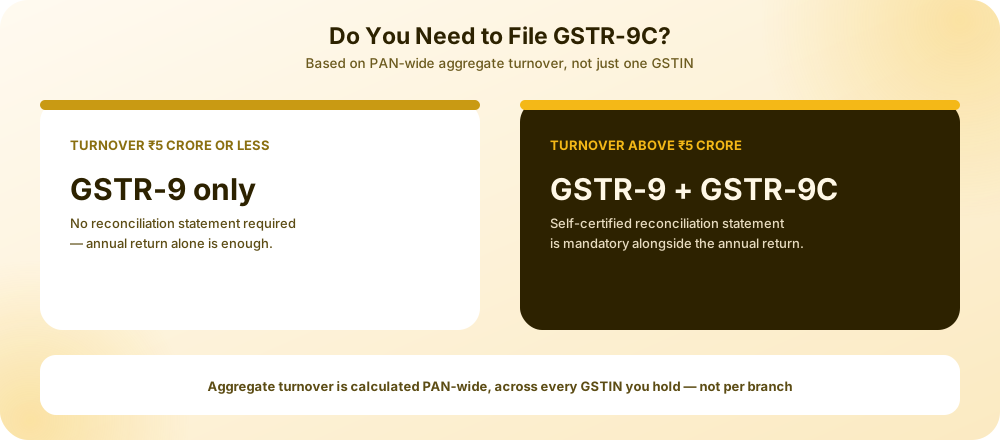
Every GST-registered taxpayer whose aggregate turnover in a financial year exceeded ₹5 crore must file GSTR-9C alongside GSTR-9. “Aggregate turnover” here means your PAN-wide turnover across all GSTINs, not just the turnover under the specific GSTIN you’re filing for — a business with three branches in three states, each individually turning over ₹2 crore, still crosses the ₹5 crore threshold on a PAN basis and every one of those three GSTINs needs a GSTR-9C. This is the single most common reason a genuinely borderline business gets caught off guard: they check their own branch’s turnover, see it under ₹5 crore, and assume they’re exempt.
The due date runs together with GSTR-9 — 31 December following the end of the financial year (so FY 2025-26’s GSTR-9C is due 31 December 2026, unless the government issues a notification extending it, which has happened in past years). You cannot file GSTR-9C before GSTR-9 for the same GSTIN — the portal enforces GSTR-9 as a prerequisite, so if your GSTR-9 figures are wrong, your GSTR-9C reconciliation inherits that error and has to be corrected at the source, not patched over in the reconciliation statement itself.
Self-certified doesn’t mean casual
Before FY 2020-21, GSTR-9C required a Chartered Accountant or Cost Accountant to formally audit and certify it — a legal signature vouching that the reconciliation was accurate. That mandatory external certification was removed from FY 2020-21 onward, and now the business itself self-certifies through its authorised signatory.
In practice this shifted risk, not effort. The actual reconciliation work — matching turnover, tax paid, and ITC across two independently-maintained sets of numbers — hasn’t gotten any easier just because a CA’s sign-off is no longer mandatory. What’s changed is who answers for it if a mismatch surfaces later: previously, a wrong GSTR-9C at least had an auditor’s professional liability attached to it; today, an unexplained gap is something the business owner is personally answering for in a notice or scrutiny, with no external certification standing between them and the department’s questions. We treat self-certification as a reason to be more careful with the reconciliation, not less.
What GSTR-9C actually contains — Part A and Part B
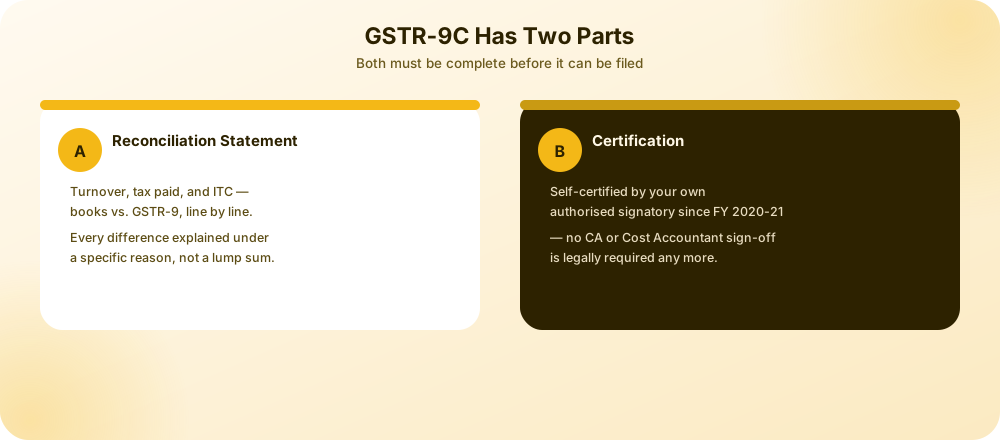
GSTR-9C has two parts, and understanding what each one is doing helps explain why the reconciliation takes real work, not just data entry:
- Part A — Reconciliation Statement. This is the actual comparison: turnover as per your audited financial statements vs. turnover as declared in GSTR-9, tax paid as per your books vs. tax paid as per your returns, and Input Tax Credit as per your books vs. ITC as availed in your returns. Every difference has to be broken down by reason — not just stated as a lump-sum gap.
- Part B — Certification. Since FY 2020-21 this is filled and signed by the taxpayer themselves (self-certification), not an external auditor. It’s a formal declaration that the reconciliation in Part A is true and correct to the best of the signatory’s knowledge.
What the turnover reconciliation checks
The turnover section reconciles your audited financial statement’s turnover against your GSTR-9 declared turnover, and requires you to explain the gap under specific heads rather than one catch-all figure. The heads that come up most often for our clients:
- Unbilled revenue at year-end. Revenue recognised in your books under accrual accounting before an invoice was actually raised (common for service businesses and long-duration contracts) — GST liability generally arises on invoice or advance, not on book recognition, so this creates a genuine, explainable timing gap.
- Deemed supplies with no invoice. Certain transactions count as a “supply” under GST (branch transfers, goods sent on approval that weren’t returned in time, gifts above the threshold to employees) even though no sale invoice was raised — these need to be added into your GST turnover even though they never appeared as revenue in your books the same way.
- Credit notes issued after the financial year closed. A credit note for an FY24-25 sale, issued in April FY25-26 after your books for FY24-25 were already closed, creates a turnover gap that has to be tracked to the specific note and specific invoice, not just netted off.
- Non-GST and exempt income mixed into “total revenue.” Interest income, dividend income, sale of a fixed asset, or exempt-supply revenue often sits inside your books’ total revenue line but shouldn’t be counted the same way in the GST turnover comparison — treating “total revenue” and “GST turnover” as the same number is one of the most common reconciliation mistakes we catch.
What the tax-paid and ITC reconciliation checks
Beyond turnover, GSTR-9C separately reconciles tax paid (rate-wise, comparing what your books show as GST liability against what was actually paid through your returns) and Input Tax Credit (comparing ITC as per your books’ purchase register against ITC actually availed across your GSTR-3B filings for the year). A gap here is a different, and often more serious, kind of problem than a turnover gap — an ITC mismatch that isn’t genuinely explainable can point to credit claimed on ineligible purchases, credit claimed without a valid invoice on record, or credit that should have been reversed under Rule 42/43 (common credit used for both taxable and exempt supplies) but wasn’t. This is the same class of mismatch our GST Reconciliation & ITC Mismatch guide covers in more depth at the monthly GSTR-2A/2B level — GSTR-9C is where a full year of those monthly gaps, if left unresolved, all surface together.
A worked example
Take a Chennai-based manufacturer with ₹8 crore audited turnover for the year — above the ₹5 crore threshold, so GSTR-9C is mandatory. Their books show ₹8,00,00,000 in total revenue. Their GSTR-9 declares ₹7,84,50,000 as GST turnover. That’s a ₹15,50,000 gap, and GSTR-9C requires it to be explained, not just acknowledged:
| Reason for the gap | Amount |
|---|---|
| Unbilled revenue at year-end (accrued, not yet invoiced) | ₹9,20,000 |
| Interest income on fixed deposits (non-GST, sits in “total revenue”) | ₹4,80,000 |
| Sale of an old delivery vehicle (capital asset, separately GST-liable, already reported elsewhere) | ₹1,50,000 |
Total explained
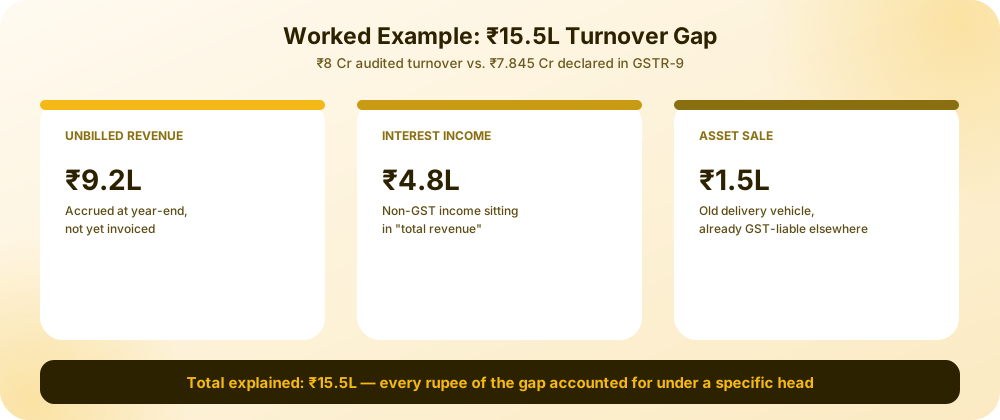 | ₹15,50,000 |
Every rupee of that gap is accounted for under a specific, defensible head — that’s what a clean GSTR-9C looks like. The risk isn’t having a gap (almost every real business has one); it’s having a gap with no explanation behind it, or an explanation that doesn’t actually reconcile down to zero when you add it up.
What happens if you don’t file, or file it wrong
GSTR-9C doesn’t carry its own separate late-fee provision the way GSTR-9 does — but that doesn’t mean skipping it is low-risk. Because GSTR-9C is a mandatory part of the annual return compliance for any business over ₹5 crore turnover under Section 44, non-filing exposes the business to a general penalty under Section 125 (up to ₹25,000), and more practically, an incomplete annual return filing is exactly the kind of gap a GST department scrutiny or audit selection algorithm flags first. A reconciliation statement that doesn’t actually reconcile — where the explained differences don’t add up to the real gap — invites the department to ask why, and “our books and returns don’t match, we’re not sure why” is not an answer you want to be giving during an actual notice. If your GST registration has been suspended or cancelled for unrelated reasons, see our Activate GST page — GSTR-9C compliance is one of the return-filing obligations that has to be current before reactivation goes through.
How GSTR-9C differs from your statutory or tax audit
Businesses that already undergo a statutory audit (mandatory for companies) or a tax audit under Section 44AB of the Income Tax Act sometimes assume GSTR-9C is redundant — that an auditor has already checked their numbers, so a second reconciliation is just paperwork. In practice the two are checking different things entirely. Your statutory/tax audit verifies that your financial statements comply with accounting standards and tax law. GSTR-9C verifies that your GST returns match those same financial statements — a company can have a perfectly clean statutory audit and still have a GSTR-9C-worthy gap, because the audit was never designed to check GST turnover against GST returns line by line. We routinely find gaps in businesses whose books were otherwise audit-clean, simply because nobody had specifically reconciled the GST-turnover view against the accounting-revenue view before.
Documents we’ll need from you
- Audited (or finalised, if audit isn’t separately mandatory for your entity type) financial statements — profit & loss, balance sheet, and notes
- Trial balance for the financial year
- All GSTR-1 and GSTR-3B filings for the year, plus the already-filed GSTR-9
- Purchase register / ITC ledger for the year
- Details of any credit/debit notes issued in the following year relating to the year under reconciliation
- Fixed asset register, if any capital asset sales occurred during the year (these are separately GST-liable and a common source of turnover-gap confusion)
The more organised these are going in, the faster the reconciliation moves — a business that can hand over a clean trial balance and a full year of returns in one go is typically looking at days, not weeks, of reconciliation work. Call or WhatsApp 70 9232 9232 and we’ll tell you exactly what we need for your specific case.
Common mistakes we catch before filing
- Treating “total revenue” and “GST turnover” as interchangeable — the single most frequent error, and the one that creates an unexplained gap where none actually exists.
- ITC claimed in books but never actually availed in GSTR-3B (or vice versa) — a genuine accounting/return mismatch that has to be identified and explained, not netted off.
- Forgetting inter-branch stock transfers that count as a deemed supply under GST even though no sale invoice exists for them internally.
- Rate-wise tax reconciliation skipped entirely — checking only the total tax figure instead of breaking it down by rate slab, which can hide a genuine rate-classification error inside an otherwise-matching total.
Our process, step by step
GSTR-9C isn’t a form we fill in from your GSTR-9 alone — it genuinely requires going back to your books. Here’s what that looks like in practice:
- Pull your audited financial statements — profit & loss, balance sheet, and the trial balance behind them — alongside your full year of GSTR-1, GSTR-3B, and GSTR-9 filings.
- Reconcile turnover line by line against the common gap heads (unbilled revenue, deemed supplies, credit notes, non-GST income) until every rupee of the difference is accounted for under a specific reason, not a lump sum.
- Reconcile tax paid and ITC — rate-wise tax comparison, and a purchase-register-to-GSTR-3B ITC comparison, flagging any credit that looks unexplainable before it becomes the department’s question instead of ours.
- Draft Part A with the full reconciliation and reasoned explanations for every identified gap.
- File GSTR-9 and GSTR-9C together, on the same 31 December deadline, self-certified through your authorised signatory.
- Keep the working papers — the actual reconciliation backup — on file in case the same numbers are ever questioned in a later notice or audit.
Throughout this, you get direct access to your consultant — no call centre, no ticket queue. If a reconciliation question comes up mid-process, you’re talking to the person actually doing the reconciliation, not a generic support line. Call or WhatsApp 70 9232 9232 to get started.
Remember: the late fee that actually bites is on GSTR-9, not GSTR-9C
Because GSTR-9C is filed together with GSTR-9 on the same portal utility, delaying the pair means you’re accruing GSTR-9’s own late fee under Section 47(2) — ₹200 per day (₹100 CGST + ₹100 SGST), capped at 0.25% of your turnover in the state or UT under each Act, so 0.5% of turnover total. For a business with ₹8 crore turnover, that cap works out to ₹4,00,000 — a genuinely serious number, and one more reason not to treat the GSTR-9C reconciliation as something that can wait until the deadline is already close. Our GST Late Fee Calculator can show you exactly what a delay is costing on the GSTR-9 side while your GSTR-9C is still being reconciled.
Pricing
GSTR-9C pricing depends on your turnover and how much genuine reconciliation work is involved — a business with clean, well-maintained books reconciles faster than one where a full year of gaps needs to be traced back to source. Call 70 9232 9232 for a fixed quote based on your actual numbers — fixed, transparent pricing, no surprise add-ons once the reconciliation is underway, and no separate “audit fee” tacked on since there’s no mandatory external audit involved anymore.
Frequently asked questions
Do I need a CA to sign my GSTR-9C?
No, not since FY 2020-21. GSTR-9C is self-certified by the taxpayer’s own authorised signatory. You can still choose to have a professional prepare and review it — we do the reconciliation for you either way — but a mandatory external certification is no longer required by law.
What if my turnover is exactly ₹5 crore?
The threshold is “exceeded ₹5 crore” — so a business at exactly ₹5,00,00,000 does not cross the threshold and isn’t required to file GSTR-9C for that year, only GSTR-9. Anything above ₹5 crore, even by a small margin, does require it.
Can I file GSTR-9C without filing GSTR-9 first?
No. The GST portal requires GSTR-9 to be filed before GSTR-9C can be submitted for the same GSTIN and year, since GSTR-9C reconciles against the figures already declared in GSTR-9.
What if I have multiple GSTINs under one PAN?
Aggregate turnover for the ₹5 crore threshold is calculated PAN-wide, across every GSTIN. If your combined turnover crosses ₹5 crore, every individual GSTIN needs its own GSTR-9C, even ones that individually turn over far less. Call 70 9232 9232 if you’re not sure whether this applies to your specific structure.
Is GSTR-9C the same as a GST audit?
It’s often called one informally, but there’s no longer a separate “GST audit” requirement in the way there was before FY 2019-20 — GSTR-9C, as a self-certified reconciliation statement, is what replaced the formal GST-audit-and-certification regime.
What’s the penalty if I file GSTR-9C late?
There’s no separate late-fee provision specifically for GSTR-9C the way there is for GSTR-9 itself, but skipping or delaying it leaves your annual return compliance incomplete under Section 44, which can attract a general penalty under Section 125 (up to ₹25,000) and is exactly the kind of gap that draws department attention. Call 70 9232 9232 well before the 31 December deadline rather than after it’s passed.
My turnover just crossed ₹5 crore for the first time this year — what should I do differently?
Start the reconciliation earlier than you would for a routine GSTR-9. First-time GSTR-9C filers often discover gaps that have been quietly accumulating for years without anyone specifically checking for them, simply because nobody was required to look until now. Call 70 9232 9232 as soon as your financial year closes, not close to the December deadline — a first-year reconciliation with genuine unexplained history takes longer to untangle than a routine annual check.
Can GSTR-9C be revised after filing?
No, once filed on the portal, GSTR-9C cannot be revised. This is exactly why the reconciliation has to be right before submission — mistakes generally have to be addressed through subsequent correspondence with the department rather than a simple resubmission.
Related guides
See our GSTR-9 Annual Return page (GSTR-9C is filed alongside it, not instead of it), our GST Reconciliation & ITC Mismatch guide for the monthly-level version of this same reconciliation discipline, and our GST Return Filing page if your monthly/quarterly filings need attention before your annual reconciliation can even begin. Call or WhatsApp 70 9232 9232 to talk through your specific numbers.