
Changed your business address, added a partner, updated your bank account, or need to add a new place of business? Your GST registration details have to be updated within 15 days of the change — through Form GST REG-14 — and not every field is treated the same way. Get the classification wrong and a simple update can sit stuck for weeks. Call or WhatsApp us on 70 9232 9232 to get your amendment filed correctly the first time.
Table of Contents
- Core fields vs non-core fields — the distinction that matters
- Core field amendments — 15 working days, or deemed approved
- Filing within 15 days isn’t optional
- A worked example — adding a partner
- What happens if you skip it entirely
- Documents needed, by field type
- A worked example — changing your registered address
- Non-core changes — fast, but still worth getting right
- Amending multiple fields at once
- Fixing an error made at original registration
- Timeline at a glance
- What we actually do
- Pricing
- Frequently asked questions
- How long does a core-field amendment actually take?
- Can I change my business’s state in an amendment?
- What if my amendment application gets rejected?
- Do I need to amend my registration for a trade name change even if my legal/PAN name isn’t changing?
- How many times can I amend my GST registration?
- Does an amendment affect my GST return filing history or ITC already claimed?
- Can I file an amendment if my GST registration is currently suspended?
- Changing a specific field?
- Related guides
Core fields vs non-core fields — the distinction that matters
GST registration fields split into two categories, and they’re handled completely differently by the portal:
| Non-core fields (auto-approved) | Core fields (officer approval needed) |
|---|---|
| Mobile number | Legal name of the business (no PAN change) |
| Email ID | Principal place of business (except state change) |
| Bank account details | Additional place(s) of business (except state change) |
| Authorised signatory (in most cases) | Addition/deletion of partners, directors, Karta, trustees |
| Goods and services (HSN/SAC) details | Trade name |
| Existing stakeholder contact details |
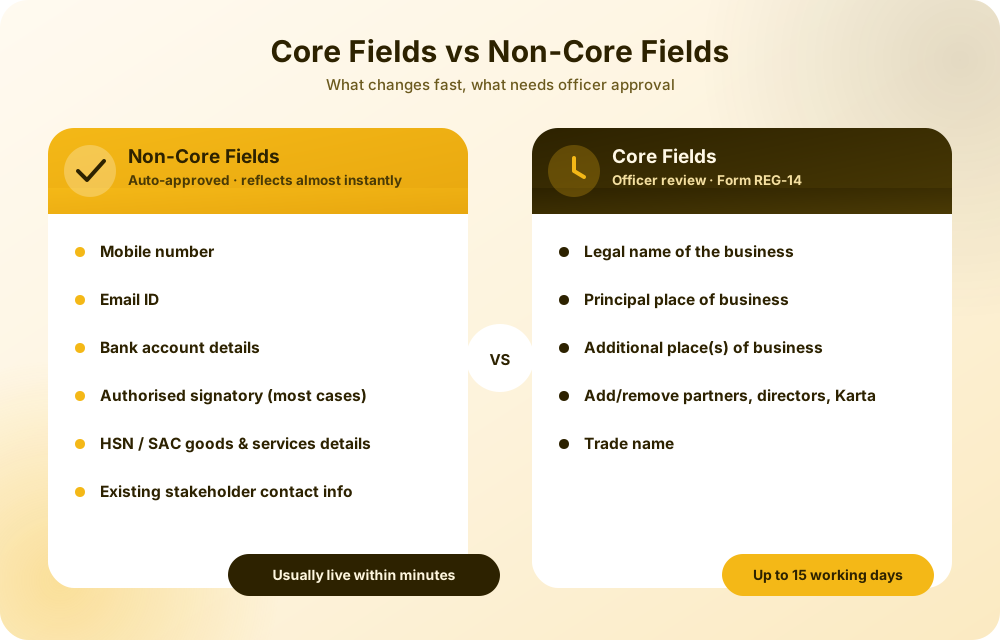
Non-core fields get auto-approved the moment you submit them — no officer review needed, the change reflects on your registration certificate essentially immediately. Core fields require a GST officer to actually review supporting documents and approve the change before it takes effect. Filing the wrong type of amendment, or expecting core-field changes to process as fast as non-core ones, is the single most common source of frustration we see — a business owner who changed their registered address two weeks ago and is still calling the department asking why nothing’s updated, when in reality the officer is still sitting on a queried, incomplete application.
Core field amendments — 15 working days, or deemed approved
Once you submit a core-field amendment via Form GST REG-14, the proper officer has 15 working days to review and approve it, or raise a query via Form GST REG-03. If they don’t act within that window and haven’t raised any query, the amendment is deemed approved automatically — but that’s a fallback built for genuine officer inaction, not something to plan a business decision around. A query raised on your application resets the clock: you get 7 working days to respond via Form GST REG-04, and if you don’t respond, or the officer isn’t satisfied with the response, the application can be rejected outright via Form GST REG-05 — at which point you’re starting the whole amendment process again, not just resubmitting the same form.
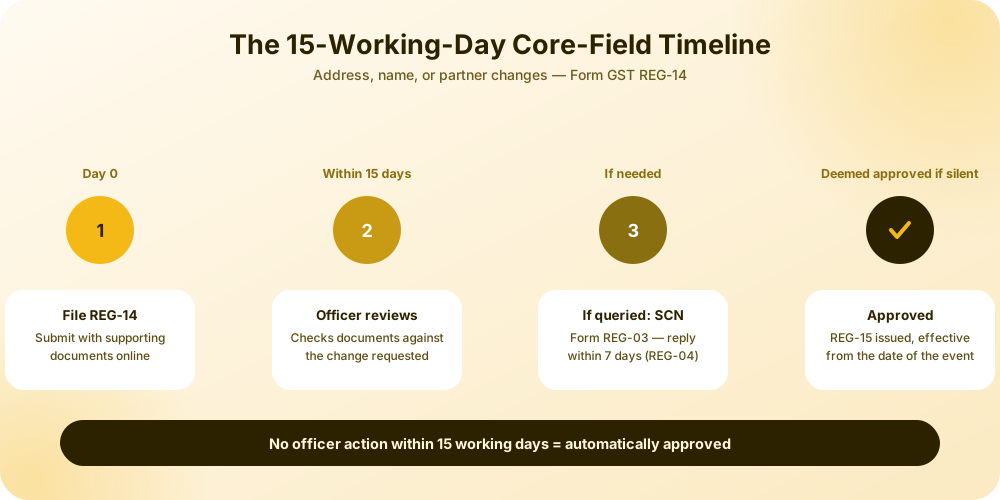
An incomplete or inconsistent submission is exactly what triggers a query in the first place — address proof that doesn’t clearly match the new address stated, a partner addition submitted without the corresponding partnership deed amendment or consent letter, or a trade name change that isn’t backed by the actual registered document showing the new name. The businesses that get core-field changes approved fastest are the ones whose supporting documents are airtight on the first submission, not the ones who submit quickly and fix problems as queries come back.
Filing within 15 days isn’t optional
The law requires you to file an amendment within 15 days of the change actually happening — not 15 days from when you get around to it. A business that changes its registered address and keeps invoicing from the old one while the amendment sits unfiled is creating a documentation mismatch that surfaces later, usually at the worst possible time — during a GST notice, a departmental audit, or when a client’s own vendor-verification process cross-checks your GSTIN details against your invoice address and flags the discrepancy before you’ve even noticed it yourself.
A worked example — adding a partner
A Chennai partnership firm brings on a new partner on 1st of the month, updating the partnership deed the same week. This is a core-field amendment (addition of a partner). The 15-day filing window runs from the date of the actual change — the date on the amended deed — not from whenever the paperwork is finally submitted. Filed correctly on day 10 with the amended deed, the new partner’s PAN and Aadhaar, consent letter, and photograph attached, a clean application typically clears within the 15-working-day officer window without a query. Filed on day 25 (already past the legal deadline) with a mismatched or unsigned deed attached, the same change can sit queried for weeks — and until it clears, the new partner isn’t formally reflected as an authorised person on the registration, which matters the moment they need to sign anything on the business’s behalf for GST purposes.
What happens if you skip it entirely
There’s no automatic daily penalty for an unfiled amendment the way there is for a late return — but that doesn’t make it low-risk. An un-updated core field means your GST registration certificate no longer accurately reflects your actual business — wrong address, missing partner, stale trade name — and a mismatch discovered during a notice, audit, or e-way bill/registration cross-check is treated as a compliance failure, potentially attracting a general penalty under Section 125 (up to ₹25,000) for not maintaining accurate registration particulars. It also creates practical problems well before it becomes a legal one: banks, vendors, and government tender portals routinely verify GST registration details against other documents, and a stale registered address or missing authorised signatory can hold up something as mundane as a bank KYC update or a tender submission.
Documents needed, by field type
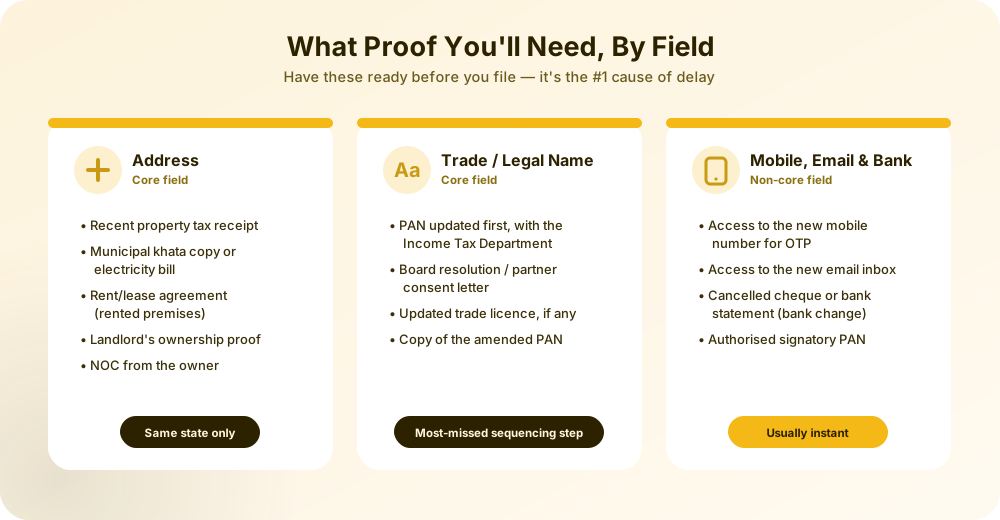
- Address change: proof of the new principal place of business — a recent electricity bill, property tax receipt, or rent/lease agreement (plus a No Objection Certificate from the owner if rented), and if it’s a shared or co-working space, documentation showing your specific right to use it.
- Adding/removing a partner or director: the amended partnership deed or board resolution, PAN and Aadhaar of the incoming/outgoing person, a consent letter, and photograph.
- Trade name change: a declaration or certificate reflecting the new trade name (a shop & establishment certificate update, or an equivalent local registration change, is often used as supporting proof).
- Bank account update: a cancelled cheque or bank statement showing the account holder name matching your GST registration name.
- Mobile/email update: no supporting document needed — this is a self-service, OTP-verified change on the portal itself.
Mismatched or unclear documents are the most common reason a core-field amendment gets queried instead of approved on the first pass — call 70 9232 9232 and we’ll check your documents are in order before anything gets submitted.
A worked example — changing your registered address
A Chennai trading business relocates from a rented office in Nandanam to a new premises in Alwarpet on the 5th of the month. This is a core-field amendment (change of principal place of business, same state). The 15-day filing window runs from the 5th, meaning the amendment needs to be submitted by the 20th. Filed on day 8 with the new lease agreement and the landlord’s NOC attached, the officer typically approves within the 15-working-day window without a query, since the documents clearly establish the right to occupy the new address. If the business instead keeps invoicing from the old Nandanam address for another two months while the amendment sits unfiled — a common real-world pattern when the move happens gradually — every invoice issued in that window carries an address that no longer matches the actual registered premises, a mismatch that a client’s own vendor-verification check, or a future GST notice, can flag well after the fact.
Non-core changes — fast, but still worth getting right
Non-core fields auto-approve, but “fast” doesn’t mean “no consequences if wrong.” A mobile number or email update that isn’t actually completed leaves you unable to receive OTPs for other GST portal actions — including future amendments, refund applications, or responding to a notice — which can turn a five-minute fix into a real bottleneck at exactly the wrong moment. See our step-by-step guides on the four most common individual field changes below if you’re only updating one specific thing.
A common real-world pattern: a business updates its authorised signatory’s mobile number after the person leaves the company, but forgets that the old number is still linked as the primary contact for OTP verification on other pending actions — the new signatory then can’t complete an unrelated amendment or a refund application because the OTP is going to a number nobody at the business can access anymore. Getting non-core updates done promptly, and specifically re-checking which contact details are tied to which portal functions after any personnel change, avoids this exact trap.
Amending multiple fields at once
If you’re changing several things at the same time — say, a new partner joining alongside a bank account update — these can often be filed together in a single amendment application rather than as separate submissions, which is usually faster and cleaner than filing one, waiting for approval, then filing the next. The one exception worth knowing: if any of the bundled changes is a core field, the entire application follows the core-field (officer-review) timeline, even if some of the individual changes in it were non-core on their own. Call 70 9232 9232 before filing if you have more than one change pending — bundling them correctly the first time avoids submitting several separate applications that each need their own review.
Fixing an error made at original registration
Not every amendment is triggered by a genuine business change — sometimes it’s a typo or mistake carried over from the original registration itself: a legal name spelled slightly differently from the PAN record, a trade name entered with the wrong punctuation, or a director’s details entered from an old address. These still go through the same REG-14 amendment process as any other change, but they’re worth catching and fixing proactively rather than waiting for them to cause a problem — a name mismatch between your GST registration and your PAN, for instance, can silently block other GST portal actions (like a refund claim or an amendment to a different field) until it’s corrected, since the portal cross-verifies against PAN records for certain transactions.
Timeline at a glance
| Field type | Filing deadline | Approval timeline |
|---|---|---|
| Non-core (mobile, email, bank account, HSN/SAC) | Within 15 days of the change | Auto-approved on submission |
| Core (legal name, address, partners, trade name) | Within 15 days of the change | Up to 15 working days, or deemed approved if the officer doesn’t act or query |
| Core field, with an officer query raised | — | 7 working days to respond, then further officer review |
Once submitted, you can track the application’s status using the ARN (Application Reference Number) generated on the GST portal — worth checking periodically rather than assuming silence means approval, since a query sitting unanswered past its 7-working-day window is exactly how a routine amendment turns into a rejected one. Call 70 9232 9232 if you’d rather we track it for you.
What we actually do
- Identifying whether your change is a core or non-core field before filing, so you know what timeline to expect from the start
- Preparing the correct supporting documents so the application isn’t queried or delayed
- Filing within the 15-day window, not after
- Tracking the application through to approval, not just submitting and hoping — including handling any REG-03 query if one comes back
- Direct access to your consultant — no call centre
Pricing
Amendment pricing depends on which fields are changing and how many changes are involved in a single application — call 70 9232 9232 for a fixed quote. Fixed, transparent pricing, whether it’s a single mobile number update or a bundled core-field change with supporting documents to prepare — no per-field surcharge if you’re updating more than one thing at once.
Frequently asked questions
How long does a core-field amendment actually take?
Up to 15 working days for the officer to act, assuming no query is raised. A clean application with complete supporting documents often clears well within that window; a queried one can take significantly longer since the 7-working-day response clock and any follow-up review resets the timeline.
Can I change my business’s state in an amendment?
No — a change of state for your principal or additional place of business isn’t handled as an amendment at all. It requires cancelling the existing registration and applying for a fresh GST registration in the new state, since GST registration is state-specific by design.
What if my amendment application gets rejected?
You’ll need to file a fresh application addressing whatever the officer’s rejection reason (via Form GST REG-05) actually was — it isn’t a simple resubmission of the same form. This is exactly why getting the supporting documents right on the first attempt matters.
Do I need to amend my registration for a trade name change even if my legal/PAN name isn’t changing?
Yes. Trade name is treated as a core field in its own right, separate from your legal business name, and needs its own REG-14 amendment with supporting documentation (typically a certificate or declaration showing the new trade name) even when nothing about your legal entity or PAN has changed.
How many times can I amend my GST registration?
There’s no fixed cap on the number of amendments over time, but each core-field change goes through the same officer-review process every time — frequent, poorly-documented amendments to the same field can draw more scrutiny than a single well-documented change. Call 70 9232 9232 if you’re planning multiple changes at once; it’s often more efficient to bundle them into one clean application than file separately.
Does an amendment affect my GST return filing history or ITC already claimed?
No — an amendment updates your registration particulars going forward; it doesn’t retroactively alter returns already filed or credit already availed under the previous details. The exception is if the change reveals that past filings were done under materially incorrect information, which is a separate, case-specific issue worth discussing directly. Call 70 9232 9232 if you’re unsure whether your situation falls into that category.
Can I file an amendment if my GST registration is currently suspended?
Generally no — the portal restricts most amendment actions while a registration is under suspension, since suspension itself is meant to freeze the registration’s status pending resolution. If you need to make a change and your registration is suspended, the suspension usually needs to be resolved first. See our Activate GST page, or call 70 9232 9232 and we’ll tell you the right order to handle both.
Changing a specific field?
See our step-by-step guides on updating your mobile number and email, updating bank account details, changing your business address, and changing your trade or legal name.
Related guides
Need a fresh GST registration instead? See our GST Registration page. GST already suspended or cancelled? See Activate GST. Call or WhatsApp 70 9232 9232 and we’ll tell you straight away whether your change is core or non-core, and what to expect.