
Moving goods worth more than ₹50,000 without a valid e-way bill can get your consignment detained at a checkpoint — and if your GSTIN is already blocked for non-filing, you can’t generate a new one at all until that’s fixed first. We handle e-way bill generation and the compliance behind it so your goods keep moving, whether that’s a one-off shipment or an ongoing daily dispatch operation. Call or WhatsApp us on 70 9232 9232.
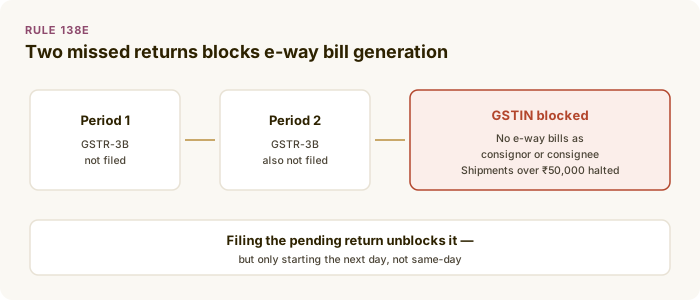
Table of Contents
- When you actually need one
- Who’s responsible for generating it
- Validity is tied to distance, not just time
- A worked example
- The blocking trap: miss 2 GSTR-3B filings, lose e-way bill access
- What gets checked at a roadside inspection
- Part A and Part B — the two halves of every e-way bill
- One truck, multiple invoices — consolidated e-way bills
- Sales returns and job work also need e-way bills
- What it actually costs to get caught without one
- Setting up a repeatable process, not a one-off fix
- What we actually do
- The transporter’s own liability, not just the seller’s
- Pricing
- Frequently asked questions
- Is the ₹50,000 threshold on the invoice value or just the taxable value?
- Do I need an e-way bill for goods moved within the same city, like between two branches?
- What happens if the e-way bill expires while goods are still in transit?
- My GSTIN just got blocked from generating e-way bills — what do I do right now?
- Do I need an e-way bill if I’m transporting goods for job work, not a sale?
- Can a transporter generate the e-way bill instead of me?
- How is the distance for validity calculated — actual road distance or straight-line?
- Related guides
When you actually need one
An e-way bill is required before you move goods worth more than ₹50,000 (the invoice/consignment value, not just the tax) across state lines — that ₹50,000 threshold is fixed nationwide for inter-state movement, set under Rule 138 of the CGST Rules. For movement within the same state, the threshold is set by each state’s own government and can differ from the national figure — Tamil Nadu, for instance, has historically set its own intra-state threshold, which is exactly where businesses shipping both within Tamil Nadu and to other states get tripped up assuming the ₹50,000 inter-state number applies everywhere. Get the wrong threshold wrong in either direction — generating one when it wasn’t required, or skipping one when it was — and you’re either wasting compliance effort or exposing a shipment to detention.
Who’s responsible for generating it
The responsibility for generating an e-way bill isn’t always the seller’s by default. If the supplier (consignor) hands over goods to a transporter without generating one, the transporter can generate it themselves using the invoice details — but if neither the consignor nor the transporter has generated it before the goods start moving, both can be held liable if the shipment is checked in transit. For businesses that regularly ship through a third-party transporter or a marketplace’s own logistics network (relevant if you’re an Amazon, Flipkart, or Meesho seller — see our Filing guide for marketplace sellers), it’s worth confirming in writing whose system is actually generating the e-way bill for each dispatch, rather than assuming it’s automatically handled.
Validity is tied to distance, not just time
Under Rule 138, a standard e-way bill is valid for 1 day for every 200 km (or part thereof) the goods need to travel; over-dimensional cargo gets a stricter 1 day per 20 km, reflecting how much slower and more logistically constrained that kind of movement typically is. The real planning question isn’t “how many days is it valid” in isolation — it’s whether the distance you’ve declared on the e-way bill matches the validity period the system will actually calculate and allow. An e-way bill that expires mid-transit because the distance was under-declared (a common mistake when the system’s auto-calculated distance based on PIN codes doesn’t match the actual road route) is a preventable, entirely self-inflicted delay — the goods get stopped, and extending or re-generating an expired e-way bill mid-route is its own separate hassle involving the transporter’s current location and a fresh justification.
A worked example
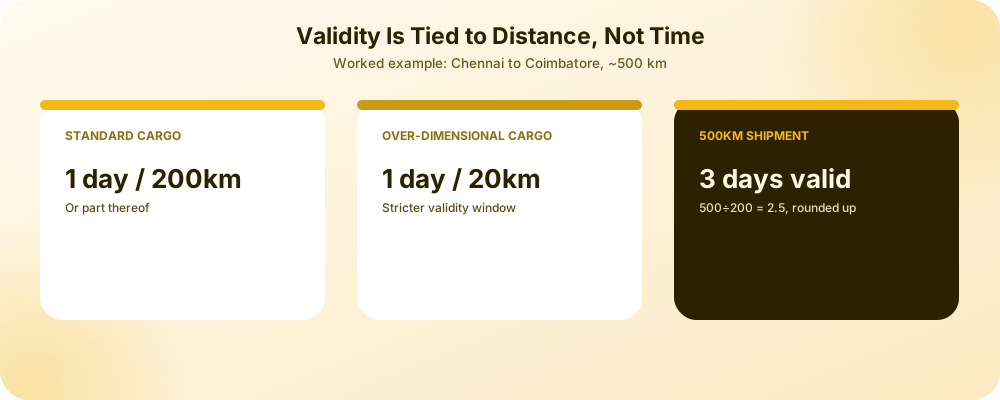
A Chennai manufacturer dispatches a consignment worth ₹3,20,000 to a buyer in Coimbatore — roughly 500 km by road. That crosses the ₹50,000 threshold, so an e-way bill is mandatory. At 1 day per 200 km, the system allows validity of 3 days (500 ÷ 200 = 2.5, rounded up to 3, since any part of a 200 km block counts as a full day). If the truck is delayed by a breakdown and the goods are still in transit on day 4, the e-way bill has technically expired — the transporter needs to either extend it (possible within a limited window before and after expiry, with a reason recorded) or the consignment risks detention at the next checkpoint even though nothing about the underlying transaction changed. This is the exact kind of gap that’s cheap to plan around in advance and expensive to fix mid-route.
The blocking trap: miss 2 GSTR-3B filings, lose e-way bill access
Under Rule 138E, if you fail to file GSTR-3B (or CMP-08 for composition taxpayers) for two or more consecutive tax periods, the GST portal automatically blocks your GSTIN from generating new e-way bills — no manual notice, no warning call, just a silent block the next time your system tries to generate one. E-way bills already generated before the block stay valid until they naturally expire; this only stops new ones from being created. For a business that ships daily, discovering this mid-operation — often when a dispatch is already loaded and ready to move — is one of the more disruptive ways a filing backlog can surface.
If this happens to you, filing the overdue GSTR-3B returns is what unblocks it — the system typically lifts the block automatically once the pending returns are filed and the “2 or more consecutive” condition no longer holds. In genuinely urgent cases where filing can’t happen immediately, a temporary exception can be requested via Form GST EWB-05 to the jurisdictional Commissioner, but that’s a fallback for a genuine emergency, not a routine substitute for staying current on filing. See our GST Return Filing page if this is the actual underlying problem, or our Activate GST page if your registration itself has been suspended, which is a related but separate consequence of the same non-filing pattern.
What gets checked at a roadside inspection
A GST officer checking a consignment in transit is typically verifying that the e-way bill’s declared details actually match the physical shipment: the invoice value, the HSN code and description of goods, the vehicle number, and whether the e-way bill is still within its validity window. A mismatch between the vehicle number on the e-way bill and the actual vehicle carrying the goods (common when a transporter swaps vehicles mid-route without updating Part B of the e-way bill) is one of the most frequent, and most avoidable, reasons for detention — the fix is simple (update Part B before the swap, not after), but only if the transporter or business actually knows to do it.
Part A and Part B — the two halves of every e-way bill
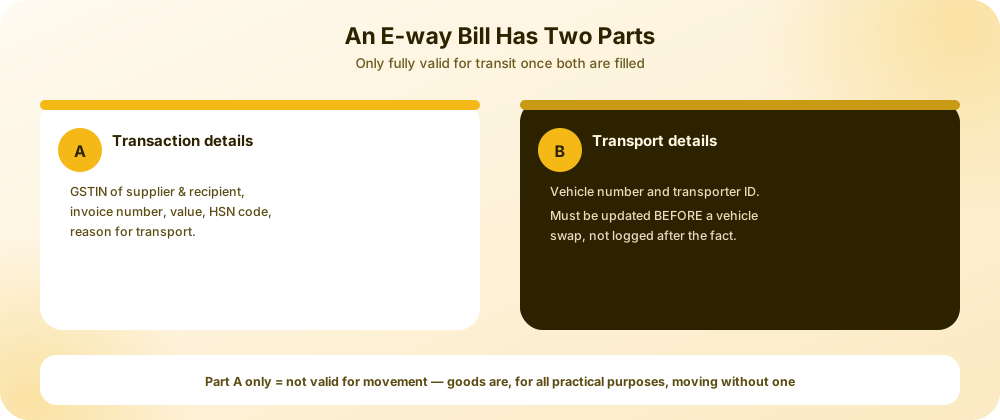
An e-way bill has two parts, and it’s only fully valid for transit once both are filled: Part A carries the transaction details — GSTIN of the supplier and recipient, invoice number and date, value of goods, HSN code, and the reason for transport (supply, return, job work, and so on). Part B carries the transport details — vehicle number and transporter ID. An e-way bill generated with only Part A filled (sometimes done when the vehicle isn’t yet finalised) isn’t valid for actual movement until Part B is added — goods dispatched on a Part-A-only e-way bill are, for all practical purposes, moving without one. Any time a transporter changes vehicles mid-route — a genuinely common occurrence on longer inter-state hauls — Part B has to be updated with the new vehicle number before the swap, not logged after the fact.
One truck, multiple invoices — consolidated e-way bills
When a single vehicle is carrying goods covered by multiple separate invoices — common for businesses consolidating several smaller orders into one dispatch run — each invoice still needs its own individual e-way bill, but a Consolidated E-way Bill (Form GST EWB-02) can be generated that bundles all of them under one reference for the transporter to carry, rather than juggling several separate documents for one truck. Getting this structure wrong — trying to generate one e-way bill covering multiple invoices as if they were a single consignment — is a common error for businesses new to running multi-order dispatch routes, and it’s exactly the kind of setup mistake that’s worth getting right once rather than fixing after a detention.
Sales returns and job work also need e-way bills
It’s a common misconception that e-way bills only apply to an outward sale. Goods sent for job work, goods sent on approval/sale-or-return basis, and goods being sent back by a customer as a genuine return all require their own e-way bill if the value crosses the threshold — the “reason for transportation” field on the e-way bill exists specifically to capture this, and choosing the wrong reason code (marking a job-work dispatch as a regular “supply,” for instance) can create its own downstream reconciliation headache when that movement later needs to be matched against your GST returns.
What it actually costs to get caught without one
Under Section 129 of the CGST Act, goods and the vehicle carrying them can both be detained if they’re found moving without a valid e-way bill (or with one that’s expired, or with details that don’t match the physical consignment). Release requires paying a penalty — typically 200% of the applicable tax if the owner of the goods comes forward to claim them, or a steeper penalty based on the value of the goods if nobody does. Beyond the direct penalty, a detained truck is a stalled delivery, a missed client deadline, and often a demurrage or detention charge from the transporter on top of the GST penalty itself — the real cost of a missing e-way bill is rarely just the fine, it’s everything downstream of the goods not arriving on time. Call 70 9232 9232 before a shipment moves, not after it’s stopped at a checkpoint.
Setting up a repeatable process, not a one-off fix
A business that generates one e-way bill a month can get away with doing it manually each time. A business dispatching daily — a manufacturer, a wholesaler, an exporter with regular container movements — needs this to be a standing process, not a fire drill every time a truck is ready to leave. That means: someone specifically responsible for generating and checking each e-way bill before dispatch, a habit of updating Part B the moment a vehicle is confirmed (not after loading is already underway), and GSTR-3B filing kept current enough that Rule 138E blocking never becomes a live risk in the first place. We set this up once, correctly, for businesses that ship regularly — rather than troubleshooting a stopped truck each time something slips.
What we actually do
- Generating e-way bills correctly, with validity matched to actual transit distance and route
- Checking state-specific intra-state thresholds before you assume the national ₹50,000 figure applies to every shipment
- Setting up a repeatable process for businesses with regular/daily dispatches, not a one-off fix each time
- Keeping your GSTR-3B filing current so your e-way bill access never gets blocked under Rule 138E in the first place
- Sorting out a Rule 138E block quickly, including the EWB-05 exception route, if it’s already happened
- Direct access to your consultant — no call centre, and no waiting on hold while a shipment sits idle
The transporter’s own liability, not just the seller’s
It’s worth being direct about this with whoever is physically moving your goods: a transporter carrying a consignment without a valid e-way bill, or with Part B not updated to match the actual vehicle, can have that vehicle detained regardless of whether the underlying sale transaction itself was entirely correct. Businesses that outsource dispatch to a third-party transporter sometimes assume the compliance risk sits entirely with the transporter — it doesn’t. If goods are detained, it’s your consignment and your delivery timeline that’s affected, even if the paperwork failure was technically the transporter’s. Building the e-way bill check into your own dispatch process, rather than trusting it entirely to the transporter, is the safer default for any business shipping regularly.
Pricing
Pricing depends on your shipment volume and whether it’s one-off generation or an ongoing arrangement covering regular dispatches — call 70 9232 9232 for a fixed quote. Fixed, transparent pricing, whether you need one e-way bill this week or a standing process for daily shipments — no per-bill surcharge that quietly adds up over a month of regular dispatches.
Frequently asked questions
Is the ₹50,000 threshold on the invoice value or just the taxable value?
It’s the total consignment value — the invoice value including GST, not just the taxable value before tax. A shipment with a pre-tax value of ₹43,000 plus 18% GST comes to over ₹50,000 total and does need an e-way bill.
Do I need an e-way bill for goods moved within the same city, like between two branches?
It depends on your state’s intra-state threshold and the specific movement type — some intra-city and short-distance movements have relaxed rules, but branch-to-branch stock transfers above the threshold generally still require one. This is exactly the kind of case-specific check worth confirming before you assume you’re exempt.
What happens if the e-way bill expires while goods are still in transit?
It can be extended within a defined window before and after expiry, with a reason recorded (typically a specified transit delay like a breakdown or natural event) — but an expired, un-extended e-way bill found during a check can lead to detention and penalty, so this needs to be handled proactively, not after the fact.
My GSTIN just got blocked from generating e-way bills — what do I do right now?
File the overdue GSTR-3B returns that triggered the Rule 138E block — the system generally lifts the restriction automatically once you’re no longer 2+ consecutive periods behind. If a shipment is urgently blocked and filing can’t happen immediately, Form GST EWB-05 to your jurisdictional Commissioner is the exception route, but call 70 9232 9232 first — we can often get the underlying filing sorted faster than the exception process itself.
Do I need an e-way bill if I’m transporting goods for job work, not a sale?
Yes, if the value crosses the threshold — job work movement isn’t exempt just because it isn’t a sale. The e-way bill’s “reason for transportation” field is where this gets correctly recorded as job work rather than a regular supply. Call 70 9232 9232 if you’re not sure which reason code applies to your specific movement.
Can a transporter generate the e-way bill instead of me?
Yes — if the consignor hasn’t generated one before handing goods to the transporter, the transporter can generate it using the invoice details provided. It’s still worth confirming in writing whose responsibility this is for each shipment, since both parties can be held liable if a check finds no valid e-way bill at all.
How is the distance for validity calculated — actual road distance or straight-line?
The portal auto-calculates distance from the supplier’s and recipient’s PIN codes using its own mapping data, with some built-in tolerance for genuine route variation. It doesn’t always match the exact road distance your driver actually travels, which is why declaring a materially wrong PIN code (rather than a small, genuine route variation) is the more common cause of validity mismatches — not the system’s own distance calculation being unreasonable. Call 70 9232 9232 if you’re regularly seeing validity periods that don’t match your actual routes; it’s often a fixable data-entry pattern, not a portal limitation.
Related guides
GSTR-3B filing is what keeps your e-way bill access unblocked — see our GST Return Filing page. Already blocked and behind on filing? See Activate GST. If a missed deadline is the real issue behind this, our GST Late Fee Calculator shows exactly what catching up will cost. Call or WhatsApp 70 9232 9232 to get your e-way bill process sorted.