
An ASMT-10 is almost always the first notice a GST-registered business ever receives, and it’s usually the least serious — as long as you act on it. It’s a “scrutiny notice” under Section 61 of the GST Act: an officer (or, more often, the GST portal’s own automated system) looked at your filed returns and found a discrepancy — a number that doesn’t match another number it should match.
Table of Contents
- What exactly did you get flagged for?
- Your deadline
- What you’re supposed to do
- What happens after you reply
- How myGSTzone handles your ASMT-10
- Common questions
- A real example
- Documents you’ll need to reply
- Why Chennai businesses see this so often
- Do I have to pay the amount mentioned in the notice?
- Can I miss the 30-day window if I’m busy?
- What if the mismatch is my supplier’s fault, not mine?
- Will this notice show up if I apply for a loan or a tender later?
- Does an ASMT-10 mean I’m being audited?
- Can I send you the notice photo right now?
- Related reading
What exactly did you get flagged for?
The notice itself will list the exact mismatch under an “observation” column. The four most common ones we see in Chennai businesses:
- Sales don’t match: what you declared in GSTR-1 (your sales) doesn’t match what you declared in GSTR-3B (your tax payment).
- ITC doesn’t match: the input tax credit (ITC) you claimed in GSTR-3B is higher than what your suppliers show in GSTR-2B.
- Turnover doesn’t match: your GST turnover doesn’t match your income-tax or e-way bill data.
- Late or missing filing: a return period is missing or was filed very late, and the officer wants an explanation.
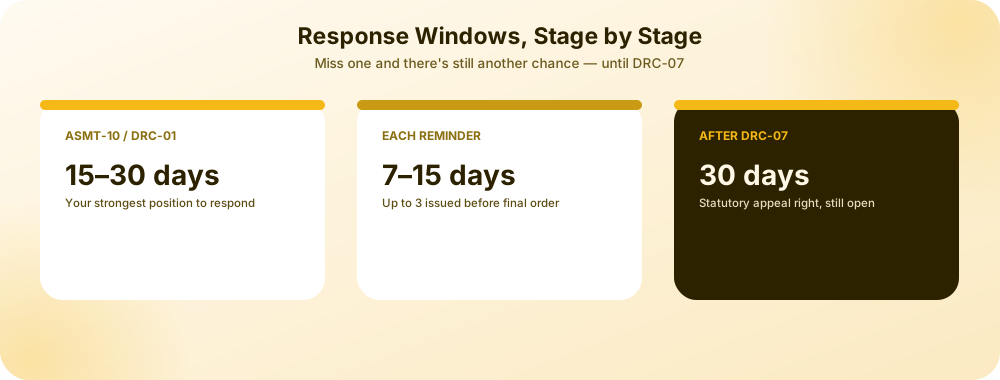
Your deadline
DEADLINE Usually 30 days from the date on the notice The exact number of days is printed on your specific notice — check the date it was issued, not the date you opened it. Call 70 9232 9232 and read us both dates; we’ll tell you exactly how many days remain.
What you’re supposed to do
You reply using Form ASMT-11 on the GST portal — not a letter, not an email, a specific form. In it, you either (a) accept the discrepancy and pay the shortfall voluntarily, or (b) explain why the department’s number is wrong and yours is correct, with supporting figures. This has to be backed by your actual books — a vague “will check and revert” reply is treated the same as no reply at all.
What happens after you reply
If the officer is satisfied with your ASMT-11 reply, they close the matter with a Form ASMT-12 — no further action, nothing shows on your record. This is the outcome in the large majority of cases where a business responds properly and on time.
If the officer isn’t satisfied — or if you never reply — the matter doesn’t just go away. It escalates to a formal Show Cause Notice (DRC-01), which is a much more serious stage with real tax, interest, and penalty at stake. This is exactly why an ASMT-10 is worth taking seriously even though it looks routine — it’s the cheapest, easiest point in the whole process to fix the problem.
How myGSTzone handles your ASMT-10
Call 70 9232 9232 and send us the notice. We pull your GSTR-1, GSTR-3B, and GSTR-2B side by side, find exactly where the numbers diverge, and tell you honestly whether it’s a real error (fixable with a small payment) or a data-matching timing issue (fixable with an explanation, no payment needed). Then we draft and file your ASMT-11 reply before your deadline. Fixed, transparent pricing — quoted once we’ve seen the actual notice.
Common questions
A real example
A Teynampet-based trading firm filed GSTR-3B for a quarter claiming ₹1,84,000 in input tax credit. Their suppliers’ GSTR-2B, however, only reflected ₹1,52,000 for the same period — a ₹32,000 gap. The portal’s automated scrutiny flagged this instantly and issued an ASMT-10 the following week. On review, ₹21,000 of the gap turned out to be genuine — two supplier invoices that hadn’t yet uploaded their own GSTR-1 on time — and was resolved with a written explanation and no payment. The remaining ₹11,000 was a duplicate entry on the firm’s own side, paid voluntarily through DRC-03 alongside the ASMT-11 reply. Total cost: the ₹11,000 shortfall plus a small interest amount — no penalty, because it was addressed at this stage rather than ignored.
Documents you’ll need to reply
Copies of the GSTR-1, GSTR-3B, and GSTR-2B for the exact period mentioned in the notice Purchase invoices and e-way bills for any ITC claims being defended A reconciliation working sheet showing where the two figures diverge, and why Proof of payment (challan) if you’re voluntarily settling part of the amount via DRC-03
Why Chennai businesses see this so often
ASMT-10s have become far more common since GST’s automated matching between GSTR-1, GSTR-3B, and GSTR-2B tightened up — the system now flags mismatches within weeks rather than during an annual audit years later. In our experience with Chennai’s trading, retail, and marketplace-seller businesses, the single biggest cause isn’t fraud or carelessness — it’s timing. A supplier who files GSTR-1 a few days late, a marketplace TCS credit that lands in a different month than the sale, or a credit note issued but not yet reflected on both sides can all trigger a mismatch that has nothing to do with any real error in your business. That’s exactly why the notice needs a proper reconciliation, not a guess.
Do I have to pay the amount mentioned in the notice?
Not necessarily. The notice states what the system thinks is wrong — it’s not a bill. If your books genuinely support your original figures, you can reply explaining the difference instead of paying. Call 70 9232 9232 and we’ll check your actual numbers before you pay anything.
Can I miss the 30-day window if I’m busy?
No — there’s no automatic extension. Missing it means the matter can move straight to a Show Cause Notice, a much more serious and expensive stage. If you’re short on time, call us today rather than after the deadline.
What if the mismatch is my supplier’s fault, not mine?
This is common — a supplier filing their GSTR-1 late means your ITC doesn’t show up in GSTR-2B on time, even though the purchase is genuine. Your ASMT-11 reply should explain this with the underlying invoice and, where possible, evidence the supplier has since filed. It rarely requires you to pay anything.
Will this notice show up if I apply for a loan or a tender later?
An ASMT-10 that’s properly closed with an ASMT-12 leaves no adverse mark on your GST record. It’s only if the matter escalates to a Show Cause Notice or demand order that it can affect things like tender eligibility or a bank’s due-diligence check — another reason to resolve it at this early stage rather than letting it sit.
Does an ASMT-10 mean I’m being audited?
No. A scrutiny notice is a narrow, desk-based check of specific figures in your returns — it’s automated in most cases and doesn’t involve an officer visiting your premises or examining your full books. A formal GST audit (under Section 65 or 66) is a separate, much broader process. Most businesses that respond properly to an ASMT-10 never hear anything further about the period in question.
Can I send you the notice photo right now?
Yes — WhatsApp or call 70 9232 9232 with a photo of your ASMT-10 and we’ll tell you the same day what it means and what to do next.
Not sure how many days you have left? Call 70 9232 9232 and read us the notice date — we’ll calculate your exact deadline.
Still unsure whether to reply or pay? Call 70 9232 9232 before you do either — it costs nothing to check first.
Related reading
- All GST notice types explained
- What happens next: DRC-01 Show Cause Notice
- GST Reconciliation: GSTR-1, GSTR-3B & GSTR-2B ITC Mismatch Explained
Don’t let a routine scrutiny notice become a bigger problem. Call 70 9232 9232 now — we’ll tell you exactly what your ASMT-10 means within minutes.