
Alwarpet has one of the densest restaurant and cafe clusters in Chennai — TTK Road and Chamiers Road alone carry dozens of Swiggy and Zomato-listed spots — and nearly every one of them runs into the same filing quirk: since January 2022, the platform pays GST on those orders itself, not you, but you still have to report them correctly in your own return. Miss that, and it’s exactly what draws a notice. GST return filing starts at ₹5,990 + GST per year for up to 30 bills a month. Call or WhatsApp 70 9232 9232.
Table of Contents
- A crowded delivery market means more room for reporting to slip
- Premium concept restaurants with multiple brands need extra care
- Section 9(5), explained without the jargon
- What we actually do for Alwarpet’s restaurants and kitchens
- Pricing — fixed, no hidden charges
- How it actually works once you call
- Mistakes we see Alwarpet’s restaurants make
- 1. Assuming aggregator tax being paid means nothing to report
- 2. Blending two restaurant brands into one filing without separating accounts
- 3. Applying the wrong GST rate on premium dine-in service
- Frequently asked questions
- Do I charge GST on Swiggy or Zomato orders myself?
- So if I don’t pay the tax, why does it need to appear in my filing at all?
- I run two restaurant concepts from one kitchen — do I need two GST numbers?
- What rate should I charge on dine-in orders?
- How much does filing cost?
- Do you work with cafes as well as full restaurants?
- I’ve received a GST notice about unreported orders — can you take over from here?
- Can I file quarterly if my turnover is on the smaller side?
- Related guides
- Talk to a consultant, not a call centre
A crowded delivery market means more room for reporting to slip
With as much competition as Alwarpet’s food scene has, most restaurants and cafes here lean heavily on Swiggy and Zomato rather than relying on walk-in footfall alone — some kitchens we work with get the majority of their revenue through the apps. That volume is good for business and bad for filing accuracy if nobody’s actually checking the numbers every month. The mistake we see most often here isn’t restaurants under-reporting on purpose — it’s owners genuinely believing that because Swiggy or Zomato “already paid the tax,” there’s nothing left to declare. There is, and skipping it is what actually causes problems.
Premium concept restaurants with multiple brands need extra care
Alwarpet has a fair number of restaurant groups running more than one concept — a sit-down space and a delivery-only sister brand out of the same kitchen, both listed separately on the apps. If both operate from one physical Tamil Nadu location, they generally sit under the same GSTIN as additional trade names rather than needing separate registrations — but reconciling two (or more) Swiggy/Zomato accounts against one filing takes real care, and it’s where we most often find gaps when we take over a new client’s books.
Section 9(5), explained without the jargon
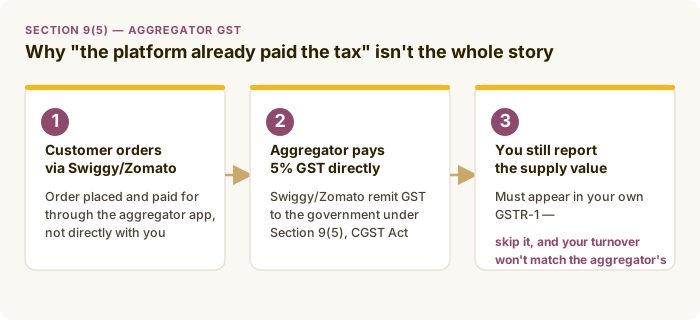
Swiggy and Zomato don’t deduct a slice of tax from your payout the way a goods marketplace like Amazon does — that’s a different mechanism (TCS under Section 52) that doesn’t apply to restaurant orders at all. Instead, under Section 9(5) of the CGST Act, the platform is treated as the deemed supplier for food delivery orders placed through the app: it collects 5% GST straight from the customer and pays it to the government directly, with no input tax credit available to the platform on it. There’s no TCS and no GSTR-8 involved here. What you’re still responsible for is showing the value of these orders correctly in your own GSTR-3B — in the specific table for supplies where the e-commerce operator pays the tax — kept separate from your dine-in and takeaway sales, where the usual rules and rate still apply to you directly.
What we actually do for Alwarpet’s restaurants and kitchens
- Monthly reconciliation against Swiggy/Zomato reports — checked against your filing before we submit anything.
- Clean separation of direct and aggregator sales — reported in the correct table, every month.
- Multi-brand, multi-account handling — if you run more than one concept from a shared kitchen, both accounts reconciled together.
- Rate checking on direct sales — confirming 5% versus 18% applies correctly to your setup.
- Direct access to your consultant — the same person, every month, over WhatsApp.
Pricing — fixed, no hidden charges
GST return filing starts at ₹5,990 + GST per year for up to 30 bills a month. Running multiple concepts or high aggregator volume? Call 70 9232 9232 for a fair quote based on your real numbers — fixed pricing either way.
How it actually works once you call
Call or WhatsApp 70 9232 9232 and we’ll start with the basics — how many concepts or brands you’re running, what share of orders come through the apps versus dine-in, roughly how many bills a month. We ask for read access to your Swiggy and Zomato reports plus your existing sales records, and the first month goes into building a clean baseline — separating direct and aggregator sales properly and checking a few months back for anything unreported. From there it’s routine: you send your monthly numbers over WhatsApp, we reconcile against both platforms’ reporting, and file on schedule. For restaurant groups running more than one concept out of Alwarpet, this is usually the first time both brands’ numbers have actually been checked together properly.
Mistakes we see Alwarpet’s restaurants make
1. Assuming aggregator tax being paid means nothing to report
Swiggy or Zomato paying the tax on an order doesn’t remove it from your own filing. It still needs to be declared, in the right place, and this single assumption is behind most of the notices we see restaurants get.
2. Blending two restaurant brands into one filing without separating accounts
If you’re running a dine-in concept and a delivery-only sister brand from the same kitchen, each needs to be reconciled against its own Swiggy/Zomato account — lumping them together makes it nearly impossible to catch a mismatch. Call 70 9232 9232 if you’d like us to check your current setup.
3. Applying the wrong GST rate on premium dine-in service
The 18%-with-ITC rate is meant for restaurant services at specified premises — hotels charging above ₹7,500 a night — not simply because a restaurant markets itself as premium. Most standalone restaurants, however upscale, still fall under the 5%-no-ITC rate.
Frequently asked questions
Do I charge GST on Swiggy or Zomato orders myself?
No. Under Section 9(5) of the CGST Act, the platform is the deemed supplier for these orders and pays 5% GST directly to the government. You don’t collect or pay tax on these specific orders.
So if I don’t pay the tax, why does it need to appear in my filing at all?
Because you still need to declare the value of these orders in your GSTR-3B, in the right table, even though the tax itself is paid by the platform. This is the single most common thing restaurants get wrong.
I run two restaurant concepts from one kitchen — do I need two GST numbers?
Not if both operate under the same legal business from one physical location — one GSTIN covers both as additional trade names, but each brand’s Swiggy/Zomato account needs to be reconciled correctly against the combined filing.
What rate should I charge on dine-in orders?
Most standalone restaurants and cafes charge 5% with no input tax credit. 18% with ITC generally applies only at specified premises — hotels with room rates above ₹7,500 a night.
How much does filing cost?
From ₹5,990 + GST per year for up to 30 bills a month. Running higher volume or multiple concepts gets a custom quote — call 70 9232 9232.
Do you work with cafes as well as full restaurants?
Yes — the same filing rules apply whether you’re a full-service restaurant, a cafe, or a delivery-only cloud kitchen, and we work with all three around Alwarpet.
I’ve received a GST notice about unreported orders — can you take over from here?
Yes. Call 70 9232 9232 and bring the notice — we’ll pinpoint exactly what’s missing and respond correctly within the deadline given.
Can I file quarterly if my turnover is on the smaller side?
If you qualify for the QRMP scheme, yes — quarterly returns with monthly tax payments. Call 70 9232 9232 to check if you qualify.
Related guides
- GST Return Filing for Swiggy & Zomato Restaurant Partners (Chennai-wide guide)
- GSTR-3B Late Fees, Interest & Penalties Explained
- GST Return Filing for Restaurants & Cloud Kitchens in Chennai
- GST Return Filing in Alwarpet, Chennai
- GST Return Filing for Swiggy & Zomato Restaurant Partners in Teynampet
- GST Registration for Swiggy & Zomato Restaurant Partners in Alwarpet
Talk to a consultant, not a call centre
Running a restaurant, cafe, or cloud kitchen on TTK Road or Chamiers Road? Call or WhatsApp 70 9232 9232 and get your Swiggy and Zomato orders reported correctly every month. Rated 5.0★ across 1,000+ Google reviews, since 2017.
Not registered yet, or launching a second concept from your kitchen? See GST Registration for Swiggy & Zomato Restaurant Partners — from ₹1,500 + GST.