
If your restaurant or cloud kitchen takes orders through Swiggy or Zomato, your GST filing has a quirk most owners get wrong the same way: since January 2022, the platform itself pays GST on those specific orders, not you — but you still have to report the value correctly in your own return every month, and skipping that is exactly what draws a notice. This page explains, in plain terms, how Section 9(5) actually works, what still falls on you, and what it costs to have it handled properly — starting at ₹5,990 + GST per year for up to 30 bills a month. If you’d rather just talk it through, call or WhatsApp us on 70 9232 9232.
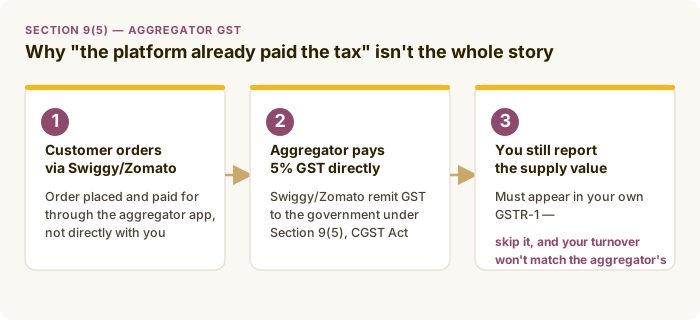
Table of Contents
- How Section 9(5) actually works — and why it’s not TCS
- Multi-outlet and cloud-kitchen brands need extra care here
- Your direct sales follow a different rate than your aggregator orders
- What we actually do for Swiggy & Zomato restaurant partners
- Pricing — fixed, no hidden charges
- 3 mistakes we see restaurants and cloud kitchens make
- 1. Not reporting Swiggy/Zomato orders at all
- 2. Mixing multiple cloud-kitchen brands into one untracked number
- 3. Charging the wrong rate on dine-in or takeaway orders
- Frequently asked questions
- Do Swiggy and Zomato deduct TCS from my payout, like Amazon does?
- If the platform already pays the tax, why do I still need to report the order?
- What GST rate applies to my dine-in and takeaway orders?
- I run two cloud-kitchen brands from one kitchen — do I need two GST registrations?
- How much does GST return filing cost for a restaurant or cloud kitchen?
- Related guides
- Talk to a consultant, not a call centre
- Locality-specific guides for restaurants and cloud kitchens
How Section 9(5) actually works — and why it’s not TCS
A lot of restaurant owners assume Swiggy and Zomato “deduct tax” from their payout the way Amazon does for online sellers — that’s not what happens here. Under Section 9(5) of the CGST Act, food delivery aggregators are treated as the deemed supplier for restaurant orders placed through their apps: they collect 5% GST directly from the customer and pay it to the government themselves, and they don’t get to claim input tax credit on it. There’s no TCS deduction and no GSTR-8 involved for these particular orders — that mechanism is for goods sold through marketplaces like Amazon, not restaurant services under 9(5). What does still fall on you is reporting the value of these orders correctly in your own GSTR-3B, in the specific table meant for supplies where tax is paid by the e-commerce operator — separately from your direct sales, where you remain responsible for charging and paying GST yourself.
Multi-outlet and cloud-kitchen brands need extra care here
If you run more than one outlet, or a cloud-kitchen brand operating out of a shared kitchen space listed separately on Swiggy and Zomato, each additional physical location within Tamil Nadu typically needs to be added as an additional place of business under your existing GSTIN rather than treated as invisible — and if you run outlets in another state entirely, that’s a separate registration, not an add-on. Virtual “kitchen brands” that share one physical kitchen but list as different restaurant names on the apps don’t each need their own GST registration if they’re genuinely the same legal business — but they do need to be reconciled together, correctly, so nothing gets double-counted or missed.
Your direct sales follow a different rate than your aggregator orders
Your own direct sales — dine-in, takeaway, phone orders — aren’t covered by Section 9(5) at all, and follow their own rate rules: most standalone restaurants and cloud kitchens charge 5% GST with no input tax credit. The 18% (with ITC) rate only applies at “specified premises” — broadly, hotel restaurants where any room in the same establishment is priced above ₹7,500 a night. Getting this rate wrong on your direct sales is a completely different mistake from the aggregator-reporting issue above, but it’s just as common, and worth checking even if your Swiggy/Zomato reporting is already clean.
What we actually do for Swiggy & Zomato restaurant partners
- Monthly reconciliation against Swiggy/Zomato reports — checked against your own filing so nothing goes unreported.
- Clean separation of direct sales and aggregator sales — reported correctly, in the right GSTR-3B table, every month.
- Multi-outlet and virtual-kitchen handling — additional places of business added correctly, nothing double-counted.
- Rate checking on your direct sales — confirming 5% versus 18% treatment matches your actual setup.
- Direct access to your consultant — no call centre, no automated menus. You reach the same person every month, on WhatsApp or phone.
Pricing — fixed, no hidden charges
GST return filing starts at ₹5,990 + GST per year for up to 30 bills a month. Running high volume across multiple outlets or cloud-kitchen brands? Call 70 9232 9232 and our sales team will work out a fair price with you directly, based on your real order volume. Fixed pricing, no hidden charges either way.
3 mistakes we see restaurants and cloud kitchens make
1. Not reporting Swiggy/Zomato orders at all
The tax being paid by the platform doesn’t mean the order disappears from your filing. It still needs to show up in your monthly return, in the right place — leaving it out entirely is the single biggest cause of the notices we see.
2. Mixing multiple cloud-kitchen brands into one untracked number
If you’re running two or three virtual brands out of the same kitchen, each listed separately on the apps, treating them as one blurry total makes it nearly impossible to reconcile against what each brand’s Swiggy or Zomato account actually reports.
3. Charging the wrong rate on dine-in or takeaway orders
Your own direct sales follow separate rules from your aggregator orders, and most standalone restaurants and cloud kitchens should be charging 5% with no input tax credit on them. Getting this rate wrong is a different problem from the aggregator reporting issue, but it’s just as common.
Frequently asked questions
Do Swiggy and Zomato deduct TCS from my payout, like Amazon does?
No. Restaurant orders through Swiggy and Zomato fall under Section 9(5) of the CGST Act, not the TCS mechanism used for marketplaces like Amazon. The platform itself pays 5% GST directly to the government as the deemed supplier — there’s no deduction from your payout and no GSTR-8 involved for these orders.
If the platform already pays the tax, why do I still need to report the order?
Because the value still needs to appear in your own GSTR-3B, in the table meant for supplies where tax is paid by the e-commerce operator. Skipping this is the single most common mistake we see, and the one that actually draws a notice.
What GST rate applies to my dine-in and takeaway orders?
Most standalone restaurants and cloud kitchens charge 5% GST with no input tax credit on their direct sales. The 18% (with ITC) rate only applies at specified premises — broadly, hotel restaurants where any room in the same establishment is priced above ₹7,500 a night.
I run two cloud-kitchen brands from one kitchen — do I need two GST registrations?
Not if they’re genuinely the same legal business — but they do need to be reconciled together correctly against each brand’s own Swiggy/Zomato reporting, so nothing gets double-counted or missed.
How much does GST return filing cost for a restaurant or cloud kitchen?
GST return filing starts at ₹5,990 + GST per year for up to 30 bills a month. Above that volume, call 70 9232 9232 and our sales team will give you a fair price based on your real order volume — fixed pricing either way.
Related guides
Not registered yet, or opening a second outlet? See GST Registration for Restaurants & Cloud Kitchens — from ₹1,500 + GST. GST filing looks different depending on your business — here’s how it works for other industries we cover:
- GST Return Filing for Amazon, Flipkart & Meesho Sellers
- GST Return Filing for Contractors
- GST Return Filing for Manufacturers & Exporters
- GST Return Filing for Architects, Interior Designers & Civil Engineers
Talk to a consultant, not a call centre
If you run a restaurant or cloud kitchen in Chennai and want someone actually checking your aggregator orders every month instead of just filing on autopilot, call or WhatsApp us at 70 9232 9232. We’re rated 5.0★ across 1,000+ Google reviews, and we’ve been doing this since 2017 — you’ll speak directly to the consultant who handles your filing, every time, not a rotating support queue.
Already registered for GST and just need filing for other services? See our full GST Return Filing service. Got a GST notice about a Swiggy/Zomato reporting gap? See our GST Notice Reply guide.
Locality-specific guides for restaurants and cloud kitchens
Based in a specific part of Chennai? These cover the same Section 9(5) mechanics and multi-outlet handling with local detail added in: Teynampet, Alwarpet, Mylapore, Nandanam, R.A. Puram, Saidapet, T Nagar, Parrys Corner, Mannadi, Ritchie Street, Chromepet, Tambaram.