
If you’re a manufacturer or exporter in Chennai, there’s a good chance you have money sitting with the government right now that you haven’t claimed back. When you export goods, the government doesn’t charge GST on that sale — but the tax you already paid on your raw materials, packaging, and other business costs is refundable, and a lot of businesses leave that money unclaimed simply because the paperwork wasn’t filed correctly or on time. This page explains, in plain terms, what actually goes wrong — and what it costs to have it handled properly, starting at ₹5,990 + GST per year for up to 30 bills a month. Prefer to just call? Reach us on 70 9232 9232.
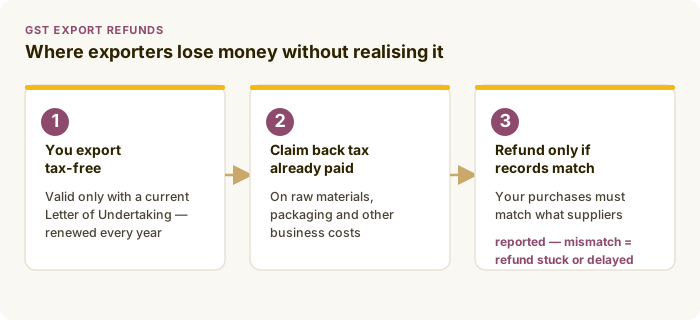
Table of Contents
- Why manufacturer and exporter GST filing is genuinely different
- The LUT has to be renewed every year — and if it lapses, you start paying tax you shouldn’t
- Getting your refund actually paid out is its own separate battle
- Your export paperwork and your GST filing have to tell the same story
- What we actually do for manufacturers and exporters
- A second refund most manufacturers don’t know to claim
- Job work deadlines feed directly into your filing
- HSN digit requirements scale with both turnover and export status
- E-invoicing — once it applies, it doesn’t switch off
- Pricing — fixed, no hidden charges
- 3 mistakes we see manufacturers and exporters make
- 1. Letting the Letter of Undertaking lapse
- 2. Not checking supplier mismatches before claiming a refund
- 3. Letting shipping records and GST filing drift apart
- Frequently asked questions
- Do I have to pay GST on goods I export?
- What is a Letter of Undertaking, and how often do I need to renew it?
- Why is my GST refund taking so long to come through?
- What does GST return filing cost for a manufacturer or exporter?
- Do you only work with exporters in Chennai, or across Tamil Nadu too?
- Does the inverted duty refund apply automatically, or do I need to claim it?
- Do supplies to an SEZ unit count as exports for GST purposes?
- Do I need an e-way bill for moving goods between my own two factories?
- Related guides
- Talk to a consultant who actually tracks your refunds, not a call centre
- Worked Example: Inverted Duty Structure Refund
- Deemed Exports and Supplies to SEZ Units
- GSTR-9/9C for Manufacturers Crossing the Threshold
- Stock Transfers Between Your Own Factories
- What We Check Every Month, Before Filing
- Refund Processing Timelines — What to Actually Expect
- Export Documentation Beyond the LUT
- Job Work Returns — What Happens If the Deadline Is Missed
- Currency Fluctuation and Export Invoicing
Why manufacturer and exporter GST filing is genuinely different
Exports are treated specially under GST law — you don’t charge your foreign buyer any GST on the sale. But that doesn’t mean the tax you paid earlier in the process just disappears. You’re entitled to get it back, in one of two ways: either you sign a yearly form (called a Letter of Undertaking, or LUT) that lets you export without paying tax upfront at all, and then claim back the tax you paid on your raw materials and costs — or you pay the tax on the export and claim a full refund of that afterwards. Most exporters choose the LUT route, since it doesn’t tie up cash upfront.
The LUT has to be renewed every year — and if it lapses, you start paying tax you shouldn’t
This is the single most common gap we find. The Letter of Undertaking isn’t a one-time form — it has to be renewed at the start of every financial year. If it lapses and nobody notices, you’re required to pay GST on your exports until a new one is filed, even though you’re legally entitled to export tax-free. We’ve seen exporters pay tax unnecessarily for months simply because their LUT quietly expired and nobody was tracking the renewal date.
Getting your refund actually paid out is its own separate battle
Claiming a refund of the tax you paid on raw materials isn’t automatic — it depends on your purchase records matching what your suppliers have reported to the government. If a supplier is late filing their own return, or reports a slightly different figure, your refund claim can get held up or rejected until it’s sorted out. Manufacturers who don’t check this every month often find a large refund stuck for far longer than it should be, simply because nobody caught the mismatch early.
Your export paperwork and your GST filing have to tell the same story
The shipping documents you file with customs and the sales figures you report in your GST filing need to match. Even small differences — a rounding issue, a shipment reported in the wrong month — can delay a refund or draw a query from the tax department. This matters more for manufacturers shipping in bulk, where a small percentage error can still be a meaningful amount of money.
What we actually do for manufacturers and exporters
- LUT renewal tracking — we renew your Letter of Undertaking every financial year before it lapses, so you never end up paying tax you don’t owe.
- Monthly refund-eligibility checking — we match your purchase records against what your suppliers have actually reported, so refund claims don’t get stuck on preventable mismatches.
- Export documentation matching — your shipping records and GST filing kept consistent, month to month.
- GST return filing — filed correctly and on time, every month.
- Direct access to your consultant — no call centre, no automated menus, the same person every month.
A second refund most manufacturers don’t know to claim
Export refunds aren’t the only money manufacturers leave unclaimed. If the GST rate on your raw materials is higher than the rate on your finished output — common in several manufacturing categories — you can accumulate more input tax credit than you’ll ever use against your output liability. This is called an inverted duty structure, and the excess credit is refundable on its own, separately from anything export-related. A recent rule change (effective October 2025) allows a 90% provisional refund of that accumulated credit, processed faster than the older full-verification route — worth checking even if you’re not currently claiming export refunds, since this applies whether or not you export at all. One condition: you can’t claim this on supplies where you’ve also taken export duty drawback, so it’s worth flagging both scenarios to whoever’s filing your returns.
Job work deadlines feed directly into your filing
If you send inputs or capital goods to a job worker for processing, GST law gives you a window to get them back — 1 year for inputs, 3 years for capital goods (moulds, dies, jigs, fixtures, and tools are exempt from the 3-year limit) — without treating the dispatch as a taxable supply. Miss that window and the original dispatch becomes a deemed supply retroactively, with GST plus 18% interest due from the original send-out date, not from when the deadline lapsed. This has to be tracked and reflected correctly in your returns; a job-work relationship that’s run for years without anyone checking these deadlines is exactly the kind of thing that surfaces as a large, unexpected liability during a departmental review.
HSN digit requirements scale with both turnover and export status
Your invoices need 4-digit HSN codes up to ₹5 crore turnover, 6-digit above that — but export and import transactions need 8-digit codes regardless of your overall turnover. Reporting inconsistently between your domestic and export invoices (a common gap when a business scales into exporting without updating its invoicing setup) creates a classification mismatch that can complicate both routine GSTR-1 filing and refund processing. We check this specifically whenever a manufacturer’s export volume changes meaningfully.
E-invoicing — once it applies, it doesn’t switch off
B2B e-invoicing becomes mandatory once your aggregate annual turnover crosses ₹5 crore in any financial year since GST began, calculated at the PAN level across all your GST registrations combined. The detail that catches manufacturers out during filing: once you’ve crossed that threshold even once, e-invoicing stays mandatory going forward, even in a quieter year when turnover dips back below ₹5 crore. Invoices raised without proper e-invoicing (once you’re covered by the mandate) aren’t treated as valid tax invoices for ITC purposes on the recipient’s side — meaning a lapse here doesn’t just create a compliance gap for you, it can cost your buyers their input credit too, which is exactly the kind of thing that damages a supplier relationship. We check this status as part of every filing cycle, not just once at onboarding.
Pricing — fixed, no hidden charges
GST return filing starts at ₹5,990 + GST per year for up to 30 bills a month. Manufacturers and exporters often run higher transaction volumes and more complex refund claims — call 70 9232 9232 and our sales team will work out a fair price with you directly, based on your real volume. Fixed pricing, no hidden charges either way.
3 mistakes we see manufacturers and exporters make
1. Letting the Letter of Undertaking lapse
This is the single biggest and most avoidable mistake. It has to be renewed every financial year, and missing the renewal means paying tax you’re legally entitled to skip.
2. Not checking supplier mismatches before claiming a refund
If your suppliers haven’t filed their own returns correctly or on time, your refund claim can be held up through no fault of your own — but only if nobody’s checking for this every month.
3. Letting shipping records and GST filing drift apart
Small, uncorrected differences between what customs shows and what your GST filing shows add up over time, and can delay or shrink a refund that’s rightfully yours.
Curious what a missed deadline would actually cost? Check our GST Late Fee Calculator.
Frequently asked questions
Do I have to pay GST on goods I export?
No — exports are tax-free for your foreign buyer. But you can only skip paying tax upfront if you have a valid Letter of Undertaking (a yearly form) on file. Without it, you’re required to pay tax on the export and claim it back afterwards, which ties up your cash unnecessarily.
What is a Letter of Undertaking, and how often do I need to renew it?
It’s a form that lets you export without paying GST upfront. It has to be renewed at the start of every financial year — if it lapses, you’re required to pay tax on your exports until a new one is filed.
Why is my GST refund taking so long to come through?
Usually because of a mismatch between your purchase records and what your suppliers have reported to the government. This needs to be checked and corrected before filing the refund claim, not after it’s already stuck in process.
What does GST return filing cost for a manufacturer or exporter?
GST return filing starts at ₹5,990 + GST per year for up to 30 bills a month. Above that volume, call 70 9232 9232 and our sales team will give you a fair price based on your real transaction volume — fixed pricing either way.
Do you only work with exporters in Chennai, or across Tamil Nadu too?
We’re based in Teynampet, Chennai, and work with manufacturers and exporters across Tamil Nadu. Everything is handled over phone and WhatsApp, so your location doesn’t affect how we work with you.
Does the inverted duty refund apply automatically, or do I need to claim it?
You need to actively claim it through the refund application process under Section 54(3). It doesn’t automatically credit back — unclaimed, the excess credit just sits carried forward indefinitely.
Do supplies to an SEZ unit count as exports for GST purposes?
Yes, they’re treated as zero-rated like a genuine export, provided you have the correct SEZ endorsement and documentation proving the supply qualifies — the paperwork is what determines eligibility, not just the buyer’s SEZ status.
Do I need an e-way bill for moving goods between my own two factories?
Yes, above the value threshold, even though no sale is happening — inter-branch stock transfers still need a compliant document (delivery challan or tax invoice) and an e-way bill where applicable.
Related guides
GST filing looks different depending on your business — here’s how it works for other industries we cover:
- GST Return Filing for Amazon, Flipkart & Meesho Sellers
- GST Return Filing for Contractors
- GST Return Filing for Restaurants & Cloud Kitchens
- GST Return Filing for Architects, Interior Designers & Civil Engineers
Talk to a consultant who actually tracks your refunds, not a call centre
If you’re a manufacturer or exporter in Chennai and want your refunds and renewals actually tracked every month instead of forgotten until money’s already been lost, call or WhatsApp us at 70 9232 9232. We’re rated 5.0★ across 1,000+ Google reviews, serving Chennai and Tamil Nadu businesses since 2017 — you’ll speak directly to the consultant handling your filing, not a rotating support queue.
Reconciling ITC across multiple vendors and states? See our GST Reconciliation & ITC mismatch guide.
Setting up a new manufacturing or export entity? GST Registration starts at ₹1,500 + GST. Already registered and just need ongoing filing? See our full GST Return Filing service.
Worked Example: Inverted Duty Structure Refund
Say a Chennai manufacturer buys raw materials taxed at 18% GST, but the finished product they sell is taxed at only 12% — a classic inverted duty structure. If they purchase ₹10,00,000 in materials (₹1,80,000 GST paid) and sell the finished goods for ₹9,50,000 (₹1,14,000 GST collected), the manufacturer has accumulated ₹66,000 more in input credit than they owe in output tax for that period. This ₹66,000 is refundable under Section 54(3), but only if actively claimed through the refund application process — it does not automatically credit back. Manufacturers who don’t realise this refund exists simply carry the excess credit forward indefinitely, effectively leaving real cash tied up with the government instead of claiming it back.
Deemed Exports and Supplies to SEZ Units
If you supply goods to a Special Economic Zone (SEZ) unit or under a deemed-export notification, these are treated as zero-rated (like a genuine export) even though the goods physically stay within India. This means the same LUT mechanism that lets you export without paying tax upfront also applies to qualifying SEZ and deemed-export supplies — but the paperwork proving the supply qualifies (SEZ endorsement, deemed-export certification) is what determines whether you actually get this treatment, not just the fact that the buyer happens to be an SEZ unit. We check this documentation before filing, not after a refund claim gets rejected for missing proof.
GSTR-9/9C for Manufacturers Crossing the Threshold
Manufacturing businesses have more moving pieces at annual-reconciliation time than most: export turnover under LUT, domestic sales at standard rates, inverted-duty refund claims, job-work movements, and capital goods ITC all need to tie out correctly across the full year once you cross ₹2 crore (GSTR-9 mandatory) or ₹5 crore (GSTR-9C reconciliation statement also required). A manufacturer who has been claiming inverted-duty refunds monthly still needs these to reconcile cleanly against the annual figures — a mismatch here can trigger a review of refunds already paid out, not just a routine annual filing.
Stock Transfers Between Your Own Factories
Moving goods between your own factories or warehouses in different states, even though no sale is happening, still requires a GST-compliant document (a delivery challan or tax invoice, depending on the specific transfer type) and, above the value threshold, an e-way bill — inter-branch stock transfers are not exempt just because no money changes hands between the locations. Manufacturers with multiple facilities sometimes underestimate this, treating internal transfers as informal movements that don’t need the same documentation as an actual sale.
What We Check Every Month, Before Filing
For every manufacturer and exporter client, our monthly process checks: whether the inverted duty refund has been correctly identified and claimed rather than left as carried-forward credit, whether job-work materials sent out are tracked against their return deadlines, whether SEZ or deemed-export supplies have the correct supporting documentation attached, and whether e-invoicing (once applicable) is correctly generated for every eligible transaction, not just some of them. Missing any one of these consistently costs real money over a year, not just a single filing period.
Refund Processing Timelines — What to Actually Expect
GST refund applications, including the inverted duty structure refund, typically take 60 days from a complete application for the department to process, though this can extend if the application is incomplete or the officer raises a query. Filing a clean, complete application the first time — rather than one that gets queried and has to be resubmitted — is the single biggest factor in how fast a refund actually arrives, more so than any inherent processing speed difference between refund types.
Export Documentation Beyond the LUT
Beyond the LUT itself, a genuine export needs supporting shipping documentation — the shipping bill, bill of lading or airway bill, and export invoice all need to align with what’s declared in your GST filing. A mismatch between your GST-reported export value and your customs documentation is a real risk area, since these two systems are cross-checked, and an exporter whose GST filing and customs paperwork tell slightly different stories is exactly the kind of pattern that draws scrutiny.
Job Work Returns — What Happens If the Deadline Is Missed
Materials sent for job work need to return (or be supplied directly from the job worker’s premises) within 1 year for inputs and 3 years for capital goods, or the movement is treated as a deemed supply, triggering GST liability on the original manufacturer as if the goods had been sold. Missing this deadline isn’t just a paperwork lapse — it creates a real, avoidable tax liability on goods that never actually left your ownership in any commercial sense. Tracking job-work deadlines is exactly the kind of detail that gets lost when materials are sent to multiple job workers across a busy production cycle, which is why we track it as a standing checklist item, not something reconstructed only when a deadline is already close.
Running a factory, an export operation, or both — call 70 9232 9232 and we will tell you exactly what your monthly filing needs to cover, refunds included.
Currency Fluctuation and Export Invoicing
Export invoices are typically raised in foreign currency, and the GST value reported needs to use the exchange rate applicable on the date of supply, as prescribed under GST valuation rules — not whatever rate you happen to notice when you sit down to file weeks later. A manufacturer converting invoices at an inconsistent or incorrect rate creates a mismatch between the declared GST value and what customs or banking records show for the same transaction, which is exactly the kind of cross-system inconsistency that draws attention.
Fixed, transparent pricing, and a team that tracks your refunds as actively as your filing deadlines — not treating a refund claim as optional extra work once the basic filing is done.
We are four floors above Teynampet Metro, rated 5.0 stars across 1,000+ Google reviews, serving Chennai manufacturers and exporters since 2017 with straight answers on refunds, not vague reassurances.
We tell you what is possible, not what you want to hear, on refund timelines, penalties, and what GST actually requires from your specific manufacturing setup.