
Sowcarpet, and Mint Street specifically, is Chennai’s biggest textile and saree wholesale corridor — the Marwadi and Gujarati trading community here has run fabric, saree, lehenga choli, and salwar wholesale out of Mint Street, Godown Street, and the surrounding lanes for generations. If you wholesale sarees, lehenga cholis, salwar suits, or fabric out of Sowcarpet, your GST filing has its own real complications — job-work reconciliation for embroidery and zari work, multiple GST rates within the same shipment, and dealing with the man-made-fibre rate correction that changed in 2025.
We file for Sowcarpet wholesalers — call 70 9232 9232 and we’ll tell you exactly what your filing involves, not a generic quote.
Why textile and saree wholesale filing is different
A generalist filer treats every invoice the same way. A Sowcarpet saree or lehenga wholesaler’s books don’t work like that — three things make this trade genuinely different from ordinary retail filing.
1. Job work in and out, constantly
Plain fabric goes out to an embroidery or zari unit and comes back as a finished lehenga or saree — often multiple times, across multiple small job-workers, some of them not GST-registered at all. Under Section 143, goods sent for job work don’t attract GST at the point of dispatch if they come back within the prescribed time (1 year for inputs, 3 years for capital goods) — but every dispatch and every return has to be tracked with a delivery challan, and if the goods don’t come back in time, it’s treated as a deemed supply and GST becomes payable retroactively. Most Sowcarpet job-work tracking is still done on paper or in a notebook — the same books that feed your GSTR-1 and GSTR-3B. Get the challan trail wrong and you either overpay tax on goods that never left ownership, or miss a deemed-supply trigger that surfaces as a notice months later.
2. Multiple GST rates in the same shipment
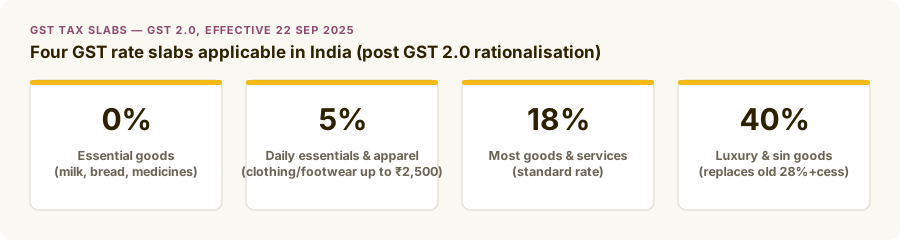
A single lehenga choli order can carry three different GST rates at once — the fabric, the finished garment, and any accessories (dupatta borders, lace, trims) can each fall under a different HSN code and rate. On top of that, GST 2.0 (effective September 2025) restructured apparel pricing: garments priced up to ₹2,500 are taxed at 5%, and anything above ₹2,500 is taxed at 18% — a much sharper jump than the old ₹1,000 cutoff, and one that matters a great deal for bridal and festive lehengas, which routinely cross that line. Get the per-piece pricing tier wrong on even a handful of invoices in a month and your GSTR-1 output tax simply won’t match what you actually collected.
3. The man-made fibre rate correction (2025)
Georgette, chiffon, net, and other synthetic fabrics common in sarees and lehengas used to sit in a genuine inverted-duty trap — the raw synthetic yarn was taxed higher (12–18%) than the finished fabric (5%), so ITC piled up faster than it could be used. GST 2.0 corrected this in September 2025, cutting man-made fibre and yarn to 5% to match the fabric rate. If you’re still carrying old accumulated ITC from before the correction, that’s a real refund opportunity under Section 54(3) — most wholesalers never claim it because nobody flags it during routine filing.
A worked example
A Mint Street wholesaler sends plain georgette fabric worth ₹80,000 out for zari embroidery to two different job-workers in the same month, and separately sells 40 finished lehenga cholis — 25 priced under ₹2,500 (taxed at 5%) and 15 priced above ₹2,500 (taxed at 18%). If the job-work challans aren’t tracked properly, the ₹80,000 in fabric can get counted as a taxable outward supply by mistake — an unnecessary tax outgo of roughly ₹4,000 at 5%. And if the 15 higher-priced lehengas get billed at the old 5% rate instead of 18%, that’s a genuine short-payment the department will eventually catch through GSTR-1 vs GSTR-3B mismatch. Correct filing avoids both.
3 mistakes we see most often
- No delivery challan trail for job work. Fabric goes out and comes back tracked only in a personal notebook — if it’s ever questioned, there’s no documentary proof it wasn’t a taxable sale.
- One blanket GST rate applied to every invoice. Billing every saree or lehenga at 5% regardless of price, missing the ₹2,500 cutoff on higher-value festive and bridal pieces.
- Old accumulated ITC left unclaimed. Refund-eligible input credit from the pre-2025 inverted duty period sitting unclaimed because nobody checked whether it qualifies under Section 54(3).
What we actually do
We reconcile your job-work challans against what actually left and returned to your shop, apply the correct rate tier per invoice instead of one blanket rate, check whether you have pre-2025 ITC sitting unclaimed, and file GSTR-1 and GSTR-3B on time every month. Fixed pricing at ₹5,990/year for up to 30 bills a month, tiered above that. Call 70 9232 9232 and we’ll walk through your actual invoice mix before quoting anything.
Frequently asked questions
Talk to a consultant, not a call centre
Fixed, transparent pricing. Direct access to your consultant — no IVR, no ticket queue. Call 70 9232 9232 or visit us at 4th Floor, Fathima Akthar Court, 453 Anna Salai, Teynampet, Chennai – 600018 (next to Teynampet Metro, B1 Exit).