
Sembudoss Street businesses never need to visit our office to get GST filing sorted — everything is handled over phone and WhatsApp. GST return filing starts at ₹5,990 + GST per year for up to 30 bills a month. Call 70 9232 9232.
Sembudoss Street: iron & steel trade, and what filing looks like here
Sembudoss Street, in the heart of George Town, is one of Chennai’s oldest iron and steel wholesale markets — rods, pipes, sheets, angles, and iron grills move through here in volume, mostly B2B, mostly on thin per-unit margins made up in bulk. Filing for a Sembudoss Street business isn’t like filing for a retail shop: the same firm often buys and sells both new stock and metal scrap side by side, and those two activities are taxed under completely different mechanisms — getting that distinction wrong is the single most common mistake we see here.
New stock vs. scrap — two different GST worlds under one roof
New iron and steel — rods, sheets, pipes, structural material — is taxed the ordinary way: 18% GST, charged forward by the seller, claimed as ITC by the buyer, reported in GSTR-1 and GSTR-3B like any other sale. Straightforward.
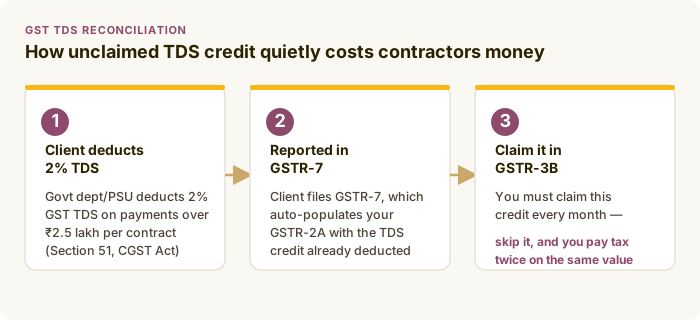
Metal scrap is different, and this is where Sembudoss Street businesses most often trip up. Since October 2024, when a registered business buys scrap (iron, steel, copper, aluminium, and similar metals) from an unregistered supplier, the buyer — not the seller — is liable to pay GST directly to the government under reverse charge (RCM), at 18% on scrap under HSN 7204. This applies even if the unregistered seller is well under the ₹40 lakh registration threshold. On top of that, when scrap is traded between two registered businesses, a separate 2% TDS under Section 51 applies on the transaction value, deducted and reported by the buyer. Missing either of these — treating scrap purchases like ordinary forward-charge purchases, or forgetting the TDS deduction on a registered-to-registered scrap sale — is exactly the kind of gap that shows up as a mismatch months later.
Heavy goods, weight-based transport, and e-way bills
Steel and iron move by weight, not by piece count, and a single Sembudoss Street consignment can easily cross the ₹50,000 e-way bill threshold on a modest number of rods or sheets. We check that every outbound and inbound e-way bill matches the actual invoice value and transport details before it becomes a discrepancy an officer flags later — a mismatch here is one of the more common triggers for a scrutiny notice in bulk-goods trade.
What we actually do
- New-stock vs. scrap classification — correctly separated at the point of filing, not sorted out after a notice arrives.
- RCM on scrap from unregistered sellers — calculated and paid correctly, ITC claimed where eligible.
- 2% TDS under Section 51 — tracked and reconciled on registered-to-registered scrap transactions.
- Monthly reconciliation — your sales and purchase records checked against GSTR-2B before we file.
- GSTR-1 and GSTR-3B filing — on the correct schedule for your turnover.
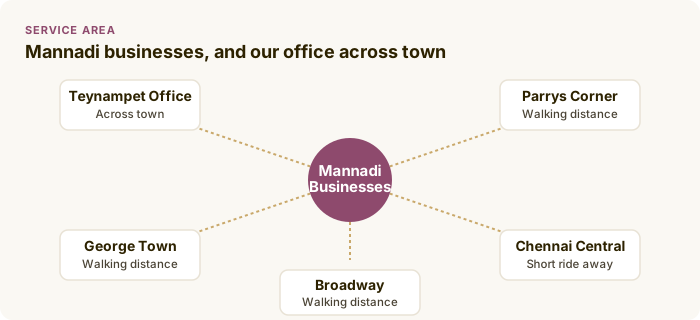
- Everything handled remotely by default — you never have to leave Sembudoss Street to get your GST filed.
A worked example: mixed new-stock and scrap trading
Say a Sembudoss Street trader sells ₹8 lakh of new steel rods in a month (forward-charge, 18% GST charged to customers as usual) and separately buys ₹1.5 lakh of scrap from an unregistered local collector. On the rod sales, nothing unusual — GSTR-1 and GSTR-3B as normal. On the scrap purchase, the trader owes 18% GST (₹27,000) directly to the government under reverse charge, payable and reported in that month’s GSTR-3B, separate from the regular sales figures. If that scrap purchase is instead bought from another registered scrap dealer, a 2% TDS (₹3,000 on ₹1.5 lakh) needs to be deducted and reported by the buyer under Section 51 — a completely different mechanism from the RCM case, and the two are easy to confuse if you’re not specifically watching for which applies.
3 mistakes we see most often on Sembudoss Street
- Treating scrap purchases like ordinary purchases — no RCM paid, discovered months later as a liability plus interest.
- Applying RCM logic to a registered-to-registered scrap sale when TDS under Section 51 is what actually applies there, not reverse charge.
- E-way bills raised with rounded or estimated weights that don’t match the actual invoiced quantity on a bulk shipment.
What to have ready before you call
Call 70 9232 9232 with a rough split of your monthly purchases — new stock vs. scrap, and registered vs. unregistered sellers on the scrap side. That single breakdown is usually enough for us to tell you within minutes whether RCM, TDS, both, or neither applies to your specific trade pattern.
Pricing — fixed, no hidden charges
GST return filing starts at ₹5,990 + GST per year for up to 30 bills a month. Given the transaction volume typical of a Sembudoss Street wholesale business, most fall into a higher tier — call 70 9232 9232 and we’ll work out a fair price based on your real transaction volume. Fixed pricing, no hidden charges either way.
Already got a GST notice?
If a scrap-related RCM gap, a TDS mismatch, or an e-way bill discrepancy has already turned into an ASMT-10 or a formal notice, see our dedicated guide: GST notices for iron & steel wholesalers on Sembudoss Street.
Why this trade needs a filer who checks, not just submits
A generalist accountant filing GSTR-3B on autopilot will happily submit whatever numbers a Sembudoss Street trader hands over — without ever asking whether last month’s scrap purchases were from a registered or unregistered seller, or whether TDS was deducted correctly on the registered ones. That gap doesn’t show up immediately; it shows up 6-12 months later as a notice with interest attached. We ask that question every single month, specifically because this trade has two genuinely different tax mechanisms running side by side, and treating them as one is the single biggest source of after-the-fact liability we see on this street.
Frequently asked questions
Does the 2% TDS apply to all my Sembudoss Street sales, or just scrap?
Just metal scrap sold between two registered businesses, under Section 51. New iron and steel — rods, sheets, pipes — is taxed the ordinary way, no TDS.
I buy scrap from small unregistered sellers — do I need to register them?
No, but you become liable to pay 18% GST on that purchase directly under reverse charge, regardless of whether the seller is registered or under the threshold. This is your liability, not theirs.
What does GST return filing cost for a Sembudoss Street business?
Starts at ₹5,990 + GST per year for up to 30 bills a month. Given typical wholesale volumes here, call 70 9232 9232 for a real quote based on your transaction count.
Do I need to visit your office?
No — everything is handled over phone and WhatsApp. Our office is at 4th Floor, Fathima Akthar Court, 453 Anna Salai, Teynampet, open 10 AM to 7 PM for anyone who prefers to walk in.
Talk to a consultant, not a call centre
Whether you’re on Sembudoss Street or elsewhere in George Town, Call 70 9232 9232 and we’ll get your GST filing sorted — including the scrap RCM and TDS mechanics most generalist filers miss. Rated 5.0★ across 1,000+ Google reviews, serving Chennai since 2017.
Based elsewhere in George Town? See our guides for Mannadi and Parrys Corner. Or start with the full GST Return Filing process.