
GST registration is the process of getting your business a GST Identification Number (GSTIN) — the 15-digit number that lets you legally charge GST on sales, claim tax credit on what you buy, and appear as a registered business on your customers’ own GST records. If your turnover crosses ₹40 lakh (₹20 lakh for services, lower in a few special-category states), registration isn’t optional — it’s the law. Getting it done right the first time matters more than getting it done fast: the wrong business constitution, the wrong principal place of business, or a mismatched document can get your application rejected and cost you weeks. We handle the full registration end to end — ₹1,500 + GST for a sole proprietorship, up to ₹2,000 + GST for a private limited company, no hidden charges. Call or WhatsApp us on 70 9232 9232.

Who actually needs to register
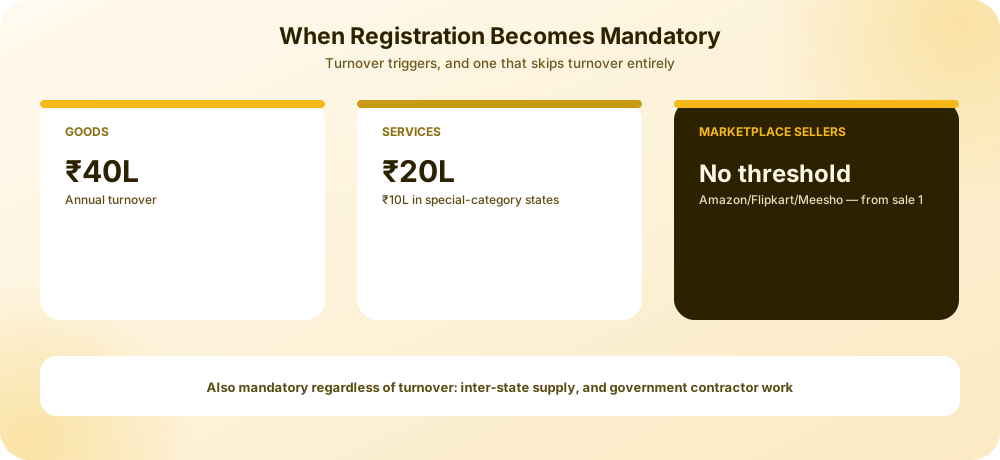
Registration is mandatory once your annual turnover crosses ₹40 lakh for goods (₹20 lakh for services; the threshold drops to ₹10 lakh in a handful of special-category states — mostly the north-eastern and hill states, which does not include Tamil Nadu, so the ₹40 lakh/₹20 lakh figures are what actually apply to every business we register here). But turnover isn’t the only trigger — if you sell on Amazon, Flipkart, or Meesho, registration is required from your very first sale, regardless of turnover, because marketplaces won’t onboard an unregistered seller. The same applies if you supply goods or services across state lines, or if you’re a contractor working for the government. Voluntary registration below the threshold is also common — many businesses register early because larger clients simply won’t work with an unregistered vendor.
What your 15-digit GSTIN actually means
Your GSTIN isn’t a random number — it’s built to be readable. The first 2 digits are your state code (33 for Tamil Nadu), the next 10 are your PAN, the 13th digit reflects how many registrations you hold against that PAN in that state, the 14th is a fixed “Z,” and the 15th is a checksum digit. This matters practically in two ways: any customer or vendor can tell which state you’re registered in just by glancing at your GSTIN, and if you ever hold more than one registration in Tamil Nadu against the same PAN (rare, but it happens with certain business splits), the 13th digit is what distinguishes them.
One business, multiple states — do you need more than one GSTIN?
GST registration is state-specific, not business-specific. If you operate purely out of Chennai — one office, one warehouse, selling from Tamil Nadu — a single GSTIN covers you. But the moment you have a genuine physical presence in another state (a warehouse, a branch office, a construction site for a contractor, an Amazon FBA fulfilment centre holding your stock), you generally need a separate GSTIN for that state, not just an “additional place of business” entry on your existing one. This is a distinction we see trip up e-commerce sellers constantly: opting into Fulfilled-by-Amazon means your stock can sit in a warehouse in Karnataka or Telangana without you ever visiting it, and that alone can trigger a registration requirement there. Multiple GSTINs mean multiple sets of monthly returns, not one consolidated filing — something worth budgeting for before you expand, not after the notice arrives.
What the process actually involves
The application itself is filed entirely online on the government’s GST portal, but “online” doesn’t mean simple. You’re asked to pick a business constitution (proprietorship, partnership, LLP, private limited, and a few others), declare your principal place of business with supporting proof, list every additional place of business you operate from, and upload PAN, address proof, business proof, and a photograph — each in a specific accepted format. A mismatch between what you declare and what your documents actually show is the single biggest reason applications get sent back for clarification or rejected outright, and each round of correction adds days to the timeline.
Documents you’ll need ready
- PAN card — of the business (or proprietor, for a proprietorship).
- Business constitution proof — partnership deed, LLP agreement, or certificate of incorporation, depending on your structure.
- Address proof for your principal place of business — electricity bill, property tax receipt, or rent agreement plus a no-objection certificate if the premises isn’t owned by the business.
- Bank account proof — a cancelled cheque or the first page of your bank passbook.
- Photograph and Aadhaar — of the proprietor, partners, or authorised signatory.
How long it actually takes
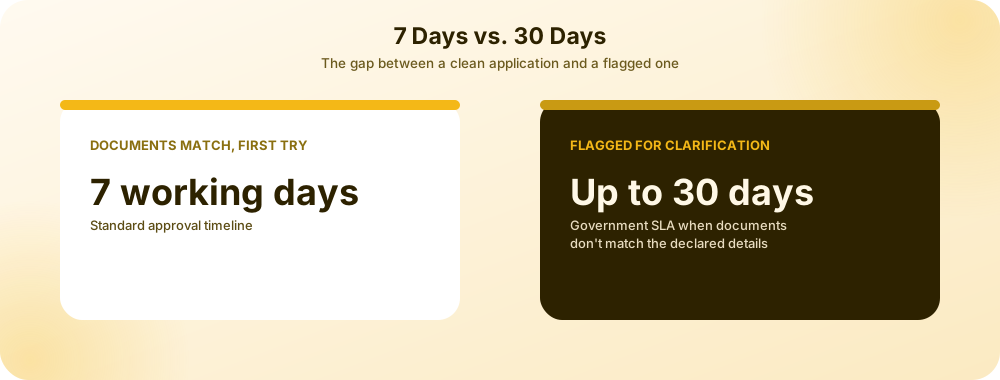
When every document matches and the application is filled correctly the first time, registration is usually approved within 7 working days. The government’s own SLA allows up to 30 days if your application gets flagged for physical verification or additional clarification — which is exactly what happens when there’s a mismatch between what’s declared and what’s documented. Getting it right the first time is the difference between a week and a month. Call 70 9232 9232 and we’ll tell you which timeline applies to your case.
Choosing the right business type — this decision is hard to undo
One of the first choices on the application is your business constitution, and it’s not a formality — it determines your compliance burden for years. A proprietorship is the simplest to register but ties GST liability directly to the individual. A partnership or LLP needs a registered deed before you can even apply. A private limited company needs its incorporation certificate first. Changing your constitution after registration isn’t a quick edit — it typically means cancelling the existing registration and applying fresh, which resets your compliance history and can disrupt input tax credit continuity. We help you get this decision right before the application goes in, not after.
Composition scheme — worth knowing about, even if you don’t choose it
If your turnover is under ₹1.5 crore, you have the option to register under the composition scheme instead of as a regular taxpayer — a flat, lower tax rate in exchange for giving up input tax credit and the ability to sell across state lines. Most of the growing B2B businesses we work with are better off as regular taxpayers precisely because they need input tax credit and interstate selling, but it’s a genuine trade-off worth understanding before you apply, not after you’re locked into a scheme that doesn’t fit how your business actually operates.
Your first 30 days after registration
Getting the GSTIN is the start, not the finish line. From the date your registration is approved, a few obligations kick in immediately: you must start issuing GST-compliant invoices (with your GSTIN, HSN/SAC codes, and the correct tax rate) on every taxable sale from day one, even before your first return is due. You’ll need to update your bank account details on the GST portal within 30 days if you didn’t have one ready at the time of application — a step people often forget once the registration itself is done. And your very first GSTR-3B and GSTR-1 become due on the standard monthly schedule from your registration month, regardless of whether you’ve actually made a sale yet — a “nil” return still has to be filed if there’s nothing to report. If your turnover is genuinely going to stay under ₹5 crore, you can also opt into quarterly filing (QRMP) at this stage rather than defaulting to monthly. We walk every new registration through this checklist before we consider the job done, not just the application itself.
3 mistakes that cost people time and money
1. Declaring a principal place of business the documents don’t support
If your address proof doesn’t clearly match the address you’ve declared — different spelling, an old electricity bill, a rent agreement in a family member’s name without a proper NOC — the application gets flagged. This is the single most common reason for delay, and it’s entirely avoidable with the right paperwork upfront.
2. Picking the wrong business constitution to save a step
Registering as a proprietorship because it’s the fastest option, when the business is actually run as a partnership, creates a mismatch that surfaces later — often when a bank, a client, or an auditor asks for documentation that doesn’t line up with what’s registered.
3. Registering late after marketplace or government contract sales have already started
Selling on Amazon or Flipkart, or supplying to a government department, without registration in place isn’t something that quietly resolves itself — it accumulates as a compliance gap that has to be explained later. Registering before your first sale avoids this entirely. If you’re not sure which of these applies to you, call 70 9232 9232 before you file, not after.
What to check the moment your certificate is issued
When approval comes through, download your registration certificate (Form GST REG-06) immediately and check three things before you file it away: your legal name and trade name are spelled exactly as they appear on your PAN, your principal place of business address matches your actual premises down to the door number, and your business constitution is what you actually intended to register as. Errors here don’t fix themselves — they need a formal amendment application, and a core-field correction like your legal name or address can take up to 15 working days for officer approval, compared to the same-day approval a non-core field change like your mobile number or email gets. We check every certificate against the original application before we hand it over, specifically to catch this at the point it’s cheapest to fix.
Doing it yourself vs. having someone who’s filed thousands of these
The government portal is free to use, and plenty of business owners start there. Where it usually goes wrong isn’t the portal itself — it’s knowing which business constitution fits your actual operating structure, which document format the system will accept without a query, and how to respond correctly when the officer raises a clarification instead of just resubmitting the same thing. We’ve filed this enough times to know what gets flagged before it gets flagged, which is the entire difference between a 7-day approval and a 30-day one.
What delaying registration past your threshold actually costs
GST liability starts from the date you crossed the registration threshold, not the date you eventually register. If you realise six months late that your turnover crossed ₹40 lakh back in month one, you’re still on the hook for tax on everything you sold from that point onward, plus interest at 18% per year on the unpaid amount, plus a penalty that can run up to 10% of the tax due (or ₹10,000, whichever is higher) for genuine delay — and considerably more if the department treats it as deliberate evasion rather than an honest gap. The practical fix, once this is spotted, is a voluntary disclosure and immediate registration rather than waiting for the department to catch it independently, since a self-reported gap is treated very differently from a discovered one. This is exactly why we ask new clients for a rough sales history going back a year, not just current numbers — so we can tell you if this already applies before it becomes a bigger problem.
What we actually do
- Document review before filing — checked against what the application will actually declare, so nothing gets flagged after submission.
- Full application filing — handled entirely by us on the GST portal.
- Clarification handling — if the officer raises a query, we respond on your behalf.
- Everything handled remotely by default — you never have to leave your business to get registered.
- Direct access to your consultant — no call centre, no automated menus, the same person throughout.
Call or WhatsApp 70 9232 9232 to start — we’ll tell you exactly what we need from you first.
Pricing — fixed, no hidden charges
GST registration pricing depends on your business type — fixed by category, no hidden charges:
- Sole Proprietorship: ₹1,500 + GST
- Partnership (up to 2 partners): ₹1,800 + GST
- Private Limited Company (up to 2 directors): ₹2,000 + GST
Call 70 9232 9232 and we’ll tell you exactly what documents you need before we start — no surprises partway through.
Why get registration done by a local consultant
A GST registration filed once and forgotten is exactly how businesses end up with a mismatched principal place of business, a business constitution that doesn’t fit how they actually operate, or a missed multi-state trigger nobody flagged. We’re based four floors above Teynampet Metro, and we don’t just file the application — we tell you what happens after, because registration is the start of a compliance relationship, not a one-time task. If a clarification notice lands six months later because something wasn’t declared quite right, you’re calling the same consultant who filed it, not starting over with a stranger.
Frequently asked questions
How much does GST registration cost?
₹1,500 + GST for a sole proprietorship, ₹1,800 + GST for a partnership (up to 2 partners), and ₹2,000 + GST for a private limited company (up to 2 directors) — fixed pricing by business type, no hidden charges. That covers the full application, document review, and handling any clarification the department raises.
How long does GST registration take?
Usually 7 working days when the documents and declared details match cleanly. It can stretch closer to 30 days if the application is flagged for clarification — which is exactly what we work to avoid by checking everything before we file.
Do I need to register if I’m below the turnover threshold?
Not legally, unless you sell on a marketplace like Amazon or Flipkart, or supply across state lines — both require registration regardless of turnover. Many businesses below the threshold still register voluntarily because larger clients often won’t work with an unregistered vendor.
Do I need to visit your office for registration?
No. Documents can be sent over WhatsApp, and the entire application is filed on your behalf without you needing to be present anywhere. If you’re near our Teynampet office and prefer to hand over paperwork in person, we’re open 10 AM to 7 PM for walk-ins.
What happens if my application gets rejected?
We handle the resubmission or clarification response directly — this is included in the ₹1,500, not billed separately. Most rejections come from document mismatches, which is exactly what our review step before filing is designed to catch.
Talk to a consultant, not a call centre
Call or WhatsApp us at 70 9232 9232 and we’ll tell you exactly what’s needed for your business before we file anything. We’re rated 5.0★ across 1,000+ Google reviews, and we’ve been doing this since 2017 — you’ll speak directly to the consultant handling your application, not a rotating support queue.
Selling on Amazon, Flipkart, or Meesho? See our GST Registration guide for e-commerce sellers — the marketplace registration rules are different from a typical business.
Working government or PSU contracts? See our GST Registration guide for contractors — tender eligibility and multi-state project rules explained.
Running a restaurant or cloud kitchen? See our GST Registration guide for restaurants & cloud kitchens — including the composition scheme decision.
Manufacturing or exporting? See our GST Registration guide for manufacturers & exporters — including LUT eligibility and multi-state factory rules.
Running an architecture, interior design, or civil engineering practice? See our GST Registration guide for professional practices — including the lower services threshold.
Based in Teynampet, Alwarpet, Nandanam, R.A. Puram, Saidapet, Mylapore, T Nagar, Parrys Corner, Mannadi, Ritchie Street, Chromepet, or Tambaram? See our locality guides for Teynampet, Alwarpet, Nandanam, R.A. Puram, Saidapet, Mylapore, T Nagar, Parrys Corner, Mannadi, Ritchie Street, Chromepet, and Tambaram — each with details on office visits and local business patterns.
Already registered and need help with filing instead? See our full GST Return Filing overview, or the industry-specific guides for e-commerce sellers, contractors, restaurants & cloud kitchens, manufacturers & exporters, and architects, interior designers & civil engineers.
Registration for online sellers and restaurants, by locality
Registering to sell on Amazon, Flipkart, or Meesho from Teynampet, Alwarpet, or Mylapore? See Teynampet, Alwarpet, or Mylapore. Opening a restaurant or cloud kitchen for Swiggy and Zomato in one of these areas? See Teynampet, Alwarpet, or Mylapore.
Also filing your annual return? See our GSTR-9 Annual Return and GSTR-9C Reconciliation pages. Need to update your registration details? See GST Amendment. Moving goods? See E-way Bill Generation.
Already received a GST notice?
If a GST notice (ASMT-10, DRC-01, REG-17, or any other) has already landed in your portal, don’t wait — see our plain-English guide to every GST notice type for what it means and exactly what to do next.