
GST return filing means telling the government, every month (or every quarter), exactly what your business sold, what you bought, and how much tax you owe as a result. If you run a real, growing business in Chennai, this isn’t a once-a-year formality — it’s a recurring task that has to be accurate every single time, because small mismatches compound into notices, blocked tax credit, and penalties. This page explains what’s actually involved, in plain language, and what it costs to have it handled properly — starting at ₹5,990 + GST per year for up to 30 bills a month. Prefer to just talk it through? Call or WhatsApp us on 70 9232 9232.
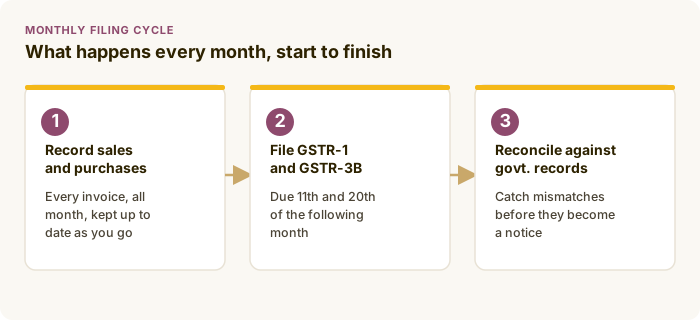
Table of Contents
- What GST return filing actually involves
- Once a year, there’s also an annual summary
- When these returns are due
- What you need to have ready before we file
- Why accurate filing is harder than it sounds
- What late filing actually costs you
- Who exactly needs to file, and how it differs by business type
- How the process actually works once you’re a client
- What we actually do
- Pricing — fixed, no hidden charges
- Filing it yourself vs. having someone check it every month
- 3 mistakes we see across almost every business type
- 1. Filing on time without checking the numbers are actually right
- 2. Claiming tax credit based on your own records instead of the government’s
- 3. Treating a notice as something to panic about instead of just respond to
- Frequently asked questions
- Do I need to file GST returns every month, or is it once a year?
- What happens if I file late?
- Why would I get a GST notice if I’ve been filing on time?
- How much does GST return filing cost?
- Do you only work with businesses in Chennai, or across Tamil Nadu too?
- Can I switch to you mid-year if I’m already filing with someone else?
- What documents do I need to give you every month?
- Talk to a consultant, not a call centre
What GST return filing actually involves
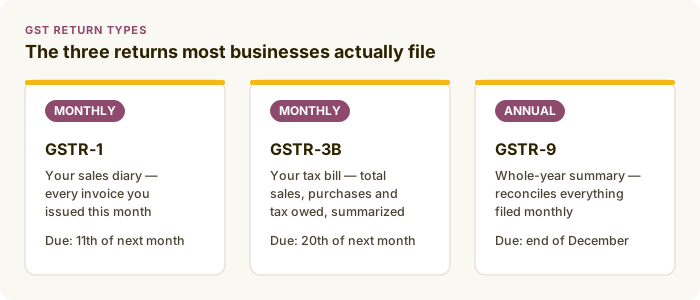
Every GST-registered business has to submit two main reports each month (or quarter, depending on your turnover): one listing everything you sold — called GSTR-1 — and one summarizing your total sales, purchases, and tax due for the period — called GSTR-3B. Think of GSTR-1 as your sales diary and GSTR-3B as your monthly tax bill. Both have to match your actual books, and both have to match what your suppliers and customers have reported on their end — because GST is designed so that everyone’s numbers cross-check each other. That cross-checking is exactly where most businesses run into trouble, not the filing itself.
Once a year, there’s also an annual summary
On top of the monthly filings, most businesses also file an annual return (GSTR-9) that summarizes the entire financial year and reconciles it against everything filed monthly. If your numbers have been accurate all year, this is mostly a formality. If they haven’t, this is usually where the gaps surface.
When these returns are due
For businesses filing monthly, GSTR-1 is due by the 11th of the following month, and GSTR-3B by the 20th. If you qualify for quarterly filing (available to smaller businesses under a scheme called QRMP), GSTR-1 moves to once a quarter, but you still have to pay an estimated tax amount every month — a detail that trips up a lot of businesses who assume “quarterly” means “nothing to do for three months.” The annual return, GSTR-9, is due by the end of December following the financial year.
What you need to have ready before we file
- Sales invoices for the period (or export/report from whatever billing software or marketplace you use)
- Purchase invoices and expense bills you want to claim tax credit against
- Bank statements, for cross-checking payment timing where relevant
- Any notices or communication from the tax department, if there’s an open issue
- Your GST login credentials, or authorization for us to file on your behalf
Most clients send this over WhatsApp every month once we’ve set up a routine — it doesn’t need to be a formal handover each time.
Why accurate filing is harder than it sounds
The actual act of submitting a return on the government portal isn’t complicated. What’s complicated is making sure the numbers going into it are right — and that depends heavily on what kind of business you run. A business selling on Amazon or Flipkart has a completely different set of things to check every month than a government contractor, a restaurant on Swiggy, a manufacturer that exports, or an architect billing project-based work. We’ve written detailed, plain-English guides for each of these, because “file your GST returns” means something different depending on your business:
- GST Return Filing for Amazon, Flipkart & Meesho Sellers — the tax the marketplace deducts on your behalf has to match your own filing every month.
- GST Return Filing for Contractors — government and PSU clients deduct tax on your payments that you have to claim back yourself.
- GST Return Filing for Restaurants & Cloud Kitchens — Swiggy and Zomato pay the tax on delivery orders, but you still have to report the sales.
- GST Return Filing for Manufacturers & Exporters — exports are tax-free, but only if a yearly form is kept current, and refunds depend on your suppliers’ own filing.
- GST Return Filing for Architects, Interior Designers & Civil Engineers — project-based billing has its own rules around tax type and advance payments.
If your business doesn’t fit neatly into one of these, that’s fine too — the core service is the same regardless: we check your actual numbers every month, not just submit whatever you hand us.
What late filing actually costs you
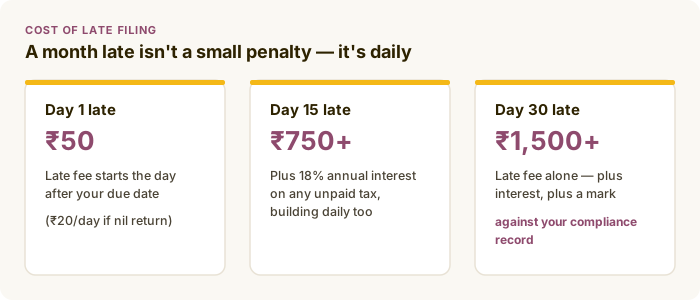
Missing a due date isn’t just a formality — it has a real, calculable cost. Late filing of GSTR-3B attracts a late fee of ₹50 per day for a normal return (₹20 per day if there was no tax due for that period), on top of 18% annual interest on any tax that was actually owed and paid late. These charges apply from the day after the due date until you actually file, so a return that’s a month late isn’t a small penalty — it adds up daily. Beyond the direct cost, a pattern of late filing can also affect how the tax department views your compliance record, which matters if your business is ever selected for closer review.
Who exactly needs to file, and how it differs by business type
Most regular GST-registered businesses file the standard monthly or quarterly cycle described above. But a few categories work differently:
- Composition scheme businesses — smaller businesses that opted for a simplified, flat-rate scheme file a much shorter quarterly statement and one annual return, instead of the full monthly cycle. This suits very small operations, but it comes with real restrictions (no tax credit claims, no selling across state lines), so it’s worth checking whether it actually fits your business before opting in.
- E-commerce sellers — as covered in our Amazon/Flipkart/Meesho guide, marketplace sellers file the standard returns but have an extra reconciliation step against tax the marketplace deducts on their behalf.
- Businesses with no sales in a period — a “nil return” still has to be filed even if you had zero sales or purchases in a month. Skipping it because “there’s nothing to report” still counts as a missed filing.
How the process actually works once you’re a client
There’s no lengthy onboarding process. Once you call or WhatsApp us, here’s what happens:
- A short call to understand your business — what you sell, how you sell it (direct, marketplace, government contracts, project-based), and your rough monthly volume. This is also when we tell you your exact pricing.
- You share your records each month — invoices, purchase bills, and any relevant statements, usually over WhatsApp.
- We reconcile before we file — checking your numbers against what the government’s own systems show, not just accepting your figures as-is.
- We file and confirm — you get a confirmation once GSTR-1 and GSTR-3B are filed, with any issues flagged before they become a problem.
What we actually do
- Monthly reconciliation — your sales and purchase records checked against what the government’s own systems show before we file, not after a notice arrives.
- GSTR-1 and GSTR-3B filing — filed on the correct schedule for your turnover, monthly or quarterly.
- Annual return filing — GSTR-9 prepared and filed at year-end, reconciled against your monthly filings.
- Notice support — if a mismatch does trigger a query from the tax department, we handle the response.
- Direct access to your consultant — no call centre, no automated menus. You reach the same person every month, on WhatsApp or phone.
Pricing — fixed, no hidden charges
GST return filing starts at ₹5,990 + GST per year for up to 30 bills a month — the same transparent, published rate for every business we work with. If your volume runs higher than that, call 70 9232 9232 and our sales team will work out a fair price with you directly, based on your real transaction volume. Fixed pricing, no hidden charges either way.
Filing it yourself vs. having someone check it every month
The GST portal itself is free to use, and nothing stops you from filing your own returns. The real cost of doing it yourself isn’t the filing — it’s not having anyone actively checking your numbers against the government’s records every single month, which is exactly what catches a problem before it becomes a notice.
| Filing it yourself | With myGSTzone | |
|---|---|---|
| Submitting the return | You do it, or your in-house accountant does | We do it for you, every month |
| Checking for mismatches before filing | Only if someone remembers to | Done every month as standard practice |
| If a notice arrives | You’re on your own to respond | We handle the response directly |
| Who you talk to | Depends who’s available | The same consultant, every time |
3 mistakes we see across almost every business type
1. Filing on time without checking the numbers are actually right
Being on time protects you from late fees. It doesn’t protect you from a mismatch notice if the figures themselves are wrong.
2. Claiming tax credit based on your own records instead of the government’s
The credit you’re allowed to claim depends on what your suppliers have reported, not what your own invoice says. These two numbers can differ, and only checking the government’s own record catches it.
3. Treating a notice as something to panic about instead of just respond to
Most GST notices are routine queries about a mismatch, not an accusation. Responding promptly and accurately usually resolves them without penalty — ignoring them is what turns a minor query into a real problem.
Frequently asked questions
Do I need to file GST returns every month, or is it once a year?
It depends on your turnover. Most businesses file two returns a month (GSTR-1 and GSTR-3B), though smaller businesses can opt into a scheme that allows quarterly sales reporting while still paying tax monthly. There’s also one annual summary return (GSTR-9) at year-end.
What happens if I file late?
Late filing attracts a daily penalty and interest on any unpaid tax. Beyond the direct cost, a pattern of late filing can also affect your compliance standing with the tax department, which matters if you’re ever selected for a closer review.
Why would I get a GST notice if I’ve been filing on time?
Timely filing and accurate filing are two different things. Notices are usually triggered by a mismatch between what you’ve reported and what the government’s systems show from your suppliers, customers, or platforms you sell through — not by late submission.
How much does GST return filing cost?
GST return filing starts at ₹5,990 + GST per year for up to 30 bills a month. Above that volume, call 70 9232 9232 and our sales team will give you a fair price based on your real transaction volume — fixed pricing either way.
Do you only work with businesses in Chennai, or across Tamil Nadu too?
We’re based in Teynampet, Chennai — the very next building to Teynampet Metro Station — and work with businesses across Chennai and Tamil Nadu. Everything is handled over phone and WhatsApp, so your location doesn’t affect how we work with you.
Can I switch to you mid-year if I’m already filing with someone else?
Yes. We start by reviewing your filings so far in the financial year to check everything reconciles correctly, then take over from the next filing period. There’s no need to wait for a new financial year to switch.
What documents do I need to give you every month?
Sales invoices for the period, purchase bills you want to claim credit against, and relevant bank statements if needed. Most clients send these over WhatsApp once we’ve set up a routine — there’s no formal paperwork process each month.
Talk to a consultant, not a call centre
If you want your GST returns actually checked every month instead of just submitted on time, call or WhatsApp us at 70 9232 9232. We’re rated 5.0★ across 1,000+ Google reviews, and we’ve been doing this since 2017 — you’ll speak directly to the consultant who handles your filing, every time, not a rotating support queue.
Based in or near Teynampet, Alwarpet, Nandanam, R.A. Puram, Saidapet, or Mylapore? See our Teynampet, Alwarpet, Nandanam, R.A. Puram, Saidapet, or Mylapore filing pages for locality-specific details.
Want to go deeper on how filing actually works? See our guides on the GST Composition Scheme, GST Reconciliation & ITC mismatch notices, and GSTR-3B late fees & interest.
Not registered for GST yet? GST Registration starts at ₹1,500. Already registered and want to see how filing works for your specific type of business? Browse our guides for e-commerce sellers, contractors, restaurants & cloud kitchens, manufacturers & exporters, and architects, interior designers & civil engineers.