

Professional practices cross the GST registration threshold faster than most business owners expect — the limit for services is ₹20 lakh, half the ₹40 lakh threshold that applies to businesses selling goods. A single mid-sized residential or commercial project can push an architecture or design practice over that line within a few months of starting out. The other wrinkle specific to this field is place of supply: a project’s location, not your office address, often decides which state’s GST applies. We handle registration end to end from ₹1,500 + GST. Call or WhatsApp us on 70 9232 9232.
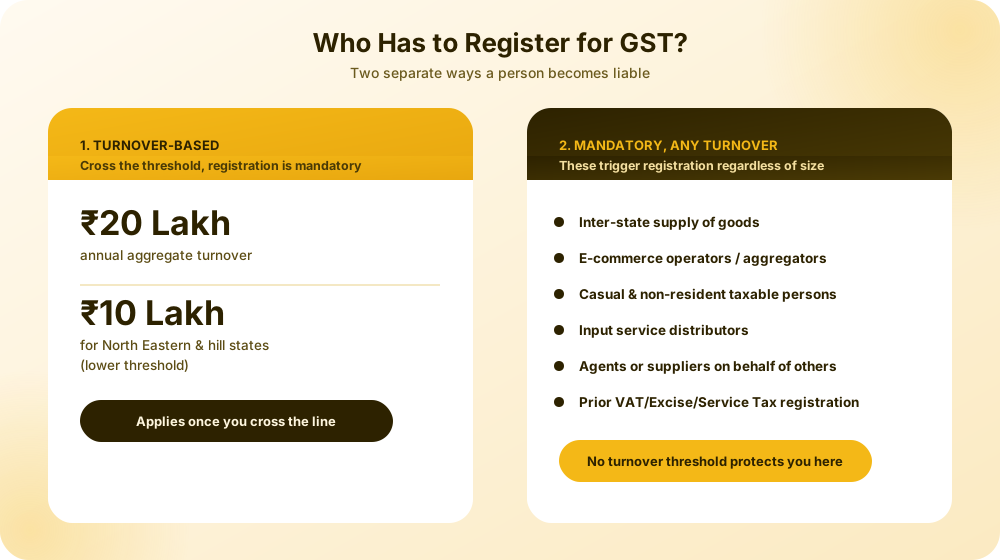
Table of Contents
- Why the threshold catches professional practices off guard
- Place of supply — why a project in another state matters
- Sole proprietor, partnership, or LLP
- Documents you’ll need
- A composition scheme built specifically for smaller service practices
- SAC codes for professional services — getting the classification right
- TDS on payments from government and institutional clients
- Registration mistakes specific to design and consulting practices
- E-invoicing — a threshold that applies permanently once crossed
- Choosing the right business constitution before you register
- Pricing — fixed, no hidden charges
- Frequently asked questions
- What’s the GST registration threshold for an architecture or design practice?
- Do I need a separate GST registration for a project in another state?
- I started as a sole proprietor but now have partners — do I need to re-register?
- How much does GST registration cost for a professional practice?
- Can this be handled without visiting your office?
- Can a small architecture practice use the composition scheme?
- Does it matter which SAC code I register under?
- Do government clients deduct TDS on my professional fees the same way as contractors?
- I have a design project in another state — do I need to register there?
- Should a small architecture practice choose composition or regular registration?
- Do I need to register before hitting ₹20 lakh if I only work with corporate clients?
- Does an LLP register for GST differently from a partnership?
- Related reading
- Talk to a consultant, not a call centre
- Worked Example: Composition Scheme vs Regular Registration for a Small Practice
- Registering When Your Client Base Is Entirely Corporate/Institutional
- Multi-City and Multi-State Practice Registration
- LLP Registration Considerations for Professional Practices
- Registering as a Freelance Consultant vs a Full Practice
- What Documents an Institutional Client Typically Asks to See
- Converting From Composition to Regular Registration as You Grow
- Registering a Multi-Disciplinary Practice
- What Happens If You Register Late, After Already Crossing the Threshold
- What If Your Practice Operates Under Multiple Trade Names?
- What If You Already Have an Informal Practice and Are Only Now Registering?
- Registering an Existing Firm That Is Restructuring
Why the threshold catches professional practices off guard
Because architecture, interior design, and civil engineering are treated as services under GST, the registration threshold is ₹20 lakh in most states — not the ₹40 lakh figure often quoted for goods-based businesses, which practice owners sometimes assume applies to them too. A single project fee, or two or three smaller ones across a year, can cross that line well before a practice feels “big enough” to need GST. Registering only after a client’s accounts team asks for a GSTIN on an invoice is a common, avoidable scramble.
Place of supply — why a project in another state matters
For services tied to immovable property — which covers most architecture, interior design, and civil engineering work — the place of supply is generally where the property is located, not where your firm is registered. Take on a project site in a different state, and depending on how the engagement is structured, that can mean the work needs to be billed under a GST registration in that state rather than your home one. This is a genuinely easy detail to miss when a design practice takes on its first out-of-state project, and it’s worth confirming before the first invoice goes out, not after.
Sole proprietor, partnership, or LLP
Many design and architecture practices start as a sole proprietorship under one named principal, then bring in partners as the practice grows — without ever updating the GST registration to reflect the new structure. That gap tends to surface when a bank, a larger client, or a professional indemnity insurer asks for documentation that no longer matches how the firm actually operates. If your practice has grown past a single-owner structure, it’s worth registering (or updating) to reflect that before it’s questioned.
Documents you’ll need
- PAN card — of the proprietor or firm.
- Professional registration or qualification proof — where applicable to your practice.
- Office address proof — electricity bill, rent agreement, or property tax receipt, plus an NOC if not owned by the practice.
- Bank account proof — a cancelled cheque or passbook first page.
- Photograph and Aadhaar — of the proprietor, partners, or authorised signatory.
A composition scheme built specifically for smaller service practices
Most people assume composition schemes are only for shops and restaurants, but a version exists specifically for service providers under Section 10(2A): a flat 6% rate (split 3% CGST + 3% SGST), available if your annual turnover is under ₹50 lakh. In exchange for the flat rate and quarterly-only filing (rather than monthly), you give up input tax credit and can’t make any inter-state supplies — every client and project has to be within your home state. For a smaller architecture or interior design practice working entirely within Chennai or Tamil Nadu, this can be a genuinely simpler option than regular registration, though it’s worth working through the numbers first, since the ITC trade-off matters more if you have significant deductible input costs (software licences, studio rent, subcontracted drafting work).
One operational difference worth knowing: composition taxpayers issue a bill of supply, not a standard tax invoice, and cannot show GST separately on it. Some larger corporate clients specifically expect a proper tax invoice with GST broken out for their own input credit purposes — worth checking your typical client base before choosing this route, since it can quietly rule out certain client relationships.
SAC codes for professional services — getting the classification right
Architecture, interior design, and engineering consultancy each fall under specific Services Accounting Codes (SAC), not a single generic “professional services” bucket. Declaring the right SAC at registration matters for two reasons: it determines how your invoices are classified in GSTR-1 reporting, and it’s what a client’s procurement or accounts team checks when verifying your registration against the nature of the engagement. A civil engineering firm that’s declared under a generic consulting code, for instance, can run into friction when a government or PSU client’s vendor verification expects a more specific classification.
TDS on payments from government and institutional clients
If you take on projects for government departments, PSUs, or other notified entities, the same Section 51 TDS rules that apply to contractors apply to your professional fees too — a 2% deduction (1% CGST + 1% SGST, or 2% IGST) on contract values above ₹2.5 lakh, credited to your electronic cash ledger via the client’s GSTR-7 filing. Architecture and engineering practices working with institutional or government clients should build this reconciliation into their monthly process, the same way a contractor would, rather than treating every government payment as if it should match the invoice value exactly.
Registration mistakes specific to design and consulting practices
- Registering under composition without checking your client mix — as covered above, corporate and institutional clients often need a full tax invoice, which composition doesn’t provide.
- Not updating registration when a sole practice takes on partners — a real, recurring gap that surfaces at the worst time (a bank loan, an insurer, a large client’s vendor audit).
- Missing an out-of-state project’s registration requirement — the place-of-supply rule for immovable-property services makes this an easy detail to overlook on a firm’s first project outside its home state.
- Declaring a generic SAC code instead of the one that actually matches your practice area, which can cause friction during institutional client vendor checks.
E-invoicing — a threshold that applies permanently once crossed
Once your practice’s aggregate annual turnover crosses ₹5 crore in any financial year since GST began, B2B e-invoicing becomes mandatory — and this is calculated at the PAN level, across all your GST registrations combined, not per registration. The detail that catches people out: once you’ve crossed that threshold even once, e-invoicing stays mandatory going forward, even in a year where your turnover happens to dip back below ₹5 crore. A growing practice that has one strong year and a quieter one after shouldn’t assume the e-invoicing requirement switches off with it.
Choosing the right business constitution before you register
A single-principal architecture or design studio typically registers as a sole proprietorship — simplest, fastest, no separate legal entity. Once a second principal joins with genuine shared ownership, a Partnership (up to 2 partners) formalises that split. Practices planning to scale into a larger, multi-project firm — bringing in associates, taking on institutional or government work at volume, or wanting limited liability protection — often move toward a Private Limited Company (up to 2 directors) instead, since it’s generally viewed more favourably by banks and larger clients running vendor due diligence. The right choice depends on how your practice is actually structured today and where you expect it to go, not just which option is quickest to set up this week.
Pricing — fixed, no hidden charges
GST registration costs from ₹1,500 + GST. If you’re taking on projects outside your home state, call 70 9232 9232 and we’ll confirm whether an additional registration applies before you invoice.
Frequently asked questions
What’s the GST registration threshold for an architecture or design practice?
₹20 lakh in annual turnover for most states, since these are treated as services — half the ₹40 lakh threshold that applies to goods-based businesses.
Do I need a separate GST registration for a project in another state?
Possibly — for services tied to immovable property, the project’s location can determine which state’s registration applies. We’ll assess your specific engagement.
I started as a sole proprietor but now have partners — do I need to re-register?
Your registration should reflect your actual business structure, so this is worth updating rather than leaving it out of date. We can advise on the right approach for your situation.
How much does GST registration cost for a professional practice?
from ₹1,500 + GST, no hidden charges.
Can this be handled without visiting your office?
Yes, entirely over phone and WhatsApp. If you’re near Teynampet and prefer to walk in, we’re open 10 AM to 7 PM.
Can a small architecture practice use the composition scheme?
Yes, if your turnover is under ₹50 lakh and all your work is within your home state. It’s a flat 6% rate with quarterly filing, but you give up input tax credit and can’t issue full tax invoices — worth checking against your typical client base first.
Does it matter which SAC code I register under?
Yes — it affects how your invoices are classified and is checked during client vendor verification, especially for government or PSU work. We confirm the SAC code that actually matches your practice area.
Do government clients deduct TDS on my professional fees the same way as contractors?
Yes — the same Section 51 rules apply: 2% deducted on contracts above ₹2.5 lakh, credited to your cash ledger. We help you reconcile this against your GSTR-7 credits.
I have a design project in another state — do I need to register there?
Possibly, depending on how the engagement is structured — place of supply for immovable-property services is usually where the project is located. We assess this before your first out-of-state invoice.
Should a small architecture practice choose composition or regular registration?
It depends on your actual expense structure — practices with minimal ITC-eligible costs (mostly salaries) often find composition simpler and cheaper; practices with substantial software, equipment, or fit-out costs often benefit more from regular registration with full ITC. This is a case-by-case financial decision, not a default.
Do I need to register before hitting ₹20 lakh if I only work with corporate clients?
In practice, yes — most institutional and corporate clients require a valid GSTIN before engaging any vendor, regardless of the technical threshold, so early voluntary registration is usually the practical choice for institution-focused practices.
Does an LLP register for GST differently from a partnership?
The documentation differs slightly — an LLP uses its LLP agreement and LLP identification number rather than a simple partnership deed — but the overall registration process and obligations are otherwise the same.
Related reading
If you are still deciding how to register, our guide to the GST Composition Scheme explains the eligibility, rates, and trade-offs against regular registration.
Talk to a consultant, not a call centre
Call or WhatsApp 70 9232 9232 and tell us about your practice and where your projects are located — we’ll confirm exactly what’s needed before filing anything. Rated 5.0★ across 1,000+ Google reviews, serving businesses since 2017.
Registering a different kind of business? See our GST Registration guides for e-commerce sellers, contractors, restaurants & cloud kitchens, or manufacturers & exporters.
Already registered and need help with monthly filing instead? See our GST Return Filing guide for architects, interior designers & civil engineers, or start with the full our GST Registration guide.
Worked Example: Composition Scheme vs Regular Registration for a Small Practice
A newly-established architecture practice expecting ₹35,00,000 in annual billings, with minimal ITC-eligible expenses (mostly staff salaries, which don’t carry GST), is a reasonable candidate for the composition scheme for service providers — a flat lower rate with simpler quarterly filing, at the cost of not being able to claim ITC on the (in this case, small) input expenses. A larger firm with substantial software licensing, office fit-out, and equipment costs would find regular registration with full ITC more beneficial despite the more involved monthly filing, since the ITC being forfeited under composition would be meaningfully larger relative to their actual cost structure. This decision is genuinely case-by-case, not a default either way.
Registering When Your Client Base Is Entirely Corporate/Institutional
Practices that work exclusively with corporate clients, government departments, or institutional bodies (rather than individual homeowners) should register from day one regardless of the ₹20 lakh threshold in practice, since most institutional clients require a valid GSTIN before they’ll even engage a vendor, GST-exempt or not — the threshold technically applies, but the commercial reality of institutional procurement usually makes early voluntary registration the practical choice.
Multi-City and Multi-State Practice Registration
An architecture or engineering firm taking on projects across multiple states — increasingly common as practices grow beyond purely local work — needs to register in each state where they maintain a genuine place of business or a project office, following the same principle covered above for place-of-supply. A firm that occasionally travels to execute a single out-of-state project without establishing a local office generally doesn’t need registration there; one that maintains an ongoing local presence for repeated project work in that state does.
LLP Registration Considerations for Professional Practices
Many design and engineering practices structure as a Limited Liability Partnership (LLP) rather than a traditional partnership or company, since it combines liability protection with the flexibility partners in professional practices often want. GST registration for an LLP follows the company-constitution documentation path (LLP agreement, LLP identification number) rather than the simpler proprietorship route, and is worth planning for at the outset if this is your intended structure rather than converting from a simpler structure later.
Registering as a Freelance Consultant vs a Full Practice
An independent architect or engineer working as a freelance consultant, rather than running a multi-person practice, follows the same GST registration threshold and process as any service provider — the ₹20 lakh threshold and registration steps don’t differ based on whether you employ staff or work solo. What does often differ is the composition-scheme decision, since a solo consultant with minimal input costs is frequently a stronger candidate for composition than a practice with staff, office overhead, and software licensing.
What Documents an Institutional Client Typically Asks to See
Beyond your GSTIN itself, corporate and government clients frequently ask to see your registration certificate, PAN, and sometimes a declaration of your composition-scheme status (since some institutional procurement processes have rules around vendor tax status). Having these readily available before you’re asked — rather than scrambling once a client’s procurement team requests them mid-onboarding — is worth preparing as part of registration itself, not treating as an afterthought once a big client relationship is already underway.
Converting From Composition to Regular Registration as You Grow
A practice that starts on the composition scheme and later crosses the ₹50 lakh services threshold, or simply finds regular registration with full ITC now makes more financial sense as costs grow, needs to file Form CMP-04 to formally exit composition, either within 7 days of becoming ineligible or before the start of a financial year if switching voluntarily. This is a real transition worth planning for, not something to handle reactively once you’ve already crossed the threshold without noticing.
Registering a Multi-Disciplinary Practice
Firms that combine architecture, interior design, and structural engineering services under one practice — increasingly common as clients look for a single point of contact across a project — register under one GSTIN covering all these service lines, with SAC codes correctly reflecting the full range of services offered. Getting the SAC classification right at registration for a multi-disciplinary practice matters more than for a single-discipline firm, since an incomplete SAC listing can create questions later about whether a specific service line was properly declared from the start.
What Happens If You Register Late, After Already Crossing the Threshold
A practice that realises it crossed the ₹20 lakh threshold months earlier and is only now registering needs to be upfront about this during the process — late registration itself is not typically penalised heavily if addressed proactively, but backdated tax liability on revenue earned before registration is a real question that needs proper handling, not something to leave ambiguous in the application. We help structure this conversation with the department correctly rather than leaving room for it to be interpreted unfavourably later.
What If Your Practice Operates Under Multiple Trade Names?
Some architects and designers operate a personal-brand practice alongside a separate studio or partnership name for larger projects. If these are genuinely the same legal entity, one GST registration covers both trade names, with the trade name itself amendable if needed. If they are genuinely separate legal entities — different partners, different constitution — each needs its own registration, since GST registration follows the legal entity, not the brand name being used for a given project.
What If You Already Have an Informal Practice and Are Only Now Registering?
Many established architects and designers built a client base informally for years before crossing the GST threshold or deciding institutional work required formal registration. Registering at this stage doesn’t retroactively tax years of informal practice — obligations begin from your registration date forward, though getting the effective date correctly documented matters if there’s ever a question about exactly when compliance began.
Whether you’re a solo consultant, a small studio, or a growing multi-disciplinary practice — call 70 9232 9232 and we will tell you exactly what registration looks like for your specific situation.
Registering an Existing Firm That Is Restructuring
A practice converting from a sole proprietorship to a partnership or LLP as it brings on new partners needs a fresh GST registration under the new constitution — the existing proprietorship GSTIN doesn’t simply convert or transfer. This means planning the cancellation of the old registration (with its own GSTR-10 obligations) alongside the new one, timed so there’s no gap in your ability to invoice clients.
We are four floors above Teynampet Metro, rated 5.0 stars across 1,000+ Google reviews, serving Chennai design and engineering practices since 2017.
We tell you what is possible, not what you want to hear, on timelines, documentation, and what your specific practice structure actually requires.