
Restaurants face a registration decision most other businesses don’t get: whether to register as a regular taxpayer or under the composition scheme, which offers a flat, lower rate but strips out input tax credit and a few other freedoms. Get this choice wrong and you’re stuck with it until you formally switch, which isn’t a quick edit. On top of that, if you list on Swiggy or Zomato, the platform needs your GSTIN before onboarding you at all — turnover doesn’t come into it. We handle the registration, including helping you decide which scheme actually fits, from ₹1,500 + GST. Call or WhatsApp us on 70 9232 9232.
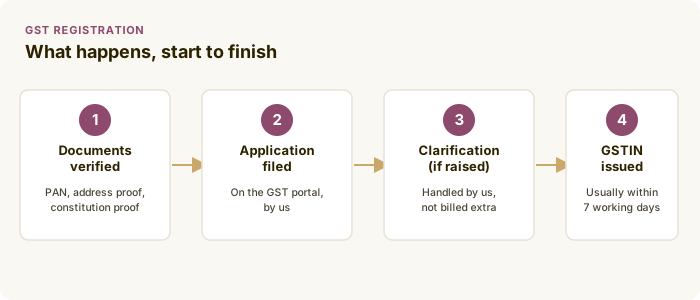
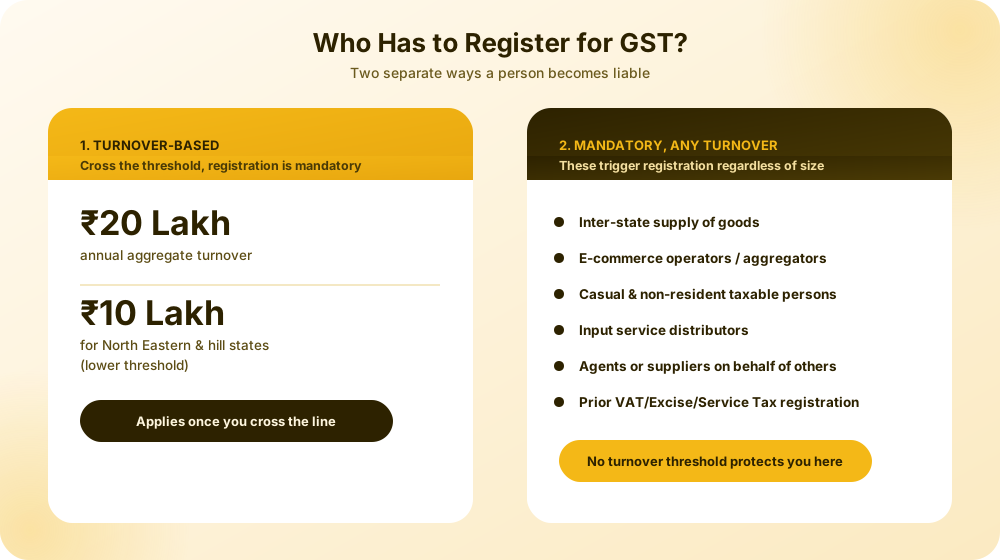
Table of Contents
- Regular taxpayer or composition scheme — the decision that matters most here
- Delivery aggregators require registration before onboarding
- Documents you’ll need
- Catering and event orders can be taxed differently from regular service
- Input tax credit trade-offs are bigger than they look on paper
- FSSAI and GST — two registrations, one operational timeline
- Multiple outlets or dark kitchens — one registration or several?
- Registration mistakes specific to food businesses
- How Swiggy and Zomato actually handle your GST — and why it’s not TCS
- Choosing the right business constitution for your kitchen
- Pricing — fixed, no hidden charges
- Frequently asked questions
- Should my restaurant register under the composition scheme or as a regular taxpayer?
- Do I need GST registration to list on Swiggy or Zomato?
- Can a cloud kitchen register under the composition scheme?
- How much does GST registration cost for a restaurant?
- Can this be done without visiting your office?
- Do I charge the same GST rate for catering orders as regular dine-in or delivery?
- I run 2 kitchens in Chennai — do I need 2 GST registrations?
- Should I get FSSAI or GST registration first?
- How do I know if composition scheme actually saves me money?
- Does GST registration cover alcohol sales too?
- Can two different cloud kitchen brands share the same physical kitchen address?
- Should I get FSSAI or GST registration first?
- Related reading
- Talk to a consultant, not a call centre
- Locality-specific guides for restaurants and cloud kitchens
- Registering a Liquor-Serving Restaurant — Two Separate Licences, Two Separate Filings
- Worked Example: Choosing Between 5% and 18% at Registration
- Shared Kitchen Spaces and Dark-Kitchen Arrangements
- FSSAI Timeline vs GST Timeline — Which to Start First
- Registering a Second Outlet — New GSTIN or Additional Place of Business?
- What Happens to Your Registration If You Close and Reopen Under a New Brand
- Delivery-Only Dark Kitchens and FSSAI Categorisation
- What We Check Before Registering Your Food Business
- What If You’re Converting an Existing Unregistered Food Stall Into a Formal Business?
Regular taxpayer or composition scheme — the decision that matters most here
Standalone restaurants and cloud kitchens with turnover under ₹1.5 crore can opt into the composition scheme: a flat 5% rate, simpler quarterly returns, and no need to itemise GST on every bill. In exchange, you give up input tax credit entirely — meaning the GST you pay on rent, raw materials, and equipment can’t be claimed back. For a kitchen with high input costs relative to revenue, regular registration with full input tax credit often works out better despite the higher headline rate. This is a genuine trade-off specific to the food business, and it’s worth working through with real numbers before you register, not after.
Delivery aggregators require registration before onboarding
Swiggy and Zomato both require a valid GSTIN as part of restaurant partner onboarding, regardless of how small the kitchen is. This runs parallel to a separate rule under Section 9(5) of the CGST Act, where the platform itself pays GST directly to the government on your behalf for orders placed through the app — but that arrangement only works once you’re registered and listed correctly on their system. Cloud kitchens that operate purely through delivery apps sometimes assume they can wait until they’re “big enough” to register; the platforms don’t give that option.
Documents you’ll need
- PAN card — of the business or proprietor.
- Address proof for the kitchen or restaurant premises — electricity bill, rent agreement, or property tax receipt, plus an NOC if the premises isn’t owned by the business.
- FSSAI licence details — most platforms and states expect this alongside your GST registration.
- Bank account proof — a cancelled cheque or passbook first page.
- Photograph and Aadhaar — of the proprietor or authorised signatory.
Catering and event orders can be taxed differently from regular service
If you take on catering work alongside regular dine-in or delivery — weekend events, corporate orders, banquet-style bookings — the GST treatment can shift depending on the nature and setting of that specific order. Outdoor catering is generally taxed at 18% with full input tax credit available, a different structure from the standard 5%-without-ITC rate that applies to most regular restaurant service. Where exactly that line falls depends on the specifics of the venue and booking, so it’s worth flagging any catering side of your business at registration rather than assuming your standard restaurant rate automatically covers it — misclassifying this is a real, avoidable source of under- or over-charged invoices.
Input tax credit trade-offs are bigger than they look on paper
The composition-versus-regular decision isn’t just about the headline rate — it’s about what you’re giving up. Under composition, you can’t claim credit on GST paid for rent, kitchen equipment, packaging materials, delivery bike maintenance, or ingredient purchases from GST-registered suppliers. For a cloud kitchen with high fixed costs (equipment, rent, packaging for delivery) relative to revenue, that lost credit can outweigh the benefit of the lower flat rate. We run the actual numbers — your rent, your typical monthly ingredient spend, your equipment costs — against both scenarios before recommending either, rather than defaulting to whichever is simpler to set up.
FSSAI and GST — two registrations, one operational timeline
FSSAI (Food Safety and Standards Authority of India) licensing and GST registration are entirely separate processes, but delivery platforms and most commercial landlords expect both to be in place before you’re fully operational. Kitchens sometimes get their GST sorted quickly but stall on FSSAI because it involves a premises inspection, which delays onboarding on delivery apps even though the GST side is done. Sequencing both applications to run in parallel, rather than one after the other, is one of the simplest ways to shorten your actual time-to-launch.
Multiple outlets or dark kitchens — one registration or several?
If you’re running more than one kitchen or outlet within the same state, you can typically operate under a single GST registration with each location added as an additional place of business — you don’t need a separate GSTIN per outlet within one state. Cross into a different state, though, and that’s a genuinely new registration, the same multi-state principle that applies to any business with a physical presence in more than one state. Cloud kitchen operators expanding city-by-city sometimes assume the registration scales automatically with their footprint; it doesn’t, once a state line is crossed.
Registration mistakes specific to food businesses
- Registering under composition, then adding a catering or events arm later — composition dealers face real restrictions on inter-state supply and certain service categories, which can conflict with a growing catering business. Worth thinking through before you commit to composition, not after.
- Address proof for a shared/co-working kitchen space that doesn’t clearly establish your right to operate there — cloud kitchens using shared commercial kitchen facilities need documentation that names them specifically, not just a general lease held by the facility operator.
- Assuming FSSAI covers GST or vice versa — they’re checked separately by different systems (delivery platforms, landlords, tax department), and having one doesn’t substitute for the other.
How Swiggy and Zomato actually handle your GST — and why it’s not TCS
Restaurant delivery is treated differently from a goods marketplace like Amazon or Flipkart, and it’s worth understanding the difference so you’re not reconciling against the wrong mechanism. Since 1 January 2022, restaurant services supplied through an e-commerce operator fall under Section 9(5) of the CGST Act — the platform itself becomes liable to pay GST on those orders, as if it were the supplier, at 5% in cash, regardless of whether your own restaurant is GST-registered. Because this is a Section 9(5) liability rather than the Section 52 TCS model that applies to goods sellers, no TCS gets deducted on your restaurant-service orders through Swiggy or Zomato — the platform is paying that 5% itself, not collecting it from your payout.
Practically, this means your GSTR-3B reporting for delivery-app orders looks different from a marketplace seller’s: these supplies are typically reported separately, since you’re not the one remitting the tax on them even though you’re the actual supplier. This is one of the most common points of confusion we see restaurant owners run into when comparing notes with a friend who sells goods on Amazon — the two mechanisms sound similar but work fundamentally differently, and mixing them up in your own return leads to reporting errors.
Choosing the right business constitution for your kitchen
Most single-outlet restaurants and cloud kitchens register as a sole proprietorship — fastest to set up, no separate legal entity required. It’s the right default for a single owner-operated kitchen. Two situations change that calculus: if you’re partnering with someone else on ownership and day-to-day running (a Partnership, up to 2 partners, documents the split clearly from day one), or if you’re planning to scale into multiple outlets, bring in outside investment, or want limited liability protection as the business grows (a Private Limited Company, up to 2 directors, costs more to maintain but positions you better for that growth).
Cloud kitchens planning a multi-brand or multi-outlet model from the outset — running several delivery-only brands out of shared kitchen infrastructure, for instance — often benefit from thinking through the Pvt Ltd route earlier than a single standalone restaurant would need to, simply because the operational complexity (multiple FSSAI licences, multiple outlet leases, staff across locations) tends to arrive faster than the revenue that would otherwise justify it. We talk through your actual expansion plans, not just your day-one setup, before recommending a constitution.
Pricing — fixed, no hidden charges
GST registration costs from ₹1,500 + GST. That includes helping you decide between regular and composition registration based on your actual cost structure, not a generic recommendation.
Frequently asked questions
Should my restaurant register under the composition scheme or as a regular taxpayer?
It depends on your input costs relative to revenue. Composition means a lower flat rate but no input tax credit; regular registration means full input tax credit but a higher headline rate. We’ll work through your actual numbers before recommending either.
Do I need GST registration to list on Swiggy or Zomato?
Yes — both platforms require a valid GSTIN before onboarding you as a partner restaurant, regardless of your turnover.
Can a cloud kitchen register under the composition scheme?
Yes, if turnover is under ₹1.5 crore, the same as a standalone restaurant. The trade-off around input tax credit applies the same way.
How much does GST registration cost for a restaurant?
from ₹1,500 + GST, no hidden charges — including guidance on which scheme suits your business.
Can this be done without visiting your office?
Yes, entirely over phone and WhatsApp. If you’re near Teynampet and prefer to walk in, we’re open 10 AM to 7 PM.
Do I charge the same GST rate for catering orders as regular dine-in or delivery?
Not always — outdoor catering can attract 18% with input tax credit, a different structure from the standard restaurant rate. We check the specifics of your catering side at registration so this is classified correctly from the start.
I run 2 kitchens in Chennai — do I need 2 GST registrations?
No, generally one registration covers multiple locations within the same state, added as additional places of business. A new state, however, does need its own registration.
Should I get FSSAI or GST registration first?
Neither strictly has to come first, but running both applications in parallel rather than sequentially usually gets you operational faster, since FSSAI’s premises inspection can take longer than GST processing.
How do I know if composition scheme actually saves me money?
It depends on your input costs — rent, equipment, packaging, ingredients from GST-registered suppliers — relative to revenue. We calculate both scenarios with your real numbers before recommending either.
Does GST registration cover alcohol sales too?
No — alcohol requires a separate Tamil Nadu excise licence entirely independent of GST registration. Neither registration substitutes for the other.
Can two different cloud kitchen brands share the same physical kitchen address?
Yes — multiple GSTINs can be registered at the same address, as long as each business has its own genuine operational and billing identity.
Should I get FSSAI or GST registration first?
Neither has to come first — they run on independent timelines and are usually started in parallel once your kitchen space and menu are finalised, since both are needed before you can genuinely start operating.
Related reading
If you are still deciding how to register, our how the GST Composition Scheme works explains the eligibility, rates, and trade-offs against regular registration.
Talk to a consultant, not a call centre
Call or WhatsApp 70 9232 9232 and tell us your rough cost structure — we’ll help you pick the right registration type before filing anything. Rated 5.0★ across 1,000+ Google reviews, serving businesses since 2017.
Registering a different kind of business? See our GST Registration guides for e-commerce sellers, contractors, manufacturers & exporters, or architects, interior designers & civil engineers.
Already registered and need help with monthly filing instead? See our GST Return Filing guide for restaurants & cloud kitchens, or start with the full the GST Registration process.
Locality-specific guides for restaurants and cloud kitchens
Registering from a specific part of Chennai? These cover the same composition-versus-regular decision and FSSAI-alongside-GST timing with local detail added in: Teynampet, Alwarpet, Mylapore, Nandanam, R.A. Puram, and Saidapet, T Nagar, Parrys Corner, Mannadi, Ritchie Street, Chromepet, Tambaram.
Registering a Liquor-Serving Restaurant — Two Separate Licences, Two Separate Filings
A restaurant planning to serve alcohol needs a Tamil Nadu excise licence in addition to GST registration — these are entirely separate applications through separate departments, and neither one substitutes for the other. GST registration alone does not authorise alcohol sales, and an excise licence does not exempt your food sales from GST. Restaurants planning both should budget realistic time for both processes, since the excise licence timeline is typically longer and more document-intensive than GST registration.
Worked Example: Choosing Between 5% and 18% at Registration
A new restaurant expecting ₹8,00,000 monthly sales with roughly ₹1,20,000 in monthly purchases (ingredients, packaging, utilities) faces a real decision at registration: the 5% rate with no ITC means paying ₹40,000 monthly GST outright on ₹8,00,000 sales; the 18% rate with ITC means charging ₹1,44,000 GST to customers but claiming back roughly ₹21,600 in ITC on those ₹1,20,000 purchases (assuming an 18% average rate on inputs), netting to a higher customer-facing price but a different net cash position for the business. Most standalone dine-in restaurants find the 5% no-ITC rate simpler and more price-competitive for customers; cloud kitchens with heavier equipment and packaging costs sometimes find the ITC-bearing rate genuinely better on margin. This is a real financial modelling exercise, not a default choice, and worth doing before registering rather than after.
Shared Kitchen Spaces and Dark-Kitchen Arrangements
Cloud kitchens operating out of a shared commercial kitchen space (common in Chennai’s dark-kitchen ecosystem, where multiple brands cook from one facility) each need their own independent GST registration under their own PAN, even if they physically share the same address. The shared address itself is not a barrier to registration — multiple GSTINs can be registered at the same physical address, provided each business genuinely has its own operational identity, brand, and billing.
FSSAI Timeline vs GST Timeline — Which to Start First
FSSAI registration/licensing and GST registration run on independent timelines and can be started in parallel rather than sequentially — there’s no requirement to have one before starting the other. In practice, most food businesses start both applications around the same time once their kitchen space and menu are finalised, since both are needed before commercial operations and delivery-platform onboarding can genuinely begin.
Registering a Second Outlet — New GSTIN or Additional Place of Business?
If you’re opening a second restaurant location within the same state, it’s generally added as an “additional place of business” under your existing GSTIN rather than requiring a fresh registration — one GSTIN can cover multiple locations in the same state. This changes only if the new outlet is in a different state, which does require its own separate registration, following the same state-specific principle that applies to any multi-location GST business.
What Happens to Your Registration If You Close and Reopen Under a New Brand
Restaurants that rebrand entirely — closing one concept and reopening as something different, even from the same kitchen — have a choice to make: amend the existing registration’s trade name (a core-field amendment requiring officer approval), or start fresh with a new registration if the underlying business structure is genuinely changing too (new ownership, new constitution). A simple rebrand with the same ownership and structure is usually handled as a trade-name amendment, not a fresh registration.
Delivery-Only Dark Kitchens and FSSAI Categorisation
Dark kitchens with no dine-in space still need the same FSSAI registration/licensing tier as a traditional restaurant, based on turnover and scale — the absence of a physical dining area doesn’t reduce the FSSAI requirement, since the licensing framework is built around food safety in preparation, not the presence of seating. This is a common misconception among new cloud kitchen operators who assume a delivery-only model needs a lighter compliance touch; it doesn’t, on the FSSAI side specifically.
What We Check Before Registering Your Food Business
For every restaurant and cloud kitchen client, registration includes: confirming the right rate choice (5% no-ITC vs 18%-with-ITC) based on your actual cost structure, correctly documenting multiple outlets or a shared kitchen arrangement if applicable, and flagging early if alcohol service will require a separate excise licence track alongside GST. Getting these right at registration avoids a much more disruptive correction later once you’re already operating and filing.
Opening your first outlet, adding a second location, or converting an informal food business into a properly registered one — call 70 9232 9232 and we will walk you through exactly what your situation needs.
Fixed, transparent pricing on registration, and a team that has handled the specific documentation quirks of restaurant and cloud kitchen GST registration for Chennai food businesses since 2017, rated 5.0 stars across 1,000+ Google reviews.
What If You’re Converting an Existing Unregistered Food Stall Into a Formal Business?
Many established food businesses in Chennai operated informally for years before crossing the GST threshold or deciding to formalise for other reasons — supplying to a corporate cafeteria contract, or wanting to list on Swiggy/Zomato, which require a GSTIN. Registering at this stage doesn’t retroactively tax your years of informal operation; GST obligations begin from your registration date forward, though it is worth getting your effective-date paperwork right so there’s no ambiguity about when compliance actually started.
Call or WhatsApp 70 9232 9232 today to get your restaurant or cloud kitchen registered correctly from day one.
Rated 5.0 stars across 1,000+ Google reviews, serving Chennai food businesses since 2017, with direct access to your consultant and no IVR queue to sit through.
We tell you what is possible, not what you want to hear, on deadlines, documentation, and what your specific food business setup actually requires.