
For manufacturers and exporters, GST registration is the first domino in a chain — you can’t file a Letter of Undertaking to export without paying IGST, you can’t claim input tax credit on raw materials, and you can’t even apply for an Import Export Code properly without a GSTIN already in place. Get the registration wrong at the start — the wrong constitution, a factory address that doesn’t match your documents — and it delays everything downstream, including your first export shipment. We handle this end to end from ₹1,500 + GST per registration. Call or WhatsApp us on 70 9232 9232.
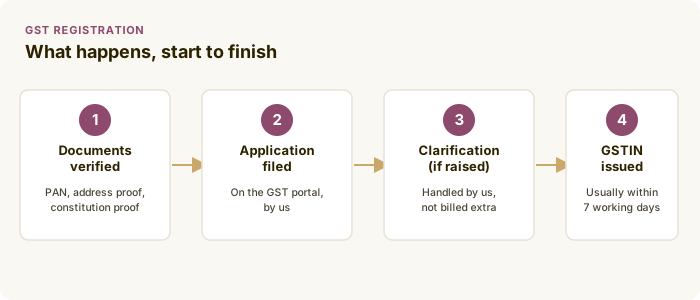
Table of Contents
- Why registration comes before everything else for exporters
- Multiple factories, multiple registrations
- Getting the business constitution right the first time
- Documents you’ll need
- Your LUT expires every year — and there’s no grace period
- Inverted duty structure — a refund manufacturers often leave unclaimed
- E-way bills for factory-to-port and inter-factory movement
- Registration mistakes specific to manufacturing and exports
- Sending goods for job work — the deadlines that matter
- Choosing the right business constitution before you register
- How many HSN digits your invoices actually need
- Pricing — fixed, no hidden charges
- Frequently asked questions
- Can I file a Letter of Undertaking before I have GST registration?
- Do I need separate GST registration for a second factory in another state?
- Do I need GST registration before applying for an Import Export Code?
- How much does GST registration cost for a manufacturer?
- Can this be done remotely?
- What happens if I forget to renew my LUT?
- What is inverted duty structure and am I owed a refund?
- Do I need an e-way bill for moving goods between my own factories?
- What happens if I declared the wrong HSN code at registration?
- Should I file my LUT before or after my first export shipment?
- Do I need a new GST registration for a second factory in a different state?
- Can I claim ITC on machinery purchased right after registration?
- Related reading
- Talk to a consultant, not a call centre
- Worked Example: Should You Register for LUT Before Your First Export Order?
- Registering for a New Factory in a Different State
- Deemed Export and SEZ Supply Registration Considerations
- Capital Goods and Machinery — ITC Considerations at Registration
- What We Check Before Registering Your Manufacturing or Export Business
- Import-Export Code (IEC) — A Separate Registration Exporters Also Need
- Registering a Manufacturing Unit vs a Trading Business — Why the Distinction Matters
- Registering When You’re Still Setting Up Your Factory
- What Happens If Your Export Volume Grows Faster Than Expected
- Choosing Between Multiple Job Workers Across Different States
Why registration comes before everything else for exporters
Exporting without paying IGST upfront requires filing a Letter of Undertaking (LUT) with the GST department — but you can only file an LUT once you already have a GSTIN. The same sequencing applies to your Import Export Code: while IEC and GST are technically separate registrations, most banks and customs processes expect both to be in place and linked before your first export consignment clears. Manufacturers who start the export paperwork before finishing GST registration often find themselves stuck mid-process, waiting on a number they should have secured weeks earlier.
Multiple factories, multiple registrations
If you manufacture out of more than one location — a factory in one state and a warehouse or second unit in another — each state generally needs its own GST registration, not one registration covering both. This matters more for manufacturers than most other businesses because expansion often means opening a new unit in a different state specifically to be closer to raw material sources or a port, and the GST registration for that new unit has to be sorted before it starts billing, not after.
Getting the business constitution right the first time
Manufacturing businesses often involve more than one investor or family member from the start, which usually means a partnership or private limited structure rather than a proprietorship. Registering under the wrong constitution to save a step early on tends to resurface at loan application time, or when a buyer’s procurement team runs a vendor compliance check and finds the registered structure doesn’t match the company’s actual ownership.
Documents you’ll need
- PAN card — of the business.
- Constitution proof — partnership deed or certificate of incorporation.
- Factory or unit address proof — for each location that needs its own registration.
- Bank account proof — a cancelled cheque or passbook first page.
- Photograph and Aadhaar — of partners, directors, or authorised signatory.
Your LUT expires every year — and there’s no grace period
A Letter of Undertaking is valid for exactly one financial year, 1 April to 31 March, and has to be renewed before the new financial year starts — there’s no automatic renewal and no extension. Miss the deadline and every export invoice you raise after 1 April becomes taxable at 18% IGST until a fresh LUT is filed, a real cash-flow hit for a business that’s used to shipping tax-free. This is one of the most common compliance slips we see among exporters who set up their LUT once at registration and never revisit it — we build the annual renewal into your compliance calendar specifically so it doesn’t get missed.
Inverted duty structure — a refund manufacturers often leave unclaimed
If the GST rate on your raw materials is higher than the rate on your finished output — common in several manufacturing categories — you can end up with more input tax credit than you can use against your output liability. This is called an inverted duty structure, and the excess accumulated credit is refundable, not just carried forward indefinitely. A recent change (CGST Instruction 6/2025, effective October 2025) allows a 90% provisional refund of the accumulated credit for applications filed after that date, well ahead of the older, slower full-verification process. One condition worth knowing: you can’t claim this refund on the same supplies where you’ve also availed of export duty drawback — the two benefits are mutually exclusive.
E-way bills for factory-to-port and inter-factory movement
Any movement of goods worth over ₹50,000 — raw material coming into your factory, finished goods heading to a port for export, stock transfers between your own units in different states — needs an e-way bill generated before the consignment moves. For manufacturers running high shipment volumes, this becomes a genuine operational process, not a one-off filing, and it’s worth setting up properly (linked to your billing software, ideally) rather than generating each one manually as an afterthought.
Registration mistakes specific to manufacturing and exports
- Declaring the wrong HSN code for finished goods — manufacturing HSN classification directly determines your output tax rate, and an inaccurate declaration at registration can cause a mismatch that surfaces at audit or refund-application time.
- Applying for IEC before GST registration is complete — as covered above, this creates a sequencing problem that delays your first shipment. GST first, IEC second, always.
- Not registering a new factory or warehouse state before it starts billing — a delay here means invoices get raised from the wrong GSTIN, which is a genuinely difficult thing to correct retroactively.
- Missing the annual LUT renewal — the single most common, most avoidable mistake on this page, and the one with the most direct cash-flow consequence.
Sending goods for job work — the deadlines that matter
If part of your manufacturing process involves sending inputs or capital goods to a job worker for processing — a common setup for manufacturers who subcontract specific stages — Section 143 of the CGST Act lets you do this without paying GST at the point of dispatch, provided the goods actually come back within the prescribed window: 1 year for inputs, 3 years for capital goods (moulds, dies, jigs, fixtures, and tools are exempt from the 3-year limit). Miss that deadline and the dispatch gets treated as a deemed supply retroactively, from the original send-out date — meaning GST plus 18% interest becomes payable as if you’d sold the goods on day one, not sent them for processing.
Manufacturers with an active job-work relationship need a proper tracking system for this — a spreadsheet noting dispatch dates and return deadlines is the bare minimum, and it’s worth building into your existing inventory process rather than treating it as a separate compliance task that’s easy to lose track of across a busy production schedule.
Choosing the right business constitution before you register
Manufacturing and export businesses often involve shared capital and multiple stakeholders from the start — a family business, co-investors funding machinery, or a founding team splitting operational roles. A Partnership (up to 2 partners) documents that split clearly; a Private Limited Company (up to 2 directors) goes further, offering limited liability and a structure that banks and larger export buyers generally find easier to underwrite for credit lines and letters of credit. A bare sole proprietorship works for a genuinely single-owner operation, but it’s worth being honest about whether that actually describes your business before defaulting to it because it’s the fastest option on the registration portal.
How many HSN digits your invoices actually need
How precisely you need to declare your HSN code depends on both your turnover and whether the sale is domestic or export. Up to ₹5 crore turnover, a 4-digit HSN code is mandatory on B2B invoices; cross ₹5 crore, and every invoice needs the fuller 6-digit code. Export and import transactions are a separate case entirely — those need an 8-digit HSN code regardless of your overall turnover. A manufacturer who’s used to a shorter domestic code can genuinely get this wrong the first time they export, since the requirement jumps straight to 8 digits rather than scaling gradually the way the domestic rule does. We confirm the right digit level for both your domestic and export invoicing at registration, so this isn’t something you discover mid-shipment.
Pricing — fixed, no hidden charges
GST registration costs from ₹1,500 + GST per registration. If you operate across more than one state, call 70 9232 9232 and we’ll confirm exactly which locations need their own registration before we start.
Frequently asked questions
Can I file a Letter of Undertaking before I have GST registration?
No — a GSTIN has to exist first. LUT filing is a separate step that comes after registration, not alongside it.
Do I need separate GST registration for a second factory in another state?
Generally yes, if that location operates as its own place of business. We’ll confirm based on how your specific operation is structured.
Do I need GST registration before applying for an Import Export Code?
They’re separate registrations, but most banks and customs processes expect both to be in place and linked before your first shipment, so it’s best to sequence GST registration first.
How much does GST registration cost for a manufacturer?
from ₹1,500 + GST per registration. If multiple locations apply, we’ll quote clearly upfront.
Can this be done remotely?
Yes, entirely over phone and WhatsApp. If you’re near Teynampet and prefer to walk in, we’re open 10 AM to 7 PM.
What happens if I forget to renew my LUT?
Every export invoice you raise after 1 April becomes taxable at 18% IGST until you file a fresh LUT — there’s no grace period. We track this renewal for you as part of ongoing compliance so it never lapses.
What is inverted duty structure and am I owed a refund?
If the GST rate on your raw materials is higher than your output rate, you likely have unused accumulated credit that’s refundable — not just carried forward. A recent rule change allows a 90% provisional refund on applications filed after October 2025. We check whether this applies to your specific product mix.
Do I need an e-way bill for moving goods between my own factories?
Yes, if the consignment value exceeds ₹50,000, even between your own units in different states. This applies to every qualifying movement, not just sales to customers.
What happens if I declared the wrong HSN code at registration?
It can be corrected, but it’s worth catching early — an incorrect HSN classification affects your output tax rate and can surface as a mismatch during an audit or refund application. We review your product classification carefully before filing.
Should I file my LUT before or after my first export shipment?
Before, if at all possible. Filing the LUT first lets you export without paying tax upfront, avoiding tying up working capital in a refund claim that has to be processed later.
Do I need a new GST registration for a second factory in a different state?
Yes — a new factory in a different state needs its own registration, following the same state-specific principle that applies to any multi-state business expansion.
Can I claim ITC on machinery purchased right after registration?
Generally yes, but the claim depends on your registration being active and correctly documented before the purchase — timing your registration relative to major capital investments is worth planning deliberately.
Related reading
If you are still deciding how to register, our our Composition Scheme breakdown explains the eligibility, rates, and trade-offs against regular registration.
Talk to a consultant, not a call centre
Call or WhatsApp 70 9232 9232 and tell us about your locations and export plans — we’ll map out the right sequence of registrations before filing anything. Rated 5.0★ across 1,000+ Google reviews, serving businesses since 2017.
Registering a different kind of business? See our GST Registration guides for e-commerce sellers, contractors, restaurants & cloud kitchens, or architects, interior designers & civil engineers.
Already registered and need help with monthly filing instead? See our GST Return Filing guide for manufacturers & exporters, or start with the full GST Registration overview.
Worked Example: Should You Register for LUT Before Your First Export Order?
A manufacturer with a confirmed first export order worth ₹20,00,000 has two options: pay IGST upfront on the export (₹3,60,000 at 18%) and claim it back later as a refund, or file a Letter of Undertaking (LUT) before shipping and export without paying tax upfront at all. The LUT route avoids tying up ₹3,60,000 in working capital while waiting for a refund to process — for most manufacturers with genuine ongoing export volume, filing the LUT before the first shipment, not after, is the financially sensible default rather than something to sort out reactively once cash is already tied up in a refund claim.
Registering for a New Factory in a Different State
Expanding manufacturing operations into a new state — a common growth step for exporters scaling production — requires its own GST registration in that state, following the same place-of-business principle that applies to any multi-state business. This registration needs to be planned alongside the physical setup of the new facility, not treated as paperwork to handle after production has already started, since operating without the registration in place creates real compliance exposure from day one of activity in the new state.
Deemed Export and SEZ Supply Registration Considerations
If a meaningful portion of your business will be deemed exports or SEZ supplies rather than standard exports, this doesn’t change your basic registration process, but it’s worth flagging at registration time so your filing setup correctly anticipates the LUT and documentation requirements these supply types carry — getting this right from the outset avoids restructuring your filing approach later once the pattern of your actual sales becomes clear.
Capital Goods and Machinery — ITC Considerations at Registration
New manufacturing businesses often make a significant capital investment in machinery before or shortly after registration. GST paid on this machinery is generally claimable as ITC, spread over the machinery’s useful life for certain categories — but the claim depends on having your registration active and correctly documented before the capital purchase, not retroactively fixed after the fact. Timing your registration relative to major equipment purchases is worth planning deliberately rather than leaving to chance.
What We Check Before Registering Your Manufacturing or Export Business
For every manufacturer and exporter client, registration includes: confirming the right business constitution for your ownership structure, correctly documenting every factory or warehouse location that will need to be part of your registration, and flagging early if export volume justifies filing an LUT immediately rather than starting with the pay-and-refund route. Getting this sequencing right at registration avoids a costly working-capital gap in your first months of export activity.
Import-Export Code (IEC) — A Separate Registration Exporters Also Need
Alongside GST registration, exporters need an Import-Export Code (IEC) issued by the Directorate General of Foreign Trade — this is a separate registration from GST entirely, required for any business engaging in cross-border trade regardless of GST status. Both are needed before genuine export activity can begin, and we help coordinate the timing of both so neither one becomes the bottleneck holding up your first shipment.
Registering a Manufacturing Unit vs a Trading Business — Why the Distinction Matters
A business that manufactures goods and a business that only trades (buys and resells) goods face largely the same GST registration process, but the HSN code accuracy and eligibility for certain schemes (like specific export incentive notifications) can differ based on whether you’re genuinely manufacturing or just trading under a manufacturer-style registration. Being accurate about your actual business activity at registration avoids eligibility questions surfacing later when you try to claim a manufacturer-specific benefit your registration doesn’t actually support.
Registering When You’re Still Setting Up Your Factory
Some manufacturers want to register before their factory is fully operational, to have documentation and banking in place ahead of the first production run. This is generally fine — GST registration doesn’t require an already-operational facility, just a valid address for the principal place of business, which can be the under-construction or newly-leased factory site itself, with appropriate proof of the lease or ownership.
What Happens If Your Export Volume Grows Faster Than Expected
A manufacturer that registers expecting modest export volume, then finds demand growing much faster than planned, doesn’t need to re-register — the same GSTIN and LUT continue to apply regardless of volume growth, as long as the LUT itself is renewed annually as required. What does change with faster growth is the importance of getting monthly filing and refund claims right consistently, since larger volumes mean larger amounts of working capital at stake in every reconciliation cycle.
Setting up a new factory, planning your first export shipment, or formalising an operation that has been running informally — call 70 9232 9232 and we will walk you through exactly what your situation needs.
Choosing Between Multiple Job Workers Across Different States
Manufacturers who send materials to job workers in multiple states need to track the movement and return of goods separately for each job worker location, since the 1-year (inputs) / 3-year (capital goods) return window applies per movement, not as one combined deadline across all job workers. This is a genuine tracking complexity worth setting up correctly from your first job-work relationship, rather than trying to reconstruct scattered records once several job workers and shipments are already in motion.
Fixed, transparent pricing on registration, and the same team continues into your monthly filing and refund claims once your GSTIN is live — nothing falls into a gap between two different service providers.
We are four floors above Teynampet Metro, rated 5.0 stars across 1,000+ Google reviews, and have coordinated GST registration alongside IEC applications for Chennai exporters since 2017.
We tell you what is possible, not what you want to hear, on timelines, documentation, and what your specific manufacturing or export setup actually requires. Direct access to your consultant, no IVR, no ticket queue.
Call or WhatsApp 70 9232 9232 today to get your manufacturing or export GST registration started correctly from day one.
Fixed pricing, direct access, no bargaining language, no surprise mid-year charges.
We are rated 5.0 stars across 1,000+ Google reviews from businesses just like yours.