
Most government and PSU tenders won’t even open your bid without a valid GSTIN attached — registration isn’t something a contractor gets around to after winning work, it’s a prerequisite for bidding at all. The part that catches contractors out later is project location: work a contract in a state where you don’t already have a place of business, and you may need to register there too, separately from wherever your company is headquartered. We handle registration end to end, including the multi-state question, from ₹1,500 + GST per registration. Call or WhatsApp us on 70 9232 9232.
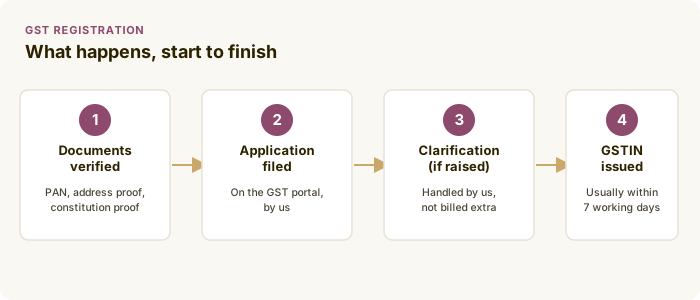
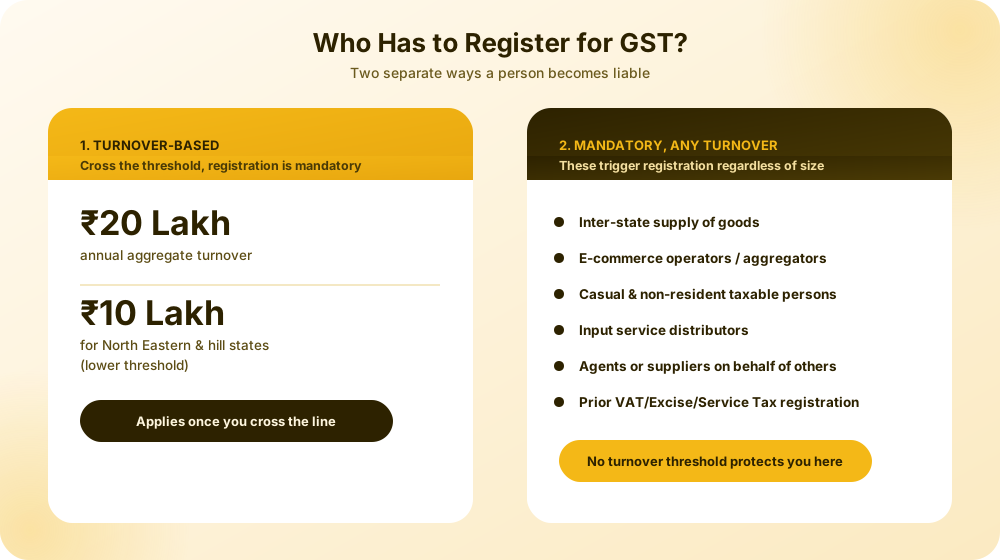
Table of Contents
- Registration as a tender eligibility requirement
- When a project site needs its own registration
- Choosing the right constitution before you register
- Documents you’ll need
- TDS on government contracts — the 2% deduction you need to reconcile
- Works contracts — how they’re actually taxed
- E-way bills for material movement to project sites
- Registration mistakes we see specifically in contracting
- Mobilization advances are taxable — even when they’re called a loan
- Claiming input tax credit on materials and equipment
- Retention money is taxed at invoicing, not when it’s finally released
- Pricing — fixed, no hidden charges
- Frequently asked questions
- Do I need GST registration before bidding on a government tender?
- Do I need a separate GST registration for a project in another state?
- I currently operate as a partnership but I’m registered as a proprietorship — is that a problem?
- How much does GST registration cost for a contractor?
- Can this be handled without visiting your office?
- What is GST TDS and why is my government payment short?
- What GST rate applies to my works contract?
- Do I need an e-way bill for materials I move to a project site?
- I have ongoing projects in 3 different states — do I need 3 separate registrations?
- Should I register before winning my first tender or after?
- Do I need my own GST registration if I only work as a sub-contractor?
- Does my GST registration affect my EMD or bank guarantee for a tender?
- Related reading
- Talk to a consultant, not a call centre
- Registering Before You Have a Confirmed Tender
- Sub-Contractor Registration — Do You Need One If You Only Work Under a Main Contractor?
- Bank Guarantee and EMD Requirements — Not a GST Matter, But Often Confused With It
- GSTR-9 and the Annual Reconciliation Contractors Specifically Face
- Registering for a Single Project vs a Standing Contracting Business
- What a Fresh GSTIN Looks Like on Your First Tender Submission
- Documents That Commonly Get Rejected, and Why
- What If You’re Registering as a Joint Venture for One Large Project?
- Keeping Registration Details Current as Your Contracting Business Grows
Registration as a tender eligibility requirement
Government departments and PSUs list a valid GST registration among the basic eligibility documents for almost every tender, alongside PAN and firm registration. Contractors who wait until after winning a bid to sort out GST find themselves unable to actually accept the award — the registration has to already exist by the time bids are submitted, not by the time work starts.
When a project site needs its own registration
GST registration is tied to a “place of business,” and for contractors that isn’t always just the head office. If you take on a long-duration project in a state where you don’t already have an office — a construction site, a manpower deployment, a long-term installation contract — that state can count as a place of business in its own right, triggering a separate registration requirement there. This is easy to miss because the paperwork for winning the contract rarely flags it; it surfaces later, usually when a client’s accounts team asks why your invoice shows a GSTIN from a different state than the one the work happened in.
Choosing the right constitution before you register
A lot of contracting businesses operate as partnerships in practice — shared capital, shared execution, sometimes multiple family members involved — but register as a sole proprietorship because it’s the fastest option on the portal. That mismatch tends to surface at the worst time: during a bank loan application, a joint-venture tender, or a client’s vendor verification, when the documentation on file doesn’t match how the business is actually structured. Getting this right before you register saves a much more painful correction later.
Documents you’ll need
- PAN card — of the business or proprietor.
- Partnership deed or incorporation certificate — if you’re not a straightforward proprietorship.
- Address proof — for your principal place of business, and any project-site location that needs its own registration.
- Bank account proof — a cancelled cheque or passbook first page.
- Photograph and Aadhaar — of the proprietor, partners, or authorised signatory.
TDS on government contracts — the 2% deduction you need to reconcile
Under Section 51 of the CGST Act, government departments, PSUs, and government-controlled entities (51%+ government equity) are required to deduct GST TDS on payments to contractors — 2% in total (1% CGST + 1% SGST for intra-state contracts, or 2% IGST for inter-state), but only when a single contract’s value exceeds ₹2.5 lakh, excluding GST. This is separate from income tax TDS, and it’s deducted at the time of payment, not at invoicing.
The deducting entity files this under GSTR-7 by the 10th of the following month, and the amount shows up as a credit in your electronic cash ledger — you can use it to offset your own GST liability. Contractors who don’t actively check for this often discover it only when their cash ledger balance doesn’t match their own calculations; it’s worth reconciling this every time you receive a government payment, not just at return-filing time.
Works contracts — how they’re actually taxed
Under GST, a works contract (construction, erection, installation, repair, maintenance, renovation, or commissioning of immovable property involving both goods and services) is treated as a single composite supply of service, not split into separate goods and services components the way it sometimes was under the pre-GST tax regime. This matters for how you invoice and what rate applies — the standard rate for most works contracts is 18%, though certain categories (some government works, affordable housing projects) can attract a concessional rate. Getting the classification right at registration — declaring the correct SAC (Services Accounting Code) for the type of contracting work you do — avoids a mismatch between what you declare and what you actually bill later.
E-way bills for material movement to project sites
If your contracting work involves moving materials — cement, steel, fittings, equipment — to a project site, and the consignment value crosses ₹50,000, you’ll need an e-way bill for that movement, generated before the goods leave. This applies whether you’re moving materials from your own stock or a supplier is shipping directly to site on your account. Contractors running multiple simultaneous sites sometimes lose track of which deliveries need one; building this into your site logistics process from the start avoids delays at checkpoints and the penalty exposure of an unaccompanied consignment.
Registration mistakes we see specifically in contracting
- Declaring a generic “construction” SAC code instead of the specific category that matches your actual work (civil, electrical, plumbing, or a composite works contract) — this can cause rate mismatches when you invoice.
- Not registering in a project state until a client flags it. As covered above, this is usually caught during a client’s vendor audit or accounts reconciliation, well after work has started — far more disruptive than registering upfront.
- Missing the TDS credit reconciliation — government payments arrive net of TDS, and contractors who don’t track this against their GSTR-7 credits can end up thinking a payment is short when it’s actually just been deducted correctly.
- Address proof for a site office that doesn’t match the tender documentation. If your registration lists a site address, it needs to be backed by a lease, NOC, or similar proof — not just a mailing address of convenience.
Mobilization advances are taxable — even when they’re called a loan
This is one of the most common surprises for contractors new to GST: a mobilization advance received to start a project — money paid upfront to cover initial site setup, equipment, and materials before work begins — is treated as taxable consideration under GST, not as a loan, even when the contract describes it as an interest-free loan secured by a bank guarantee. A 2026 Gujarat Authority for Advance Ruling confirmed this directly: what matters is that the amount is ultimately adjusted against your running account bills and forms part of the contract value, not what the payment is labelled in the paperwork.
The time of supply — meaning when GST becomes payable — is whichever comes first: the date you raise an invoice, or the date you actually receive the advance. In practice, this means GST on a mobilization advance is usually due the moment it hits your account, well before the corresponding work is done. Contractors who don’t plan for this can end up with a real cash-flow gap: GST paid out on an advance months before the matching revenue and input credits catch up. Building this into your project cash-flow planning from the start avoids the scramble.
Claiming input tax credit on materials and equipment
The GST you pay on cement, steel, fittings, hired equipment, and other project inputs is generally available as input tax credit against your output GST liability — but only if your supplier has actually filed their return and reported the invoice, since ITC under GST is matched against what your suppliers declare, not just what you paid. This is why the choice of supplier matters beyond price: a supplier who’s inconsistent about filing can quietly cost you credit you’re otherwise entitled to. We flag this specifically when reviewing a new contractor’s supplier list at registration, since it’s a recurring, avoidable source of ITC mismatches later.
Retention money is taxed at invoicing, not when it’s finally released
Most construction and works contracts withhold a retention amount — typically 5-10% of each running bill — released only at project completion or after the defect liability period ends. It’s tempting to assume you only owe GST on the retention portion once it’s actually paid out, but that’s not how it works: the retained amount still represents the value of the service you’ve supplied, so it forms part of your taxable invoice value from the day you raise the bill, not from the day the retention is finally released. Getting your cash-flow planning wrong on this point — assuming GST liability tracks cash received rather than invoices raised — is a recurring, avoidable problem for contractors on longer projects with large retention holdbacks.
Pricing — fixed, no hidden charges
GST registration costs from ₹1,500 + GST per registration. If your work spans more than one state, call 70 9232 9232 and we’ll map out exactly which registrations your contracts actually require.
Frequently asked questions
Do I need GST registration before bidding on a government tender?
Yes, in almost every case. GST registration is typically listed as a basic eligibility document, so it needs to be in place before you submit a bid, not after you win one.
Do I need a separate GST registration for a project in another state?
Often, yes — particularly for longer projects where you maintain a site office or ongoing presence in that state. We’ll assess your specific contract to confirm whether it applies.
I currently operate as a partnership but I’m registered as a proprietorship — is that a problem?
It can become one during a loan application, tender, or vendor verification. It’s worth correcting the registration to match your actual structure before it gets questioned.
How much does GST registration cost for a contractor?
from ₹1,500 + GST per registration. If multiple state registrations apply to your contracts, we’ll quote clearly before starting.
Can this be handled without visiting your office?
Yes — documents can be sent over WhatsApp and we file on your behalf. If you’re near Teynampet and prefer to hand over paperwork in person, we’re open 10 AM to 7 PM.
What is GST TDS and why is my government payment short?
Government departments and PSUs deduct 2% GST TDS on contracts above ₹2.5 lakh under Section 51. It’s not a shortfall — it’s a credit that lands in your electronic cash ledger and offsets your own GST liability. We help you reconcile this against your GSTR-7 credits every payment cycle.
What GST rate applies to my works contract?
Most works contracts are taxed at 18% as a composite supply of service, though some government works and affordable housing projects attract a concessional rate. We confirm the correct SAC code and rate for your specific contract type at registration.
Do I need an e-way bill for materials I move to a project site?
Yes, if the consignment value crosses ₹50,000 — whether it’s your own stock moving to site or a supplier shipping materials directly on your account. This applies per movement, not per project.
I have ongoing projects in 3 different states — do I need 3 separate registrations?
Likely yes, if each project counts as an independent place of business (typically longer-duration projects with a site office or ongoing presence). We assess each contract individually rather than assuming a blanket answer.
Should I register before winning my first tender or after?
Before. Most tender processes require a valid GSTIN as part of the bid documentation itself, and registering reactively once a deadline is close risks missing the bid window entirely.
Do I need my own GST registration if I only work as a sub-contractor?
Yes, once your own turnover crosses the ₹20 lakh threshold for services — working exclusively under a main contractor doesn’t exempt you from registering in your own right.
Does my GST registration affect my EMD or bank guarantee for a tender?
Not directly — EMD and bank guarantees are handled through your bank as a separate financial requirement. A valid GSTIN is usually a tender-submission prerequisite, but it doesn’t determine your EMD eligibility.
Related reading
If you are still deciding how to register, our GST Composition Scheme explained explains the eligibility, rates, and trade-offs against regular registration.
Talk to a consultant, not a call centre
Call or WhatsApp 70 9232 9232 and tell us about the tenders or contracts you’re working with — we’ll confirm exactly which registrations you need before filing anything. Rated 5.0★ across 1,000+ Google reviews, serving businesses since 2017.
Registering a different kind of business? See our GST Registration guides for e-commerce sellers, restaurants & cloud kitchens, manufacturers & exporters, or architects, interior designers & civil engineers.
Already registered and need help with monthly filing instead? See our GST Return Filing guide for contractors, or start with the full how GST Registration works.
Registering Before You Have a Confirmed Tender
Many government and large private tenders require a valid GSTIN as part of the bid documentation itself, before the contract is even awarded. This creates a timing question for new contracting businesses: register speculatively ahead of bidding, or wait until you’ve actually won work? Since GST registration carries no ongoing cost beyond your regular filing once you’re operational, and most tender processes reject bids without a valid GSTIN outright, registering ahead of your first confirmed contract is the safer default for anyone seriously pursuing tender-based work, rather than registering reactively once a tender deadline is already close.
Sub-Contractor Registration — Do You Need One If You Only Work Under a Main Contractor?
Yes. Even if you never invoice a government body or end client directly, and only ever bill a main contractor, you still need your own GST registration once your turnover crosses the standard threshold (₹20 lakh for services). Working exclusively as a sub-contractor doesn’t exempt you from registration — the threshold applies to your own turnover, not to who you invoice.
Bank Guarantee and EMD Requirements — Not a GST Matter, But Often Confused With It
Tender processes typically require an Earnest Money Deposit (EMD) or bank guarantee, which is a separate financial/banking requirement, not a GST registration matter — but contractors sometimes assume their GST registration status affects EMD eligibility. It doesn’t directly; a valid GSTIN is usually a prerequisite for tender submission, but the EMD itself is handled through your bank, independent of your GST status.
GSTR-9 and the Annual Reconciliation Contractors Specifically Face
As covered in our Filing guide, contracting businesses crossing ₹2 crore in annual turnover need GSTR-9, and the reconciliation is more involved than for most business types because of mobilization advances, retention money, and TDS credits spread unevenly across the year. Getting your registration constitution and business details right at the outset — the right business type, correctly documented address, and accurate bank details — makes this annual reconciliation meaningfully easier than starting with a registration that has to be amended repeatedly as inconsistencies surface.
Registering for a Single Project vs a Standing Contracting Business
Some contractors register specifically for one large project and plan to deregister afterward; others are building a standing business expecting a continuous pipeline of contracts. The registration process itself is identical either way, but a project-specific registration still carries the same annual and monthly filing obligations for as long as it stays active — there is no “project mode” registration with reduced compliance. If you genuinely expect only one project and then a long gap, voluntary cancellation once the project concludes (with the usual GSTR-10 final return) is worth planning for rather than leaving a dormant, unfiled GSTIN sitting active.
What a Fresh GSTIN Looks Like on Your First Tender Submission
A newly-issued GSTIN carries no filing history yet, which is normal and doesn’t disqualify a bid on its own — tender evaluators generally look at business experience and financial capacity separately from GST registration age. What does matter is that the GSTIN is active and in good standing at the time of submission; a suspended or under-review registration at tender time is a genuine problem, a brand-new but properly active one is not.
Documents That Commonly Get Rejected, and Why
Beyond the standard PAN, Aadhaar, and address proof, contractor registrations sometimes get queried over unclear business-activity descriptions — a generic “contractor” description without specifying the type of work (civil, electrical, manpower supply) can trigger a query asking for clarification, since the officer needs to understand what HSN/SAC codes and rates apply. Being specific about your actual work type in the application avoids this back-and-forth.
What If You’re Registering as a Joint Venture for One Large Project?
Joint ventures formed specifically to bid on and execute a single large project (common for infrastructure tenders requiring combined financial capacity) need their own GST registration as a distinct entity, separate from each partner company’s existing registration — a JV is treated as its own taxable person under GST, not simply an extension of either partner’s GSTIN. This is a registration structure worth planning before the joint venture agreement is finalised, since it affects how invoicing and ITC flow between the JV and its constituent partners.
Keeping Registration Details Current as Your Contracting Business Grows
A business that starts as a small proprietorship taking local jobs, then grows into a multi-state operation with several ongoing government contracts, often accumulates registration details that no longer reflect reality — an old address, an outdated bank account, a business-activity description that hasn’t kept pace. None of this is urgent in isolation, but it compounds: outdated details make officer queries more likely on every future amendment or annual filing. Reviewing your registration details periodically, not just when something forces the issue, keeps this from becoming a bigger cleanup job later.
Bidding your first tender, expanding into a new state, or simply formalising a contracting business that has been running informally — call 70 9232 9232 and we will walk you through exactly what registration needs to look like for your situation.
Fixed, transparent pricing on registration, direct access to a consultant who understands contracting specifically, not a generic filing template applied to every business type.
We are four floors above Teynampet Metro, rated 5.0 stars across 1,000+ Google reviews, and have been handling contractor GST registrations for Chennai businesses since 2017.
Call or WhatsApp 70 9232 9232 today to get started with your contractor GST registration.