
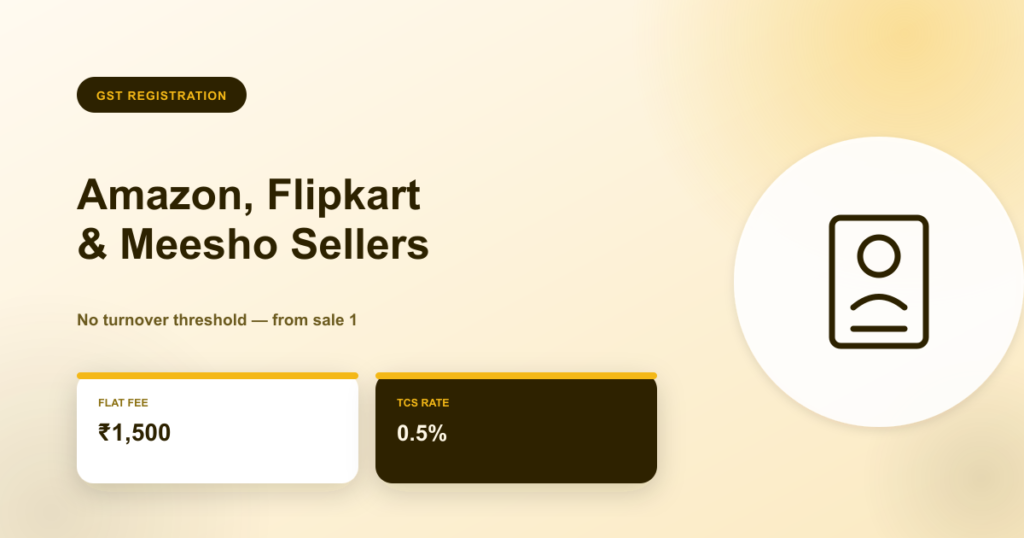
Sell on Amazon or Flipkart and GST registration stops being optional the moment you list your first product — there’s no turnover threshold to cross first, because marketplaces won’t let an unregistered seller onboard at all. What trips people up isn’t the registration itself, it’s realising too late that a single GSTIN often isn’t enough: if you store inventory in an FBA warehouse outside your home state, that state usually needs its own registration too. We handle this end to end, including the multi-state piece, from ₹1,500 + GST per registration. Call or WhatsApp us on 70 9232 9232.
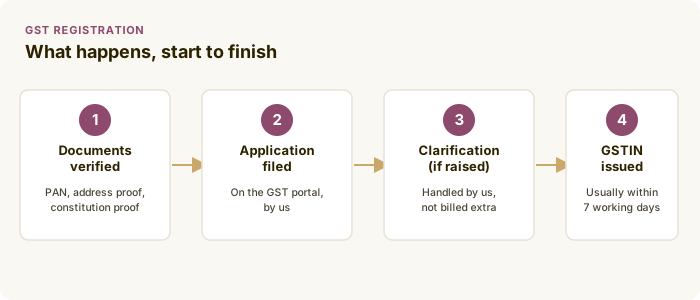
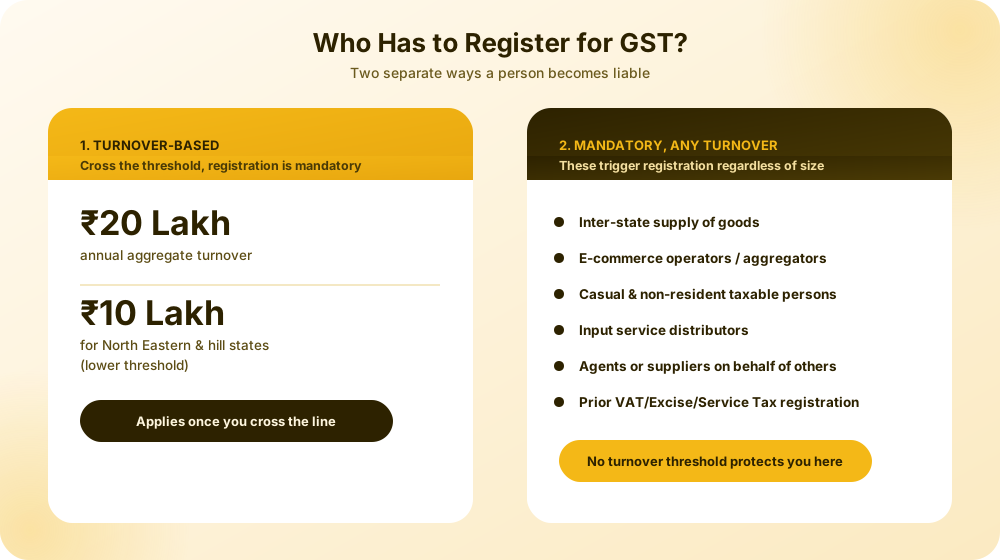
Table of Contents
- Why marketplace sellers can’t wait for a turnover threshold
- The multi-state registration trap
- What you’ll need to register
- A mistake we see often
- TCS — the tax Amazon, Flipkart and Meesho deduct on your behalf
- Choosing the right business constitution before you register
- HSN/SAC codes — get this right at registration, not after
- Registration mistakes that go beyond the composition scheme trap
- Selling internationally through Amazon Global or Flipkart’s export programs
- What happens after your GSTIN is issued
- Pricing — fixed, no hidden charges
- Frequently asked questions
- Do I need GST registration to sell on Amazon or Flipkart even if my turnover is low?
- Do I need separate GST registration for each state where Amazon stores my inventory?
- Can I register under the composition scheme as a marketplace seller?
- How much does GST registration cost for an e-commerce seller?
- Do I need to visit your office for this?
- What is TCS and do I lose that money?
- Does Meesho have different GST requirements than Amazon or Flipkart?
- I already have GST for another business — can I just add marketplace selling to it?
- What happens if my registration application gets rejected or sent back for clarification?
- Does the GST rate on my product change if I sell it from a different state?
- How long before my planned launch should I start GST registration?
- Can I start selling before my GSTIN is approved?
- Related reading
- Talk to a consultant, not a call centre
- Locality-specific guides for online sellers
- State-Wise GST Rates Don’t Change — But Where You Register Does
- The Realistic Registration Timeline for a New Seller
- What If You’re Already Registered in Your Home State and Just Adding Marketplace Sales?
- GST Registration for a Private Limited Company vs a Proprietorship Seller
- Verifying Your GSTIN Is Correctly Linked on Each Platform
- Amending Your Registration If Your Business Details Change
Why marketplace sellers can’t wait for a turnover threshold
The ₹40 lakh threshold that applies to most businesses simply doesn’t apply here. Section 24 of the CGST Act specifically requires registration for anyone supplying goods through an e-commerce operator, regardless of how small the business is. Amazon and Flipkart always check for a valid GSTIN before approving a seller account. Meesho does too, except in categories where it accepts a PAN-based Enrolment ID instead — see our GST for Meesho Sellers guide for exactly which categories qualify, so in practice the registration has to happen before day one, not after your first few sales.
The multi-state registration trap
If you use Amazon’s FBA (Fulfilled by Amazon) or Flipkart’s equivalent fulfilment network, your inventory doesn’t just sit in one place — it gets distributed across warehouses in whichever states Amazon’s algorithm decides will serve your customers fastest. Each state where you store stock counts as a “place of business” under GST law, and each one technically needs its own state-specific GST registration. Sellers who register only in their home state and later opt into pan-India FBA often find out about this gap only when a state tax notice arrives, well after the fact.
What you’ll need to register
- PAN card — of the business or proprietor.
- Address proof — for your registered place of business (your home address is fine for most online-only sellers).
- Bank account proof — a cancelled cheque or passbook first page.
- Photograph and Aadhaar — of the proprietor or authorised signatory.
- Business constitution proof — if you’re not registering as a straightforward proprietorship.
A mistake we see often
New sellers sometimes register under the composition scheme because the lower flat tax rate looks appealing, without realising composition dealers aren’t allowed to sell through e-commerce operators at all — Amazon and Flipkart will simply reject the onboarding. If you’re planning to sell on a marketplace, you need to register as a regular taxpayer from the start.
TCS — the tax Amazon, Flipkart and Meesho deduct on your behalf
Every marketplace registered as an e-commerce operator under GST is required to deduct Tax Collected at Source (TCS) on the net value of your sales before paying you out — currently 0.5% in total (0.25% CGST + 0.25% SGST for intra-state supplies, or 0.5% IGST for inter-state), under Section 52 of the CGST Act. This rate was halved from 1% effective 10 July 2024, so if you registered before that and are still budgeting on the old figure, it’s worth updating. TCS isn’t an extra cost to you; it’s an advance against your own GST liability, deposited by the marketplace directly to the government under your GSTIN. You’ll see it reflected in your GSTR-2A/2B and can claim it as a credit while filing GSTR-3B.
The confusion we see most often is sellers not reconciling this figure at all — assuming the marketplace “handles the GST part” and skipping the credit claim, which means paying tax twice in effect. Your monthly payout report from Amazon/Flipkart/Meesho shows the TCS deducted; matching that against what shows up in your GSTR-2A before filing is a five-minute check that avoids overpaying every single month.
Choosing the right business constitution before you register
Most marketplace sellers register as a sole proprietorship — it’s the fastest to set up, needs no separate legal entity, and is what the vast majority of individual sellers and small D2C brands use. But the choice matters more than it looks:
- Sole Proprietorship — simplest, fastest, but you’re personally liable for business debts. Fine for most single-person marketplace operations.
- Partnership (up to 2 partners) — makes sense if you’re splitting ownership and operations with someone else from day one; liability is still not limited, but responsibilities and profit shares are documented.
- Private Limited Company (up to 2 directors) — worth considering once you’re scaling past a certain volume, hiring staff, or want limited liability protection and easier access to business loans or investment later. Costs more to set up and maintain (annual ROC filings on top of GST), so it’s not the default choice for a seller just starting out.
Switching your business constitution later isn’t a simple “amendment” — a change from proprietorship to a Pvt Ltd company, for instance, usually means winding down the old GSTIN and registering fresh under the new legal entity, since GST registration is tied to the PAN of the specific constitution. Getting this decision right before you register saves that entire headache down the line.
HSN/SAC codes — get this right at registration, not after
Your GST registration application asks you to declare the HSN (Harmonized System of Nomenclature) codes for the goods you plan to sell. This isn’t a formality — it determines the tax rate applied to your invoices, and it’s checked against what you actually list on the marketplace. Sellers who declare a narrow or generic set of codes at registration and then list a wider product range later often run into mismatches that trigger clarification notices from the department.
If you’re planning to sell across multiple product categories — say, apparel and home goods — it’s worth declaring the HSN codes for all of them upfront rather than adding categories piecemeal. We check this against your actual product catalogue before filing, specifically to avoid this becoming a problem six months in.
Registration mistakes that go beyond the composition scheme trap
- Address proof that doesn’t match the declared principal place of business. If you’re operating out of a rented flat or a shared space, the proof document (rental agreement, NOC from the owner, utility bill) needs to match exactly what’s declared on the application — mismatches are one of the most common reasons for a clarification notice at the registration stage.
- Not declaring the e-commerce operator relationship correctly. The GST REG-01 application has a specific field for this; leaving it blank or filling it in incorrectly can cause your marketplace onboarding to get flagged even after your GSTIN is issued.
- Registering with a bank account that isn’t yet operational. The bank account details you provide need to be verifiable and active — a newly opened account still in the activation window is a common, avoidable delay.
- Assuming one state registration covers pan-India FBA from day one. As covered above, this is the single biggest structural mistake we see, and it’s almost always caught only after a state notice arrives, not before.
Selling internationally through Amazon Global or Flipkart’s export programs
If you’re planning to sell beyond India — Amazon Global Selling and Flipkart’s cross-border programs both let Indian sellers list to overseas buyers — GST registration alone doesn’t cover you. Exports need an Import Export Code (IEC) from DGFT, a completely separate registration from GST, though both use your PAN as the base identifier. Without an IEC, marketplaces won’t let you enable international shipping on your listings, regardless of how compliant your GST registration is.
The GST side of exports has its own mechanics worth knowing before you switch it on: exports are treated as zero-rated supplies under GST, meaning you don’t charge GST on the export sale itself, but you can still claim input tax credit on the inputs that went into it. Most exporters do this either by filing a Letter of Undertaking (LUT) — which lets you export without paying IGST upfront and claiming it back later — or by paying IGST on the export and claiming a refund afterward. The LUT route is faster in practice and avoids the cash-flow hit of paying tax you’ll eventually get back, which is why most marketplace sellers who go international choose it.
If exporting is on your roadmap even if not immediate, it’s worth mentioning when you register — the business nature and HSN declarations you make at this stage carry forward, and setting them up correctly for a future export-capable business avoids a second round of amendments later.
What happens after your GSTIN is issued
Getting the GSTIN is the start, not the end. A few things matter in the first 30 days that catch new marketplace sellers off guard:
- Add your GSTIN to every marketplace seller account — Amazon, Flipkart, and Meesho each require this separately in their seller dashboards, and listings won’t go live on some categories until it’s verified.
- Set your invoice series correctly — GST-compliant tax invoices need a specific, sequential numbering format; marketplaces often auto-generate these on your behalf, but it’s worth confirming the format matches what your GSTIN’s state code expects.
- Start tracking GSTR-1 and GSTR-3B deadlines immediately — your first return is due even if you haven’t made a sale yet in some cases, and marketplace sellers who assume “no sales, no filing needed” are a common source of late-fee surprises. See our GST Return Filing guide for marketplace sellers for the specifics.
Pricing — fixed, no hidden charges
GST registration costs from ₹1,500 + GST per state. If you need registrations in multiple states for FBA or a similar fulfilment network, call 70 9232 9232 and we’ll map out exactly which states you need before we start.
Frequently asked questions
Do I need GST registration to sell on Amazon or Flipkart even if my turnover is low?
Yes. Selling through an e-commerce operator requires registration regardless of turnover — there’s no threshold exemption for marketplace sellers.
Do I need separate GST registration for each state where Amazon stores my inventory?
Generally yes, if you’re using a fulfilment network that stores stock across multiple states. We’ll help you identify exactly which states apply based on your fulfilment settings.
Can I register under the composition scheme as a marketplace seller?
No — composition scheme dealers are barred from selling through e-commerce operators. Marketplace sellers must register as regular taxpayers.
How much does GST registration cost for an e-commerce seller?
from ₹1,500 + GST per state registration, flat, no hidden charges. If you need multiple states for FBA-style fulfilment, we’ll quote clearly upfront.
Do I need to visit your office for this?
No — documents can be sent over WhatsApp and the entire application is handled remotely. If you’re near Teynampet and prefer to walk in, we’re open 10 AM to 7 PM.
What is TCS and do I lose that money?
No — TCS deducted by the marketplace (0.5% total, since the rate was halved from 1% in July 2024) is an advance against your own GST liability, not a separate cost. It shows up in your GSTR-2A/2B and gets claimed as a credit when you file GSTR-3B. Skipping this reconciliation is the most common way sellers end up overpaying.
Does Meesho have different GST requirements than Amazon or Flipkart?
The underlying GST law is the same across all e-commerce operators — registration before onboarding, no turnover threshold exemption, TCS deduction. Each platform’s own seller-onboarding checks and document formats differ slightly, which we account for when we file.
I already have GST for another business — can I just add marketplace selling to it?
Only if the new activity fits under the same legal entity and PAN, and your registered place of business and declared HSN codes cover it. If the marketplace business is meaningfully separate (different constitution, different state), it usually needs its own registration rather than an addition to the existing one.
What happens if my registration application gets rejected or sent back for clarification?
Most rejections come from a document mismatch — address proof not matching the declared address being the most common. We review every document against the application before submission specifically to avoid this, and if a clarification does come through, we handle the response.
Does the GST rate on my product change if I sell it from a different state?
No. GST rates are set by product category (HSN code) nationally — they don’t vary by which state you’re registered or shipping from. What varies by state is only your registration obligation, not the tax rate.
How long before my planned launch should I start GST registration?
2-4 weeks, to leave buffer for both the ~7 working day GST registration itself and the marketplace’s own seller-account verification, which typically takes a few more days after your GSTIN is issued.
Can I start selling before my GSTIN is approved?
No — Amazon, Flipkart, and Meesho all require a verified GSTIN before activating your seller account, so registration has to be complete first, not run in parallel with your first listings.
Related reading
If you are still deciding how to register, our guide to the GST Composition Scheme explains the eligibility, rates, and trade-offs against regular registration.
Talk to a consultant, not a call centre
Call or WhatsApp 70 9232 9232 and tell us which marketplaces and fulfilment networks you’re planning to use — we’ll map out exactly which state registrations you need before we file anything. Rated 5.0★ across 1,000+ Google reviews, serving businesses since 2017.
Registering a different kind of business? See our GST Registration guides for contractors, restaurants & cloud kitchens, manufacturers & exporters, or architects, interior designers & civil engineers.
Already registered and need help with monthly filing instead? See our GST Return Filing guide for Amazon, Flipkart & Meesho sellers, or start with the full our GST Registration guide.
Locality-specific guides for online sellers
Registering from a specific part of Chennai? These cover the same no-threshold registration and multi-state FBA issues with local detail added in: Teynampet, Alwarpet, Mylapore, Nandanam, R.A. Puram, and Saidapet, T Nagar, Parrys Corner, Mannadi, Ritchie Street, Chromepet, Tambaram.
State-Wise GST Rates Don’t Change — But Where You Register Does
A common misconception among new marketplace sellers is that GST rates on their products differ by state. They don’t — GST rates are set nationally by product category (HSN code), the same rate applies whether you’re shipping from Chennai or a fulfilment centre in Delhi. What genuinely does change by state is your registration obligation: every state where your goods are physically stored requires its own GST registration, as covered in our multi-state guide above, but the tax rate itself stays constant across all of them for the same product.
The Realistic Registration Timeline for a New Seller
From the day you submit a complete application with Aadhaar authentication, expect roughly 7 working days to a GSTIN, assuming no query is raised. Most new marketplace sellers register 2-4 weeks before their planned launch date to leave buffer for account setup on the marketplace side as well — Amazon, Flipkart, and Meesho all require a verified GSTIN before your seller account goes live, and their own verification adds a few more days on top of the GST registration itself. Sellers who wait until the week before a planned launch to start registration often end up delaying their actual go-live date, not because GST registration itself is slow, but because there’s no buffer left for anything to go wrong.
What If You’re Already Registered in Your Home State and Just Adding Marketplace Sales?
If you already run an offline business with an existing GST registration in Tamil Nadu, and you’re now adding Amazon, Flipkart, or Meesho as a new sales channel, you don’t need a fresh registration — your existing GSTIN covers marketplace sales from the same registered place of business. What you do need to do is add your GSTIN correctly to each marketplace’s seller account, and make sure your existing filing already accounts for the new sales volume and the TCS credit that will start appearing. The registration question only becomes live again if the marketplace’s fulfilment programme (FBA, Flipkart fulfilment) starts storing your stock in a state where you don’t already have a GSTIN — see our multi-state guide above for that scenario specifically.
GST Registration for a Private Limited Company vs a Proprietorship Seller
Most new marketplace sellers start as sole proprietorships, since it’s the fastest registration path and requires only the individual’s own PAN and Aadhaar. As volume grows, some sellers convert to a private limited company for liability protection or to bring in investors — this requires a fresh GST registration under the company’s own PAN, since a company is a legally distinct entity from its founder even if the same person runs both. The proprietorship’s GSTIN doesn’t transfer or convert; it has to be cancelled once the company registration is active and the business genuinely moves over, with the usual GSTR-10 final-return obligations that come with any cancellation.
Verifying Your GSTIN Is Correctly Linked on Each Platform
After registration, double-check that the GSTIN entered on your Amazon Seller Central, Flipkart Seller Hub, or Meesho Supplier Panel profile exactly matches your certificate — a single-digit typo here is a surprisingly common and avoidable cause of TCS being reported against the wrong GSTIN, which then shows up as a mismatch that has nothing to do with your actual filing but everything to do with a data-entry error at setup. We check this as part of onboarding every new marketplace seller client, not just the registration itself.
Amending Your Registration If Your Business Details Change
If your trade name, business address, or bank details change after your marketplace-seller GST registration is approved, these are handled as standard amendments, not a fresh registration — non-core fields like bank details are near-instant, while core fields like a business address need officer approval within 15 working days. See our full GST Registration Amendment guide for the exact process either way.
Whatever stage you’re at — pre-launch, mid-registration, or already trading and only now sorting out GST — call or WhatsApp 70 9232 9232 and we’ll tell you exactly what’s needed for your specific situation.
Fixed, transparent pricing on the registration itself, and the same team continues with you into monthly filing once your GSTIN is live, so nothing falls into a gap between two different service providers.